


Every top model, with tools built in.
Search the web, run deep research, read files, create images and run code with GPT, Claude, Gemini, Grok and more.
Tired of brand guidelines that just collect dust? Learn how to create brand guidelines that unite your team, build consistency, and drive real growth.
Ever spent weeks crafting the perfect brand guidelines, only to see them collect digital dust in a forgotten Google Drive folder? We’ve all been there.
Creating brand guidelines is about so much more than just picking pretty colors and a cool font. It's about bottling up your brand's very soul—its mission, its voice, its personality—and creating a playbook so everyone on your team can tell the same powerful story, consistently.
Let’s be honest. Have you ever seen a company’s Instagram feed look like it was managed by three different people with three completely different personalities? That’s the classic sign of brand guidelines that were celebrated for a day and then promptly ignored.
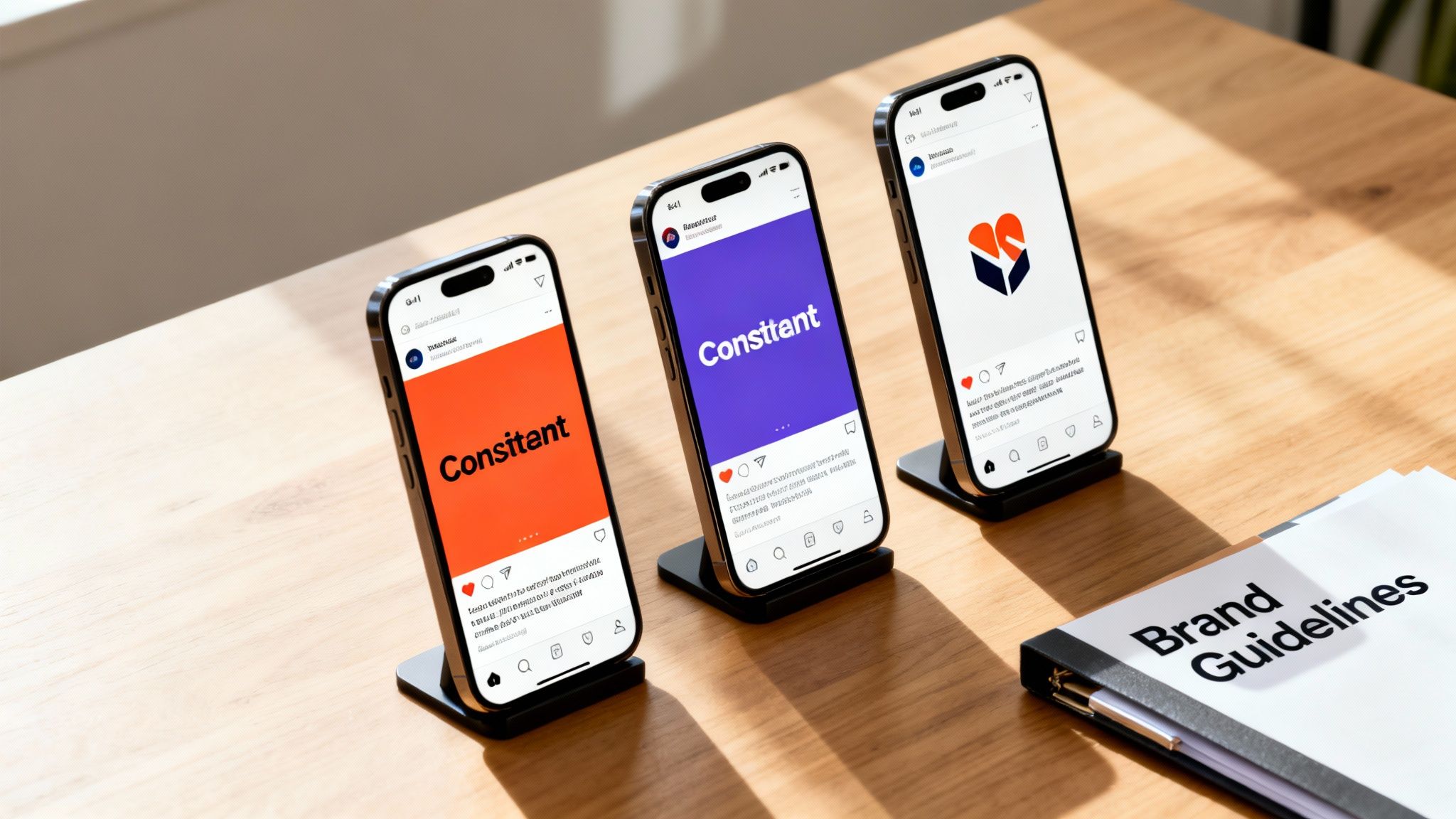
The biggest culprit? The old-school, 100-page PDF. It’s dense, static, and about as inspiring as a tax form. When a marketer is on a tight deadline and needs the right tagline, or a designer just needs the correct logo file, they aren’t going to sift through a massive document. They’re going to wing it. And that’s where brand consistency starts to crumble.
This isn't just a pet peeve for designers; it hits your bottom line. Hard. When your brand looks and sounds the same everywhere, customers start to recognize you. They trust you. That trust is golden—studies show that maintaining brand consistency can increase revenue by over 20%.
On the flip side, inconsistency breeds confusion. It makes your brand feel unreliable and unprofessional, chipping away at the very trust you’re trying to build. If every customer touchpoint feels disconnected, you’re not building a cohesive brand; you're just creating a random collection of stuff.
The point of brand guidelines isn't to put creativity in a straitjacket. It’s to build a strong foundation that empowers creativity, making sure every new asset, blog post, or campaign makes the brand stronger, not weaker.
So, what’s the secret to creating guidelines people actually want to use? Shift your thinking from a static rulebook to a living, breathing brand system.
The best, most useful brand guidelines today are:
Forget the dusty PDF. Picture a dynamic hub where anyone can find exactly what they need in seconds. Using a knowledge base management system is a game-changer here, turning dry rules into an interactive, genuinely helpful resource. Tools like Zemith can centralize all your assets, letting your team generate on-brand content—from social media images to email copy—without ever second-guessing the rules. This approach doesn't just encourage consistency; it makes it the easiest and most natural way to work.
Look, I get it. The temptation to jump right into picking colors and debating fonts is real. That’s the fun part. But hold on. Before you get lost in a three-hour argument over "cerulean blue" versus "sky blue," we need to lay the groundwork.
The best brand guidelines—the ones that actually work and don't just collect dust—are built on a rock-solid strategy. This is where you define your brand’s soul.

This first phase is all about tackling the big questions: Who are you? Why do you even exist? And who are you for? Nail this stuff now, and every decision you make later—from your logo to your social media voice—will feel natural and authentic, not like you're just guessing.
These aren't just fluffy words you stick on your "About Us" page and forget. Think of them as the compass for your entire company.
A strong brand strategy is the bedrock of effective guidelines. It's the whole process of figuring out how core business strategy translates into brand language, making sure your visuals and voice actually stand for something.
"Our target audience is millennials in cities." Sorry, but that’s not going to cut it. You need to dig so much deeper. Create detailed user personas that feel like actual people, because they represent them.
Give them names, jobs, even weird hobbies. What keeps them up at night? What podcasts are on their phone? What’s the last thing they Googled? Knowing your ideal customer is "Brenda," a 32-year-old freelance designer who’s terrified of client feedback and drinks way too much cold brew, is infinitely more useful than just "millennials." This deeper empathy is a huge part of the human-centered approach detailed in the design thinking process steps.
If your brand walked into a party, who would it be? The witty intellectual cracking jokes in the corner? The warm, approachable host making sure everyone has a drink? Or the energetic life of the party dragging everyone onto the dance floor?
A great little exercise to get this figured out is "Brand as a Person." Get your team in a room and ask:
These questions might seem silly, but they get you to a tangible personality. The answers directly inform your tone of voice, which is absolutely essential for building a brand that feels human.
For example, a platform like Zemith might define its personality as "The Brilliant Assistant"—calm, incredibly capable, and always one step ahead, but with a friendly, encouraging vibe. This personality then shapes everything from website copy to UI elements, making the whole experience feel intentional. This isn't just navel-gazing; it’s the most critical step in creating brand guidelines that will actually serve you.
Okay, this is where the magic happens. We've defined the soul of your brand, and now it's time to give it a face. If your brand strategy is the blueprint, your visual identity is the finished house—the thing people see, walk through, and hopefully, fall in love with. This isn’t just about making things look pretty; it's about crafting a distinct visual language that screams you from a mile away.
Think of this section as your brand’s ultimate toolkit. Once it's done, anyone from a senior designer to a marketing intern making a quick social post will have everything they need to stay on-brand. No more guesswork. No more "I thought this shade of blue looked close enough."
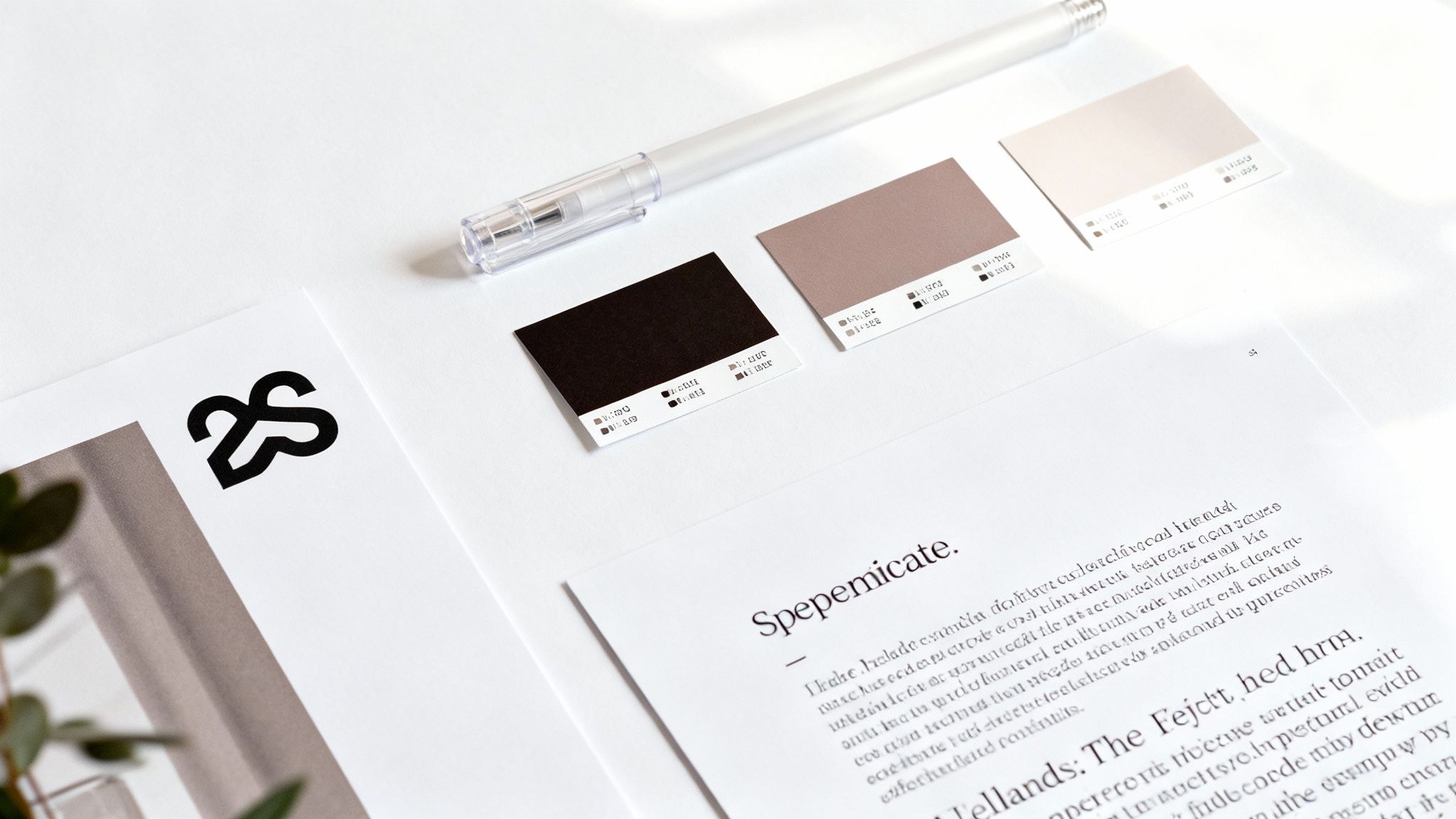
Your logo is the most concentrated shot of your brand identity—its official signature. It’s going to be everywhere, which means you need to protect it from well-intentioned but disastrous creative choices. I’m talking about the squished, stretched, or pixelated logos that make designers everywhere shed a single, silent tear.
To prevent this tragedy, your guidelines must be crystal clear:
By setting these rules, you're not stifling creativity. You're ensuring your brand’s most recognizable asset remains powerful and clear, no matter where it appears.
Color is pure emotion. It’s often the very first thing someone registers, and it can set a mood in a fraction of a second. Your guidelines need to lock in a color palette that’s both unique to you and versatile enough for every marketing channel you can think of.
Here’s a simple way to structure it:
For every single color, you must provide the exact color codes. "Light blue" means nothing. Give your team the precise values for every context. This is non-negotiable.
Here’s a quick-reference checklist to make sure you’ve covered all the essentials for your visual identity.
Having these four pillars clearly defined puts you miles ahead of the competition and builds a rock-solid foundation for consistency.
If color is your brand’s emotion, typography is its voice. The fonts you choose say so much. Are you a modern, clean sans-serif? A classic, trustworthy serif? Or maybe a quirky, creative script?
Keep your font selection tight to maintain a professional feel. A good rule of thumb is one font for headlines (a "display" font) and another, more legible font for body text. From there, define a clear hierarchy: H1, H2, H3, body paragraph, captions, etc. For each one, specify the font, size, and weight (e.g., Bold, Regular, Light).
The global brand value landscape is fiercely competitive. The top 30 brands own more than 80% of total industry value. While tech is still the most valuable sector, retail brands have now surged past the $1 trillion mark in total valuation. Those numbers show why having unbreakable guidelines is so critical for building brand equity that lasts. You can discover more insights about brand value on Our Own Brand.
Finally, let's talk pictures. The imagery you use—photos, illustrations, icons—sets the entire scene for your brand's story. Are you bright, airy, and optimistic, with photos of people smiling in the sun? Or are you moody and professional, using dramatic lighting and a more serious tone?
Your guidelines should tackle these questions head-on:
Let’s be honest: endlessly scrolling through stock photo sites is a soul-crushing experience. A much better approach is to use AI to generate unique visuals that are perfectly on-brand. Tools like Zemith can help you build a consistent library of custom assets. Even better, if you find an image you love, you can reverse-engineer it. For more on that, check out our guide on how to turn an image into a powerful AI prompt and generate endless variations in the same style. It saves a ton of time and ensures every single image feels like it came from the same creative universe.
If your brand walked into a room, what would it sound like? Would it be the life of the party, cracking clever jokes? The thoughtful expert asking deep questions? Or the warm, approachable friend making sure everyone feels included?
That’s your brand voice. It's not just what you say, but how you say it.
Getting this right is the difference between building a real, human connection and just being another company shouting into the void. It’s the secret sauce that makes your tweets, your emails, and even your 404 error pages feel unmistakably you.
"We want to sound friendly and professional." I've heard that a thousand times. It's a start, but it’s not a voice—it’s a vague wish. To make your brand voice something your team can actually use, you have to get specific and turn that vibe into a set of clear, actionable rules.
Look at Mailchimp. Their voice is famously quirky, helpful, and just a little bit weird. They don't just tell their team to "be friendly." They have specific guidelines that encourage using humor, but never at the user's expense. That's the level of detail that creates consistency.
Start by defining a few core personality traits. Are you:
Pick 3-4 key adjectives, then really dig into what each one means in practice. If one of your traits is "Confident," what does that sound like? Simple: it means using active voice, making clear statements, and ditching wishy-washy words like "maybe" or "perhaps."
Your brand voice is your personality translated into words. It ensures that whether someone is reading a blog post or a customer support ticket, they feel like they’re having a conversation with the same "person." This consistency is the bedrock of trust.
This is one of the most practical tools you can give your team. Seriously. It’s a simple cheat sheet that takes all the guesswork out of copywriting. Trust me, your team will thank you for getting rid of corporate jargon forever.
Your list should have a few key parts:
Messaging pillars are the 3-5 core ideas your brand talks about over and over again. They’re the backbone of your content strategy, making sure everything you create reinforces your core message and what makes you valuable.
For a company like Zemith, the pillars might be:
With these pillars defined, a content creator can ask, "Does this blog post support one of our key messages?" If the answer is no, it's probably off-brand.
This level of consistency has a real impact. Research shows that 81% of consumers need to trust a brand before they even consider buying from it. And what builds that trust? A consistent, holistic brand identity—which can boost revenue by up to 23%.
Okay, documenting your voice is one thing. But applying it consistently across a growing team? That's a whole other challenge. This is where AI tools can become your secret weapon for brand consistency at scale.
Instead of just telling your team "write in a witty but helpful tone," you can feed your voice guidelines directly into an AI model. With a platform like Zemith, you can build a custom knowledge base with your brand voice rules, messaging pillars, and even that "words to avoid" list.
From there, your team can use it to generate or refine content. You can explore how AI tools rewrite text to match a specific tone, ensuring every piece of copy—from a quick social media caption to a detailed report—sounds like it came from the same brain. It's like having a brand voice coach looking over everyone's shoulder, without the awkwardness.
So, you’ve done the hard work. You’ve wrestled with strategy, agonized over hex codes, and debated the merits of the Oxford comma. The result? A beautiful, comprehensive set of brand guidelines. But here’s the tough-love moment: if that document just gathers digital dust in a forgotten folder, it’s worthless.
The real measure of success isn't how exhaustive your guidelines are, but how often they’re actually used.
Think of your guidelines as a tool, not a rulebook. If the tool is clunky, hidden away, or hard to use, people will simply find their own way—and that's when brand consistency goes right out the window.
What's the number one killer of great brand guidelines? Accessibility. Or rather, a lack of it.
When your designer is rushing to meet a deadline, they aren't going to spend ten minutes hunting through a 100-page PDF for the correct logo variant. They'll grab the first one they can find on their desktop, and you end up with a pixelated, outdated logo on a crucial sales deck. We've all seen it happen.
To prevent this, you have to move beyond the document and build a living, breathing brand hub. This could be a dedicated section on your intranet, an interactive microsite, or a centralized creative platform. The key is to make it the single source of truth.
Imagine your team pulling approved assets, applying brand colors, or even getting on-brand copy suggestions without ever leaving their design software or word processor. When consistency becomes the easiest option, you've already won.
This is all about putting your brand voice into action—moving from high-level concepts to day-to-day execution.
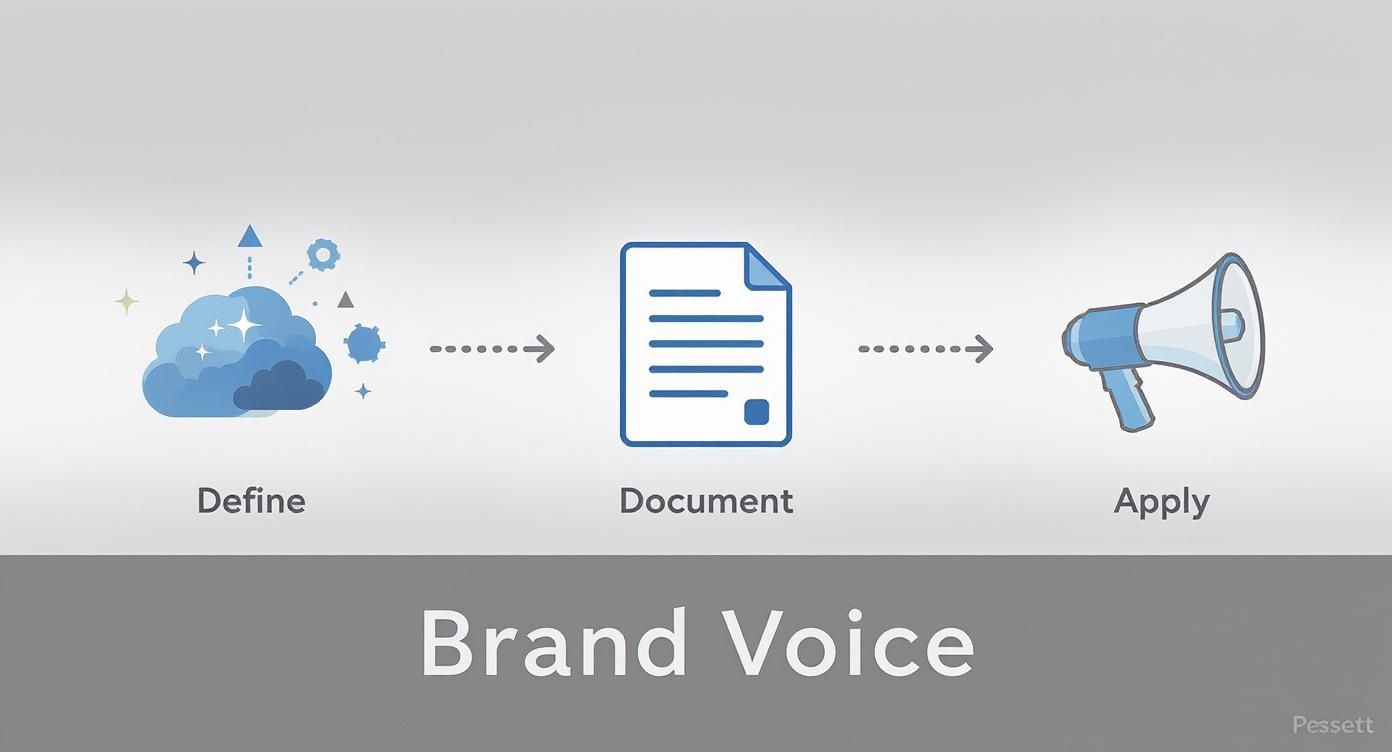
Defining the voice is the first step, but documenting it and applying it consistently is what actually builds a brand people recognize and trust.
You can’t just drop a link in Slack and call it a day. A rollout needs energy. Treat the launch of your new brand guidelines like you would a new product—because that's what it is. It's the operating system for your entire brand.
Kick things off with a company-wide meeting. Walk everyone through the new hub and, most importantly, explain the why behind the choices. When people understand the strategic thinking, they’re far more likely to get on board.
Your brand guidelines are a living document. They should evolve as your brand grows. Schedule an annual review to make sure they're still relevant and serving your team's needs.
Follow up with ongoing training, especially during new hire onboarding. You want the brand guidelines to become a core part of your company culture. A great way to do this is to appoint a few brand "champions" in different departments—go-to people who can help their colleagues and keep the momentum going. If you're looking for ways to keep everyone aligned, our guide on creative workflow management software has some great tips.
Ultimately, this all drives toward one thing: building strong and memorable brand awareness. By making your guidelines accessible, useful, and an celebrated part of how you work, you empower everyone to be a brand steward. That’s how you build the consistency that helps you stand out.
Alright, let's dive into some of the questions that always come up when teams start getting serious about their brand guidelines. I’ve seen these trip people up time and time again, so let’s clear the air.
Think of your brand guidelines as a living, breathing part of your company—not a dusty rulebook you set on a shelf. A good rule of thumb is to give them a solid, top-to-bottom review at least once a year.
That said, you don’t want to wait a full year if something big happens. A major event—like launching a new product line, pivoting to a new audience, or a complete messaging overhaul—is your cue to update them immediately.
Smaller tweaks? Those can happen on the fly. Adding new icons or a campaign-specific tagline doesn't require a full-scale review. The whole point is to keep the guidelines useful and current, so they reflect where your brand is today.
Hands down, the single biggest mistake is creating brand guidelines in a vacuum. I’ve seen it happen so many times: the design team (or worse, a single executive) locks themselves away and emerges with a 100-page manifesto.
The result? Nobody uses it. It’s totally disconnected from how the marketing, sales, or product teams actually work.
The fix is simple but critical: involve stakeholders from the very beginning. Talk to marketing. Get feedback from sales. Understand the needs of the product team. When people feel like they've had a hand in building the guidelines, they're far more likely to actually use and defend them.
Yes. Absolutely, 100% yes. Putting this off is one of the most common—and costly—mistakes a startup can make. Think of it like pouring the foundation for a house; you wouldn’t just start throwing up walls and hope for the best, right?
You don’t need to create a massive brand bible on day one. Just start with the essentials. A "lean" guideline is your best friend here.
Focus on getting these basics down on paper:
This simple starting point prevents messy inconsistencies from taking root and saves you a world of headaches later on. Trust me, it’s much easier to build good habits from the start than to untangle a branding mess a year from now.
Ready to build a living brand hub that your team will actually use? Zemith centralizes all your brand assets, voice guidelines, and creative tools into one seamless AI-powered workspace. Stop chasing down files and start empowering your team to create on-brand content, effortlessly. Explore Zemith today.






Trusted by teams at






The top models, plus image, video and voice tools, in one plan.
Without Zemith
ChatGPT PlusUS$20.00Claude ProUS$20.00Google AI ProUS$19.99SuperGrokUS$30.00Perplexity ProUS$20.00 MidjourneyUS$10.00
 ElevenLabsUS$6.00Le Chat ProUS$14.99
 RunwayUS$15.00Kling StandardUS$8.80
 Gamma PlusUS$12.00
 Otter ProUS$16.99
 QuillBot PremiumUS$19.95
 Photoroom ProUS$12.99
 Quizlet PlusUS$7.99
Total if paying separatelyUS$234.70/mo
"I love the way multiple tools they integrated in one platform. Going in the right direction."
— simplyzubair
"The quality of data and sheer speed of responses is outstanding. I use this app every day."
— barefootmedicine
"The credit system is fair, models are perfect, and the discord is very responsive. Quite awesome."
— MarianZ
"Just works. Simple to use and great for working with documents. Money well spent."
— yerch82
"The organization of features is better than all the other sites — even better than ChatGPT."
— sumore
"It lives up to the all-in-one claim. All the necessary functions with a well-designed, easy UI."
— AlphaLeaf
"The team clearly puts their heart and soul into this platform. Really solid extra functionality."
— SlothMachine
"Updates made almost daily, feedback is incredibly fast. Just look at the changelogs — consistency."
— reu0691
Hand off the research, writing, design and follow-ups. Zemith picks the tools it needs and brings back finished work.
Search the web, run deep research, read files, create images and run code with GPT, Claude, Gemini, Grok and more.
Zemith keeps working in the cloud and pings you when it's done.
Notion, Linear, Canva, Airtable and more. It asks before it creates or changes anything.
Docs, slides, sheets and PDFs, ready to send.
Chain models and tools on a visual canvas, from one prompt to a finished promo video.
Briefings, reports and reminders run on a schedule and are ready when you need them.
Real-time voice that can see your camera or screen.
The best image and video models, in one studio.
Turn PDFs, links and YouTube videos into podcasts, quizzes, flashcards and mind maps.














 Podcast
 Quiz
Quiz Flashcards
 Mind map
 Infographic