


Every top model, with tools built in.
Search the web, run deep research, read files, create images and run code with GPT, Claude, Gemini, Grok and more.
Discover how to prepare for coding interviews with a practical, step-by-step plan that covers study methods, mock problems, and proven tips to boost your score.
Alright, let's be honest. The words "coding interview" can send a shiver down the spine of even a seasoned software engineer. It often feels less like a job interview and more like a high-stakes, pop-quiz you forgot to study for. Did I just hear a "pop"? Nope, that was just my last remaining shred of confidence.
But here's the secret: preparing for it isn't black magic. It’s a process. It boils down to a manageable, repeatable plan: mastering core data structures, getting cozy with common algorithm patterns, and actually rehearsing how you'll answer behavioral questions. It’s all about having a solid game plan, not just hoping the interviewer asks you how to reverse a string.
So, you're ready to land that dream tech job. First of all, awesome. Making that decision is half the battle. Now for the part that feels like staring up at a mountain: the prep. This isn't just about grinding out hundreds of LeetCode problems until your eyes glaze over (we've all been there). It's about being strategic.
Think of this as your personal coaching plan, designed to get you from "Ugh, a binary tree" to "Heck yeah, I love a good graph problem." We're going to break down exactly how to prep for a coding interview for beginners and veterans alike with a clear, no-fluff strategy. Just actionable advice on what to study, how to practice, and how to structure your time.
Here’s what we’ll cover:
Here's the thing to remember: the goal isn't to memorize every algorithm ever invented. It's about learning to see the patterns, understanding the trade-offs of your choices, and being able to talk through your thought process. That's what interviewers actually care about.
This guide will give you that structured path, turning a giant, scary challenge into a series of small, manageable wins. Let's get into it.
To kick things off, let's summarize the key areas you'll need to focus on. Think of this table as your north star for the entire preparation journey.
Nailing these five areas is the surefire way to walk into your interviews feeling prepared and confident, not just hoping you get lucky with a question you've seen before.
Ever tried building IKEA furniture without the instructions? You might end up with something that sort of looks like a dresser, but it’s wobbly, you’re frustrated, and there's a pile of "extra" screws you hope weren't important. That's what preparing for a coding interview without a plan feels like.
A structured plan turns that overwhelming goal into a series of small, manageable wins. It really boils down to your timeline and where you're starting from. The process is pretty straightforward: study the concepts, practice applying them until it's second nature, and eventually, you achieve mastery.
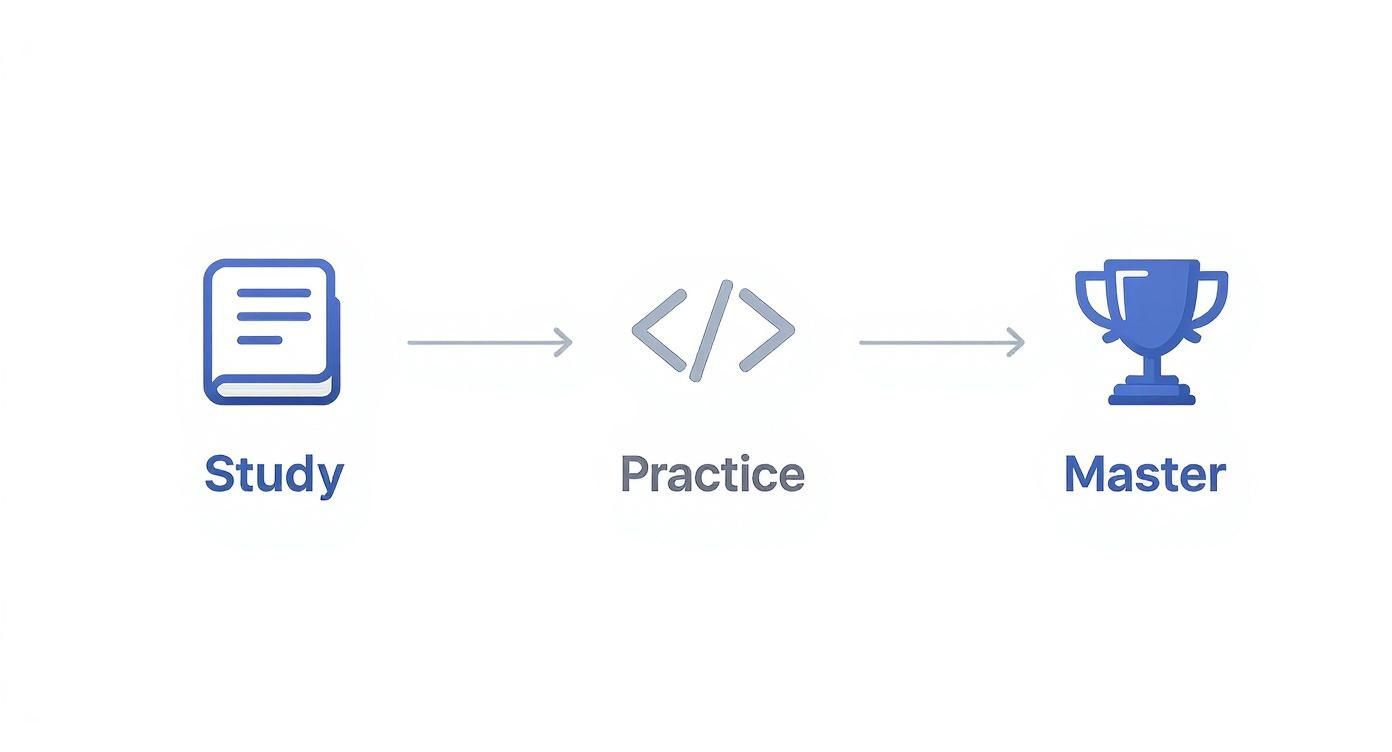
Each stage builds on the last, turning theory into the practical skill that interviewers are actually looking for.
Deciding on a timeline is your first big move. How soon are your interviews? What does your daily schedule look like for coding interview preparation? Here’s a quick breakdown to help you choose.
Ultimately, the best plan is the one you can actually stick to. Let’s dive into what each of these looks like in practice.
Got an interview breathing down your neck? This plan is your adrenaline shot. It's intense, demanding, and all about high-impact topics and rapid-fire pattern recognition.
This is all about getting the maximum return on your time. Forget obscure algorithms; stick to what shows up in 80% of interviews.
For most people, this timeline is the sweet spot. It gives you enough breathing room to actually learn the concepts properly without the frantic panic of a 30-day sprint.
This balanced strategy helps prevent burnout while making sure you’re ready for both the technical and the "tell me about a time when..." parts of the interview.
A key to staying organized is having a central place for your notes. Using a tool like Zemith's Smart Notepad helps you quickly jot down key concepts, save code snippets, and even use AI to rephrase complex explanations into simpler terms. It’s like a digital brain that never forgets the difference between a min-heap and a max-heap.
This one's for those who want to build a truly rock-solid foundation. It's perfect if you're switching careers, new to DSA, or aiming for a top-tier company and want to leave no stone unturned.
No matter which plan you pick, consistency is king. Random, chaotic study sessions are way less effective than a steady, planned approach. For more tips, check out our guide on how to study more effectively.
Alright, let's get into the main event. If coding interviews were a video game, Data Structures and Algorithms (DSA) would be the final boss. This is where most interviews are won or lost. The goal is to build pattern recognition so you can see a new problem and think, "Ah, this smells like a two-pointer problem," not, "Have I seen this exact problem before?"
Think of these as your fundamental building blocks. If you get a solid handle on these, you’ll be ready for the vast majority of technical screens.
Mastering these topics is how you build a strong foundation for everything else that comes your way.
Let's talk about Big O. It's really just a way to describe how your code's performance changes as the amount of input grows. Think of it like sending thank-you notes.
Your interviewer isn't just looking for a correct answer; they want to see that you can analyze these trade-offs and find an efficient one.
Just randomly picking problems off a list is like throwing darts in the dark. A much smarter approach is to use a targeted strategy that helps you zero in on your weak spots.
This is where AI-powered tools can be a game-changer. For example, Zemith’s problem recommender can analyze your performance and suggest the perfect problems to fill your knowledge gaps. No more wasting time on concepts you've already mastered.
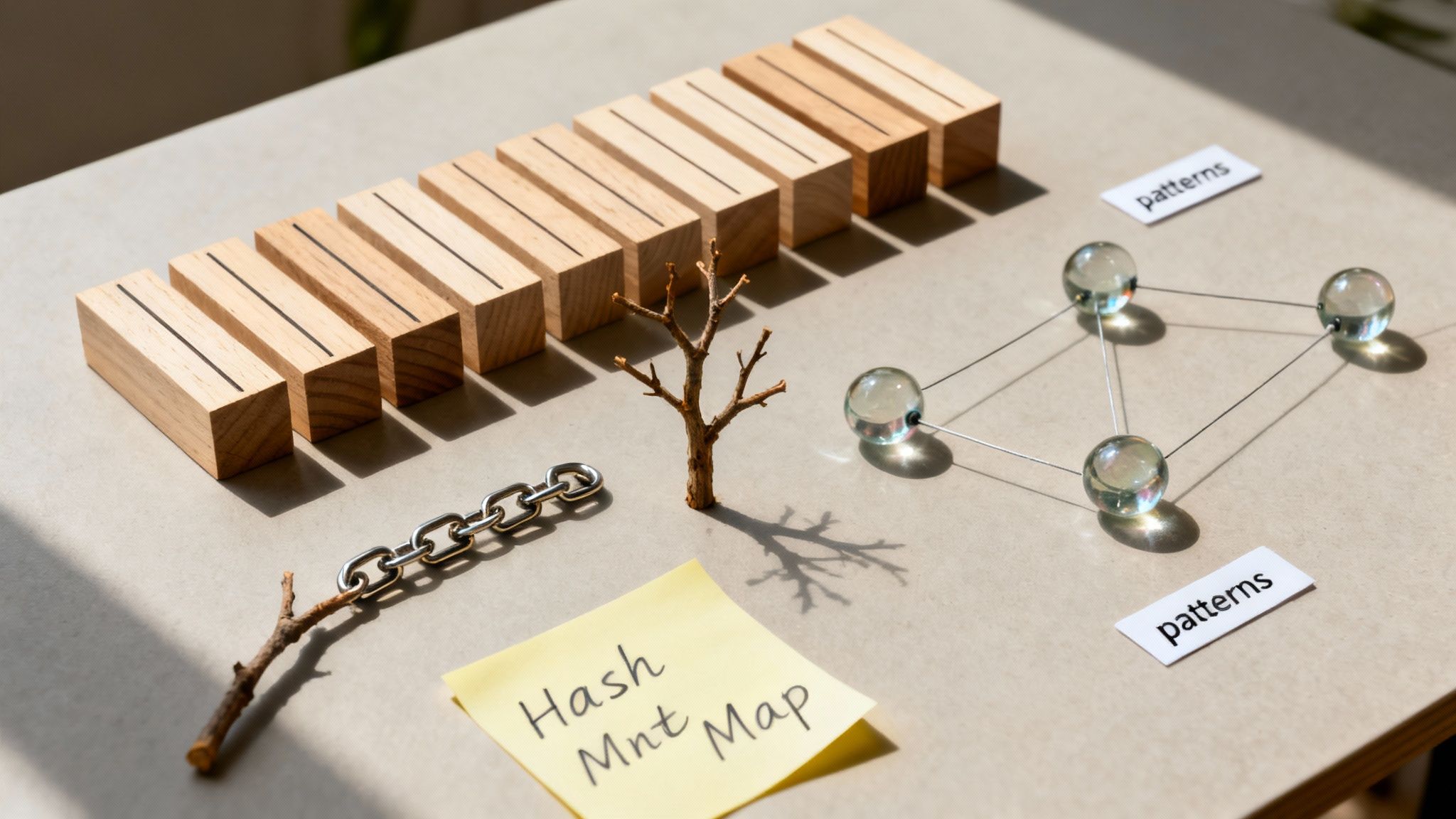
This kind of personalized feedback loop turns your study sessions from random shots in the dark into precision-guided training. It's the most efficient way to prepare for technical coding interviews.
I'll let you in on a secret: acing the DSA interview isn't about solving 500 problems. It’s about solving 50 problems in a way that you deeply understand the underlying patterns.
The moment you stop trying to memorize solutions and start looking for the fundamental patterns is the moment you truly begin to master the coding interview. It's a shift from "what's the answer?" to "what kind of problem is this?"
Once you make this mental shift, you'll start seeing that most problems are just dressed-up versions of a few core ideas.
Common Patterns to Master
Focusing on these patterns gives you a reusable toolkit. If you want to dive deeper, check out our guide on how to improve problem-solving skills.
https://www.youtube.com/embed/i53Gi_K3o7I
You just crushed the data structures problem. Flawless victory. But just as you’re about to celebrate, the interviewer says, “Okay, now let’s talk about system design.” For mid-level or senior engineers, this is where the real interview begins.
System design is about big-picture thinking, trade-offs, and handling ambiguity. The behavioral interview, on the other hand, is how they figure out if you're a human they'd actually want to work with. Spoiler alert: they do!
The dreaded question: "Design Twitter." Your mind goes blank. It feels like being asked to build a skyscraper with a single Lego.
The trick isn't to have all the answers—it's to have a framework.
A Simple Framework for Any Design Question:
Thinking about the data layer is especially important. Understanding some core database design principles can give you a massive advantage.
Don’t get lost in the weeds. The interviewer wants to see your thought process. It’s perfectly fine to say, "I'm not sure about this part, but here are two options and the pros and cons of each." That’s what a real engineer does.
After grilling you on tech, they’ll switch gears with questions like, "Tell me about a time you disagreed with your manager." Your new best friend is the STAR method.
To get really good at this, start by looking at some common behavioral interview questions and then practice telling your own stories out loud.
Here's a pro tip: don't let the interview be the first time you say your stories out loud. Rehearsal is the solution, and AI can be an incredible practice partner.
Platforms like Zemith can really help here. You can use its Smart Notepad to write out your STAR stories. Then, ask its AI features for feedback: "Can you make this story more concise?" or "How can I better emphasize the result?" This turns a static script into a polished, interview-ready narrative.
It’s like having a career coach on demand, helping you perfect your delivery until you can tell your professional stories with confidence.
Solving problems on your laptop, alone in your room, is one thing. Solving them while a real person watches you, asking probing questions as the clock ticks down? That's a completely different beast. It’s the difference between shooting hoops in your driveway and sinking a free throw in a packed stadium.
This is exactly why mock interviews are non-negotiable. They're the single best way to simulate the pressure and unpredictability of the real thing.
Don't just go through the motions. To really get value out of these sessions, you have to be intentional about getting feedback.
The real magic of mock interviews happens when you get uncomfortable. That's where you find your blind spots—the rambling explanations, the panicked silence when you get stuck. These are the wrinkles you need to iron out.
Finding human partners is great, but scheduling can be a pain. What if you could get instant, expert-level feedback anytime you wanted? This is where AI tools completely change the game.
Top candidates often solve 50-80 problems and simulate interview conditions over and over again. This is where an AI-powered platform like Zemith becomes your unfair advantage. Instead of waiting for a partner, you can fire up the AI Mock Interviewer and get hundreds of reps in a safe, controlled environment.

This tool lets you talk through your solution out loud, and the AI gives you immediate feedback on your communication, technical accuracy, and overall problem-solving approach. The AI can even simulate different interviewer personalities—from the silent note-taker to the overly helpful one—preparing you for anything. This is a game-changer for anyone figuring out how to pass a technical interview.
It's also worth understanding the bigger picture of How To Use LLMs In A Coding Interview. By blending traditional mock interviews with AI-powered practice, you build the muscle memory for solving problems under pressure. To see how AI is changing development more broadly, check out our guide on the best AI coding assistants.
You’ve ground through problems, you’ve followed a schedule, and you’re feeling mostly ready. But let’s be real—there are always a few last-minute questions that can mess with your confidence.
Think of this as your final pep talk. We’re going to tackle some of the most common “what if” scenarios to help you walk into that interview room feeling solid.
This question causes way more anxiety than it deserves. The short answer? The one you know best.
Seriously. Your goal is to show off how you think. Interviewers would much rather see you solve a problem fluently in Python, Java, or C++ than watch you stumble through unfamiliar syntax. Comfort leads to speed and clarity.
That said, there are a few practical things to keep in mind:
My advice? Avoid super-niche languages unless the job description specifically calls for it. You don’t want to waste ten precious minutes trying to implement a basic hash map from scratch.
First off, take a breath. It happens to literally everyone. How you recover from being stuck is often a more important signal than getting the answer right away.
The absolute worst thing you can do is sit there in panicked silence. Your thought process is the product you’re selling, not just the final lines of code.
Here's your game plan for when your mind goes blank:
Yes. A thousand times, yes. This is a little-known secret that can literally save your candidacy. A recruiter would much rather you interview successfully in two months than fail tomorrow.
If a recruiter reaches out and you know you aren’t ready, it is 100% okay to say so.
Here's a simple script you can adapt:
"Thanks so much for reaching out! I’m really excited about this opportunity at [Company Name]. To be honest, I want to make sure I put my best foot forward, and I'd like a bit more time to prepare. Would it be possible to schedule my interview for around [suggest a date a few weeks out]?"
This shows self-awareness and respect for their time. It’s far better to delay and get the offer than to rush in, bomb the interview, and face a one-year cooldown period before you can apply again.
Ready to turn all this knowledge into action? Zemith is your all-in-one AI partner for interview prep. From using the AI Mock Interviewer to get live feedback, to organizing your notes in the Smart Notepad, we give you the tools to practice smarter, not just harder. Stop juggling dozens of sites and start preparing with a single, powerful platform. Get started on Zemith today and walk into your next interview with the confidence you deserve.
Pay less than one AI subscription and get GPT, Claude, Gemini and more, plus 50+ AI tools.






Trusted by teams at






The top models, plus image, video and voice tools, in one plan.
Without Zemith
ChatGPT PlusUS$20.00Claude ProUS$20.00Google AI ProUS$19.99SuperGrokUS$30.00Perplexity ProUS$20.00 MidjourneyUS$10.00
 ElevenLabsUS$6.00Le Chat ProUS$14.99
 RunwayUS$15.00Kling StandardUS$8.80
 Gamma PlusUS$12.00
 Otter ProUS$16.99
 QuillBot PremiumUS$19.95
 Photoroom ProUS$12.99
 Quizlet PlusUS$7.99
Total if paying separatelyUS$234.70/mo
"I love the way multiple tools they integrated in one platform. Going in the right direction."
— simplyzubair
"The quality of data and sheer speed of responses is outstanding. I use this app every day."
— barefootmedicine
"The credit system is fair, models are perfect, and the discord is very responsive. Quite awesome."
— MarianZ
"Just works. Simple to use and great for working with documents. Money well spent."
— yerch82
"The organization of features is better than all the other sites — even better than ChatGPT."
— sumore
"It lives up to the all-in-one claim. All the necessary functions with a well-designed, easy UI."
— AlphaLeaf
"The team clearly puts their heart and soul into this platform. Really solid extra functionality."
— SlothMachine
"Updates made almost daily, feedback is incredibly fast. Just look at the changelogs — consistency."
— reu0691
Hand off the research, writing, design and follow-ups. Zemith picks the tools it needs and brings back finished work.
Search the web, run deep research, read files, create images and run code with GPT, Claude, Gemini, Grok and more.
Zemith keeps working in the cloud and pings you when it's done.
Notion, Linear, Canva, Airtable and more. It asks before it creates or changes anything.
Docs, slides, sheets and PDFs, ready to send.
Chain models and tools on a visual canvas, from one prompt to a finished promo video.
Briefings, reports and reminders run on a schedule and are ready when you need them.
Real-time voice that can see your camera or screen.
The best image and video models, in one studio.
Turn PDFs, links and YouTube videos into podcasts, quizzes, flashcards and mind maps.












 Podcast
 Quiz
Quiz Flashcards
 Mind map
 Infographic