


Every top model, with tools built in.
Search the web, run deep research, read files, create images and run code with GPT, Claude, Gemini, Grok and more.
Learn strategic planning process steps to map goals, align teams, and drive results with a practical, repeatable framework.
Let’s be honest for a moment: most strategic plans are destined for a dusty shelf. They become well-intentioned monuments, meticulously crafted in a boardroom and then promptly forgotten once everyone gets back to their "real" work. It’s like that fancy treadmill you bought in January.
It’s a bigger problem than you might think. One study even found that a staggering 49% of nonprofits operate without any strategic plan at all. And for those that do, many fail to see them through.
So, why the grim statistics? It almost always comes down to the approach. Plans fail when they're treated as a one-time, top-down mandate instead of a living, breathing guide for the entire organization. They become rigid documents in a world that demands agility.
From my experience, the reasons for failure are remarkably consistent, no matter the industry. It's rarely a lack of good ideas; it's a breakdown in connection and follow-through.
Here are the usual suspects:
To keep your strategy off the shelf, you need a process that's built for action. If you're looking for a deep dive into the specific mechanics, this guide on Strategic Planning Process Steps for Maximum Business Leverage is an excellent resource.
The fundamental shift here is moving from rigid 'planning' to adaptive 'strategic doing.' It’s about building a resilient framework that helps you navigate change, not just document an ideal future that may never arrive.
This infographic really captures that dynamic flow, showing how the process moves from initial planning into active execution and, crucially, continuous adaptation.
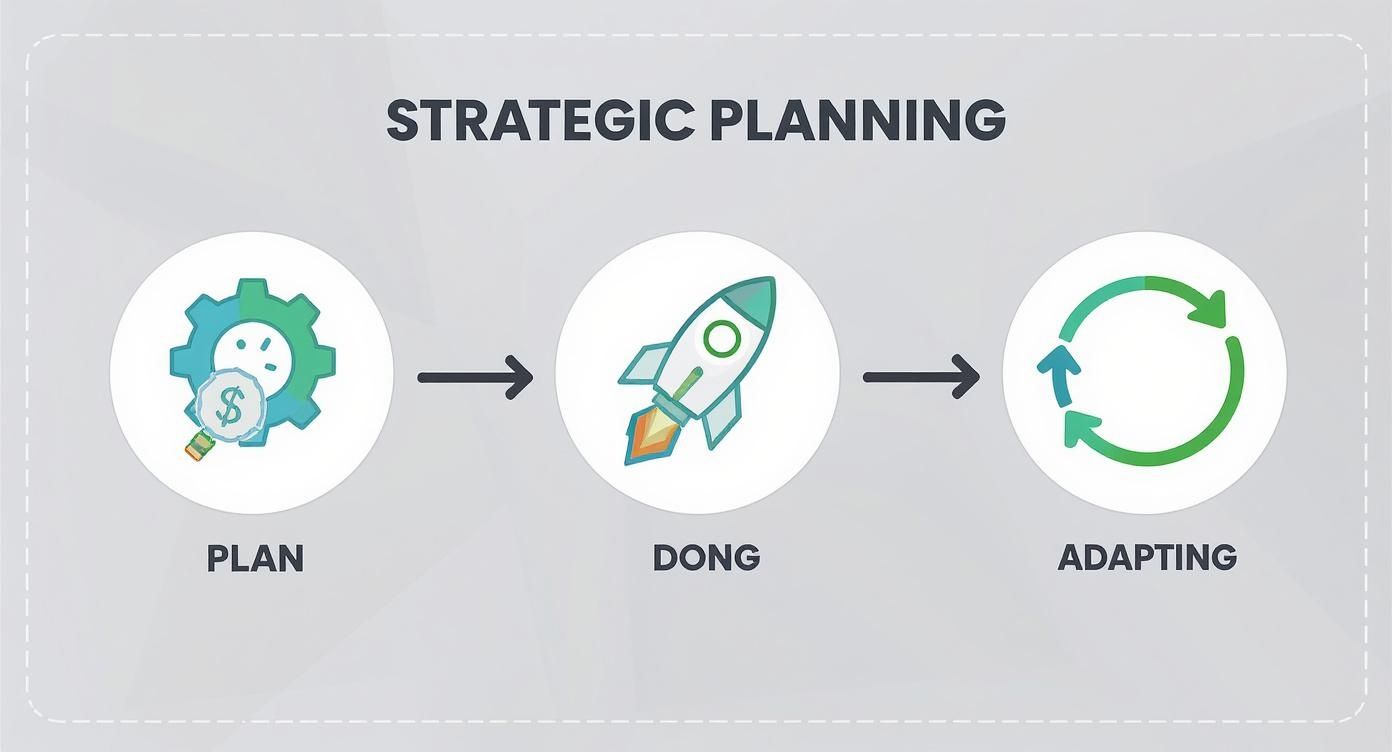
Here's a quick look at the core phases we'll be exploring. Think of it as a journey, where each step builds on the last to create a powerful, actionable strategy.
The main takeaway is that planning isn't a one-time event—it’s a continuous cycle. Without the 'Doing' and 'Adapting,' the 'Planning' phase is just an academic exercise. This guide will give you that actionable roadmap, one that connects your highest vision to the daily tasks that bring it to life.
This is how you create a plan your team is genuinely excited to execute.

Before you can punch a destination into your company’s GPS, you have to know your exact starting coordinates. This seems obvious, but you’d be surprised how many teams try to plan a cross-country road trip without knowing which city they’re in. You end up with a plan, sure, but it’s completely useless.
This foundational phase is all about taking a brutally honest look at your organization's current position. I'm not talking about a quick checklist of things you're good at. This is a deep, objective analysis of your internal realities and the external world you operate in. You're building the launchpad for your entire strategy; if it's built on wishful thinking, the whole thing will eventually crumble.
A classic tool for this is the SWOT analysis (Strengths, Weaknesses, Opportunities, Threats), and for good reason. It provides a simple framework to categorize where you stand. But the real value isn't in just filling out the four boxes—it's in the tough, honest conversations that this exercise forces.
For a SaaS company, a strength might be its intuitive user interface, but a weakness could be its slow feature deployment. An opportunity could be the growing demand for AI integration, while a major threat is a competitor suddenly slashing their prices. If you want to really master this, we have an in-depth guide on how to conduct a SWOT analysis with more actionable tips.
I've seen it time and again: skipping this environmental scan is one of the most common—and costly—mistakes in the entire strategic planning process steps. It's not a "nice-to-have"; it’s a critical predictor of whether you'll succeed or fail.
Don't just take my word for it. One major study analyzing public organizations across 25 countries found a clear, undeniable pattern. Organizations that skipped a thorough environmental analysis were 30% less likely to adapt to change and achieve long-term success. The data is clear: understanding your environment isn't optional. For those who want to dig into the numbers, you can explore the full research findings on systematic planning.
Key Takeaway: Your strategic plan's success is directly tied to the quality of your initial assessment. A plan based on assumptions is a fantasy; a plan based on evidence is a roadmap.
To get this right, you need to look both inward and outward. Gather everything: financial reports, customer feedback, employee surveys, market research, and deep competitor analysis. The goal is to assemble an unfiltered, 360-degree view of your reality. Once you have this solid foundation—and only then—are you ready to start charting a course for the future.
Once you have a firm grip on where you stand today, you can start looking toward the horizon. This is where we define the very soul of your organization—your North Star. Forget about crafting a vague, corporate-sounding sentence just to hang on the wall. We're talking about creating the compass that will guide every single decision you make, from major product launches to minor marketing tweaks.
It's a common mistake to use "vision" and "mission" interchangeably, but they serve two distinct, powerful purposes. Think of your vision as your ultimate destination—the future you're trying to create. Your mission is the purpose of your journey—what you do every day to get there.
Let's break it down with a simple example:
A weak vision statement sounds generic, like "To be a leading provider of X." A strong one, on the other hand, paints a vivid picture of a better future. It needs to be aspirational enough to get your team excited but clear enough that everyone knows exactly what you're building together.
Your mission statement is your "why." Beyond the paycheck, it's the reason your team shows up every day, ready to tackle challenges. To be effective, it has to be actionable and unique to your company.
Here’s a great way to test your mission: ask yourself, "Could our biggest competitor say the same thing?" If the answer is yes, you need to dig deeper. "Providing quality software" is forgettable. "Empowering small businesses to compete with giants through intuitive financial tools" is a mission. That's a statement that attracts the right talent and the right customers.
Key Insight: Your vision and mission are more than just words for your "About Us" page. When truly integrated into your operations, they become powerful filters for decision-making. Does this new feature align with our mission? Will this partnership move us closer to our vision?
To make sure these statements become part of your company's DNA, they have to be visible and referenced all the time. This is where a central platform like Zemith.com can be a game-changer. By linking your strategic goals directly back to your core mission and vision within your digital workspace, you ensure every project, task, and team is pulling in the same direction.
This transforms your North Star from a poster on the wall into a tangible, daily guide. It’s what keeps your entire team aligned, inspired, and ready to turn that solid foundation into a powerful force for growth.

A great vision without a clear plan is really just a daydream. This is the stage in the strategic planning process where we stop gazing at the horizon and start building the bridge to actually get there. It’s time to get real about the "how."
We need to break down that big North Star vision into tangible goals and measurable objectives. Think of it this way: if the vision is "to become the recognized industry leader," the goals are the major milestones along that journey. The objectives, then, are the specific, quantifiable steps you'll take to hit each of those milestones.
This is where so many strategies fall flat. A goal like "improve marketing" is useless. It’s vague, unmeasurable, and you might as well just aim to "be more awesome." Instead, we have to get specific using a framework that forces clarity and creates accountability.
The most reliable tool for this is the SMART framework. It's a classic for a reason—it works. It forces you to make sure every single objective is:
Let’s put this into a real-world context. Say a marketing team's part of the vision is "to become the industry leader." A corresponding SMART objective might be: "Increase marketing qualified leads (MQLs) from organic search by 20% by the end of Q3 by publishing eight new long-form blog posts and optimizing our top ten existing pages."
See the difference? It’s not a wish; it's a mini-plan. We know exactly what success looks like (20% increase), how it’s measured (MQLs), and when it’s due (end of Q3).
Key Takeaway: A goal without a number is just a slogan. Attaching specific metrics and deadlines transforms a vague aspiration into an actionable target that your team can rally behind.
The real magic happens when these goals cascade throughout the entire organization. The company’s high-level strategic goals are broken down into departmental objectives. In turn, those department objectives are broken down into individual or team key results.
Suddenly, everyone—from the CEO to the newest intern—understands precisely how their daily work connects to the bigger picture. This creates an incredible sense of alignment and purpose. A software developer isn’t just fixing bugs; they're improving user retention, a key objective for the product team, which directly supports the company's strategic goal of market leadership.
This is where trying to manage everything in spreadsheets becomes a recipe for chaos. A centralized platform is essential. Using a tool like Zemith.com allows you to map these goals, track progress in real-time, and make the entire hierarchy visible to everyone. It builds that critical bridge from lofty ambition to the daily grind, ensuring everyone is walking in the same direction.
Welcome to the graveyard of great ideas. It’s a sad but true fact that most strategies don’t die from a bad vision—they die from a thousand tiny execution failures. This is where the real work begins, turning that beautifully crafted plan into tangible results.
The first, most critical step is assigning crystal-clear ownership. Every initiative, every KPI, and every goal needs a designated champion. Who is responsible for hitting that Q3 sales target? Who is accountable for reporting progress on the new feature launch? Without clear owners, important tasks inevitably fall through the cracks and accountability evaporates.
Visible leadership engagement is the secret sauce for successful execution. When the C-suite is actively involved, it sends a powerful message that the strategy is a top priority, not just another corporate exercise. This isn't just a feeling; it's backed by hard data.
A comprehensive survey by the Economist Intelligence Unit found that companies with high levels of executive engagement in strategic planning reported 65% better financial performance than their peers. This underscores that when leadership sets the tone and ensures accountability, the entire organization is more likely to succeed. To see how top-level commitment impacts outcomes, you can learn more about why strategic planning is so important.
Key Insight: Execution isn't just about managing tasks; it's about leading people. Active leadership inspires commitment and removes roadblocks, ensuring the plan maintains momentum long after the initial kickoff meeting.
This is also where the right tools become absolutely essential. Trying to manage complex strategic initiatives with scattered spreadsheets and endless email chains is a recipe for disaster. It creates confusion, hides progress, and makes accountability nearly impossible.
To truly bring your strategy to life, you need a central hub where everyone can see the plan, track progress in real-time, and understand how their work contributes to the bigger picture.
Of course, a plan without resources is just a wish. This phase demands a careful, honest allocation of your most valuable assets:
Platforms like Zemith.com are built for this very challenge. It acts as a single source of truth, connecting your high-level goals to the daily tasks required to achieve them. This ensures everyone stays aligned and accountable, which is a cornerstone of effective execution.
For more ideas on keeping your initiatives on track, check out our guide on project management best practices. By systemizing your execution, you ensure your strategic plan becomes a living, breathing driver of success.

You’ve built your plan, assigned ownership, and set your teams in motion. It’s a huge accomplishment, and frankly, you’ve already made it further than many organizations do. But this isn't the finish line. Far from it.
Think of your strategic plan less like a stone tablet and more like a GPS navigation system. It’s designed to guide you, but it constantly needs to recalculate when you hit unexpected roadblocks or discover a faster route. This final, ongoing phase is all about that cycle of monitoring, evaluating, and adapting. Without it, even the most brilliant plan will become irrelevant in just a few months.
For your plan to remain a living, breathing guide, you have to build a consistent review rhythm into your company’s culture. Let’s be clear: an annual check-in is useless. That's like checking your GPS once a year on a cross-country trip. The best organizations I’ve worked with establish a steady cadence of meetings to assess progress honestly.
Here’s a practical breakdown:
These reviews are only as good as the data you bring to them. This is where a centralized platform like Zemith.com becomes indispensable. When goals and progress are tracked in real-time on visual dashboards, your review sessions transform from backward-looking report-outs into productive, forward-looking conversations. To really nail this, you might also want to explore our guide on https://www.zemith.com/blogs/evidence-based-decision-making.
Let's face it, a dense 50-page strategy document is hard to communicate and even harder to track. This is precisely why visual tools like strategy maps or balanced scorecards are so effective. They turn a complex plan into an intuitive, at-a-glance guide that anyone in the organization can grasp immediately. A key part of making this work involves consistent, real-world tracking project progress, which feeds back into the map and allows for timely adjustments.
The impact here isn't just theoretical. A 2020 report found that companies using graphical strategy maps were 50% more likely to hit their performance targets. The same study also showed that organizations holding regular quarterly reviews were 60% more likely to achieve their goals than those with static, "set-it-and-forget-it" plans.
Key Takeaway: Pivoting isn't a sign of failure; it's a sign of agile leadership. The ultimate competitive advantage is building a culture where your team feels safe enough to flag problems and suggest better ways forward.
Ultimately, this continuous loop of monitoring, evaluating, and adapting is what separates a successful strategy from a document that gathers dust. It ensures your plan remains a powerful, relevant tool for navigating a world that refuses to stand still.
Even with a solid roadmap in hand, some questions always come up once a team starts diving into the strategic planning process steps. It's totally normal. Let's walk through a few of the most common ones I hear to help clear the air.
Thinking you can set a strategic plan and just look at it once a year is a recipe for irrelevance. A year is an eternity in today's market. That's like checking the map only once a day on a cross-country road trip—you’re almost guaranteed to miss a critical turn.
From what I've seen, the most agile and successful companies conduct one major strategic review annually, but they check in on their progress quarterly. Those quarterly meetings are sacred. They're your best chance to make course corrections, shift resources where they're needed most, and make sure your plan is still grounded in reality. Don't let your strategy just become a document that collects dust on a shelf.
Hands down, the biggest mistake is failing to get genuine buy-in from the team. I’ve watched this play out more times than I can count: leadership huddles in a room, creates what they think is a brilliant plan, and then "unveils" it to everyone else. This approach is almost always dead on arrival.
Without involvement, you get compliance, not commitment. The plan feels like an order from on high, not a shared mission. To avoid this, the process has to be inclusive right from the start. When people feel like their perspective was heard and their ideas are reflected in the final strategy, they become its most passionate advocates.
The most brilliant strategy in the world is useless if the people meant to execute it don't feel a personal stake in its success.
You can absolutely start out with spreadsheets and shared documents, but I'll be honest—they get messy, fast. They’re clunky for collaboration, give you zero real-time visibility into what’s happening, and turn progress tracking into a painful, manual chore. It’s a classic case of trying to save a little money upfront only to create massive headaches down the road.
This is exactly why dedicated strategy platforms exist. They're built to keep your goals front and center, connect day-to-day tasks back to the company's biggest objectives, and serve up real-time data for your review meetings. It just makes the whole process smoother and a lot more effective.
Ready to move beyond messy spreadsheets and bring your strategy to life? Zemith provides a unified workspace to define goals, track progress, and keep your entire team aligned. See how our all-in-one AI platform can transform your strategic planning at https://www.zemith.com.







Trusted by teams at






The top models, plus image, video and voice tools, in one plan.
Without Zemith
ChatGPT PlusUS$20.00Claude ProUS$20.00Google AI ProUS$19.99SuperGrokUS$30.00Perplexity ProUS$20.00 MidjourneyUS$10.00
 ElevenLabsUS$6.00Le Chat ProUS$14.99
 RunwayUS$15.00Kling StandardUS$8.80
 Gamma PlusUS$12.00
 Otter ProUS$16.99
 QuillBot PremiumUS$19.95
 Photoroom ProUS$12.99
 Quizlet PlusUS$7.99
Total if paying separatelyUS$234.70/mo
"I love the way multiple tools they integrated in one platform. Going in the right direction."
— simplyzubair
"The quality of data and sheer speed of responses is outstanding. I use this app every day."
— barefootmedicine
"The credit system is fair, models are perfect, and the discord is very responsive. Quite awesome."
— MarianZ
"Just works. Simple to use and great for working with documents. Money well spent."
— yerch82
"The organization of features is better than all the other sites — even better than ChatGPT."
— sumore
"It lives up to the all-in-one claim. All the necessary functions with a well-designed, easy UI."
— AlphaLeaf
"The team clearly puts their heart and soul into this platform. Really solid extra functionality."
— SlothMachine
"Updates made almost daily, feedback is incredibly fast. Just look at the changelogs — consistency."
— reu0691
Hand off the research, writing, design and follow-ups. Zemith picks the tools it needs and brings back finished work.
Search the web, run deep research, read files, create images and run code with GPT, Claude, Gemini, Grok and more.
Zemith keeps working in the cloud and pings you when it's done.
Notion, Linear, Canva, Airtable and more. It asks before it creates or changes anything.
Docs, slides, sheets and PDFs, ready to send.
Chain models and tools on a visual canvas, from one prompt to a finished promo video.
Briefings, reports and reminders run on a schedule and are ready when you need them.
Real-time voice that can see your camera or screen.
The best image and video models, in one studio.
Turn PDFs, links and YouTube videos into podcasts, quizzes, flashcards and mind maps.












 Podcast
 Quiz
Quiz Flashcards
 Mind map
 Infographic