


Every top model, with tools built in.
Search the web, run deep research, read files, create images and run code with GPT, Claude, Gemini, Grok and more.
Unlock peak performance with these 10 actionable collaborative learning strategies. Learn how to integrate AI tools like Zemith for maximum impact.
Remember those dreaded group projects? The ones where one person did all the work, another "supervised," and the third mysteriously vanished until presentation day? We've all been there. It’s the kind of experience that makes you question the very idea of teamwork. But what if collaboration wasn't a chaotic mess but a super-powered engine for growth and innovation? Let's be real, true collaboration is more than just cramming people into a room (or a Zoom call) and hoping for magic. It requires structure, the right mindset, and, today, the right tech.
This guide isn't about fluffy theories or trust falls. We're diving deep into 10 powerful collaborative learning strategies that actually work, from corporate boardrooms to creative studios. These aren't just abstract concepts; they are practical, actionable frameworks designed to get your team thinking, building, and solving problems together. We'll break down everything from Peer Code Reviews for developers to Structured Academic Controversy for marketing teams, giving you step-by-step instructions for each. To unlock the full potential of your team, it's essential to understand and implement effective student engagement strategies in any learning environment.
Better yet, we’ll show you how to amplify every single strategy with AI tools. You’ll see how a smart platform like Zemith can automate the grunt work, facilitate brainstorming, and turn good ideas into great outcomes, all without the usual headaches. So, if you're ready to ditch dysfunctional group work and build a truly collaborative culture, you're in the right place. Let's get to it.
Ever spent hours staring at a bug only for a colleague to spot it in five seconds? That's the magic of Peer Code Review and Pair Programming in a nutshell. This classic collaborative learning strategy involves developers working together on the same codebase, either by reviewing each other's work asynchronously (code review) or by coding together in real-time (pair programming). It's a powerful combo of quality control and on-the-job training.
Instead of coding in a silo, this approach turns software development into a team sport. It helps catch bugs early, ensures code quality, and, most importantly, spreads knowledge like wildfire. Junior developers learn from seniors, and seniors get a fresh perspective on their own habits. Everyone wins, except maybe the bugs. They hate this one simple trick.
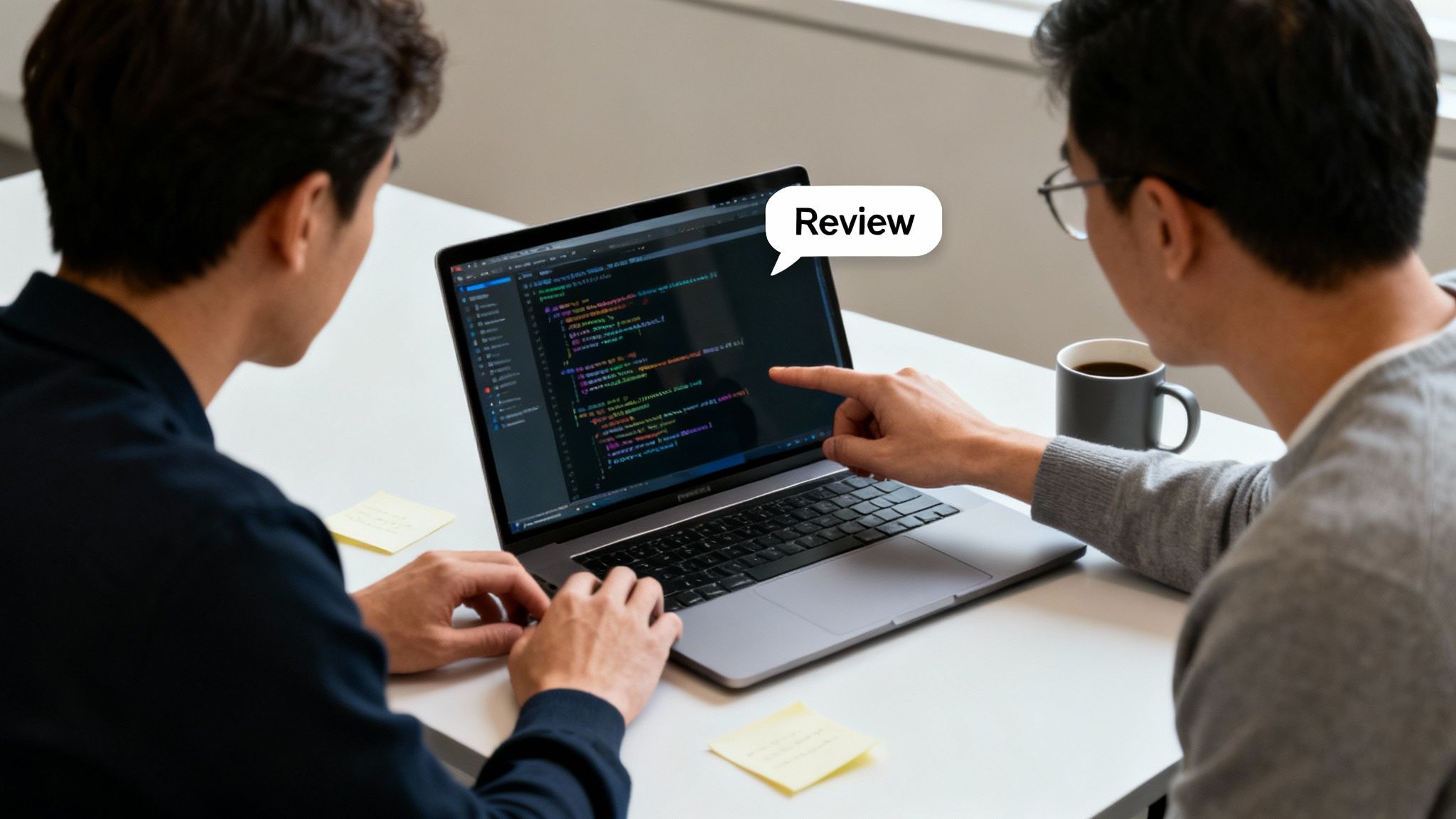
Getting started is easier than you think. The key is to establish a clear, supportive process that focuses on constructive feedback, not criticism.
Remember the nightmare of emailing a document back and forth, only to end up editing an outdated version? Collaborative Document Development and Annotation sends that chaos packing. This strategy involves multiple people working on a single, shared document in real-time, leaving comments, suggestions, and edits that everyone can see. It's the secret sauce for everything from team project proposals and marketing copy to research papers and technical documentation.
This approach transforms writing from a solo chore into a dynamic, team-based conversation. Instead of waiting for feedback, you get it instantly, allowing for rapid iteration and a much richer final product. It’s a powerful way to merge diverse perspectives, ensure accuracy, and build a shared understanding of the content. Everyone contributes, and the document evolves collectively, preventing version control headaches and ensuring the best ideas make it to the final draft.

Success here hinges on creating a structured environment where collaboration can flourish without descending into a free-for-all. Clear rules and smart tools are your best friends.
There's learning, and then there's doing. Project-Based Learning (PBL) communities blend the two, creating a powerful environment where people with diverse skills unite to build something tangible. Think of the massive open-source communities behind Linux or Django, or a startup cohort hustling to launch a new product. It’s one of the most effective collaborative learning strategies because the goal isn't just to learn; it's to create.
This approach moves learning from abstract theory to applied practice. Team members contribute their unique expertise, whether it's coding, design, or marketing, to solve a real-world problem. Along the way, they pick up new skills from each other, share specialized knowledge, and develop a deep, practical understanding of their domain. It’s less like a classroom and more like a workshop where everyone is both a teacher and a student.
The magic of a PBL community lies in its shared goal and organized collaboration. Keeping everyone aligned and productive is crucial, especially when team members are juggling different tasks and responsibilities.
Remember those group projects where one person does all the work? Jigsaw Learning is the antidote. This clever collaborative learning strategy breaks a larger topic into smaller pieces, turning each learner into an "expert" on one piece of the puzzle. It’s like assembling the Avengers, but for knowledge sharing. And with less spandex.
The process is simple but effective. Learners start in a "home group." They then break off into "expert groups," each dedicated to mastering a specific sub-topic. Once they've become specialists, they return to their original home groups to teach their peers what they learned. This creates a powerful web of interdependence where every member's contribution is essential for the whole picture to emerge. No one can coast, and everyone becomes both a student and a teacher.
Success with the Jigsaw method hinges on clear organization and providing your experts with the right tools to master their slice of the topic.
Remember being told to "put on your thinking cap" in school? Think-Pair-Share is the group version of that, but with a collaborative twist. First, you ponder a question alone (Think), then you team up with a partner to hash it out (Pair), and finally, you share your combined brilliance with the wider group (Share). It's a classic for a reason: it ensures everyone gets a voice, not just the loudest person in the room.
By bringing AI into the mix, this strategy transforms from a simple classroom exercise into a powerhouse for innovation and deep analysis. It’s no longer just about what two people can come up with; it's about what two people and a super-intelligent assistant can create together. This approach is fantastic for everything from design thinking workshops to analyzing complex customer feedback.
The goal is to use AI as a creative partner, not just a glorified search engine. By integrating AI tools, you can deepen discussions, challenge assumptions, and generate ideas that might never have surfaced otherwise.
Ever feel like the best way to understand something is to try explaining it to someone else? That’s the core idea behind Reciprocal Teaching and Peer Instruction. This isn't your average study group; it's a structured dialogue where students take on specific roles to guide the conversation, effectively teaching each other the material. It's one of the most dynamic collaborative learning strategies for professional development that deepens comprehension.
This approach transforms passive learners into active participants. By assigning roles like Predictor, Questioner, Clarifier, and Summarizer, everyone is responsible for a piece of the learning puzzle. It builds not just knowledge but also metacognitive skills, confidence, and communication abilities. Forget one-sided lectures; this is learning in surround sound.
Success here hinges on structure and clear role definitions. You want to empower participants to lead, not leave them guessing what to do next.
Ever wonder how doctors diagnose a rare illness or how consultants solve a billion-dollar problem? They don’t do it alone. They use Collaborative Problem-Solving and Case Study Analysis, a strategy where teams dissect complex, real-world scenarios to develop robust solutions. This method is a powerhouse for building critical thinking, as it forces you to move beyond theory and into the messy, unpredictable world of practical application.
This approach transforms learning from a passive activity into an active investigation. By pooling diverse expertise and perspectives, teams can uncover insights that an individual might miss. It’s the ultimate intellectual team sport, popularized by institutions from Harvard Business School to top engineering firms, because it mirrors how high-stakes challenges are solved in the professional world.

Success here isn't just about finding the "right" answer; it's about the rigor of the analytical process. The key is to structure your team's workflow from research to final presentation, ensuring no stone is left unturned.
Ready to move beyond "I'm right, you're wrong"? Structured Academic Controversy (SAC) is a debate-style strategy where arguing is the whole point, but winning isn't. Instead of defending one position to the death, small teams explore a controversial issue from all angles, argue for opposing views, and then work together to find common ground. It's a fantastic way to build critical thinking and the rare skill of understanding a perspective you don't agree with.
This method transforms a potential shouting match into a thoughtful exploration. Participants are assigned a position, research it, present it, and listen to the counterargument. Then, the real magic happens: they switch sides and argue for the opposing view. This process forces a deeper understanding of the topic's nuances and promotes empathy, making it one of the most powerful collaborative learning strategies for complex issues.
Success with SAC lies in the structure. The goal is synthesis, not victory. By guiding the process, you can turn heated debate into a high-level learning experience.
Ever stumbled upon a solution on Stack Overflow and thought, "Wow, an entire community exists just to solve these problems"? That's a Community of Practice (CoP) in action. This collaborative learning strategy goes beyond one-off workshops, creating a living network of people who share a passion or profession and learn from each other over time. It’s a group brain, constantly evolving.
A CoP isn't just a chat group; it's a self-organizing system where members voluntarily come together to develop expertise, solve tricky problems, and share what they've learned. Think of it as a book club for your career, where the book is your shared domain and the discussions lead to real-world breakthroughs. It’s where deep, practical knowledge is born and nurtured.
Building a thriving CoP doesn't happen by accident. It requires a shared space, a clear purpose, and the right tools to keep the knowledge flowing.
What if you could have the best of both worlds: the focused energy of a live brainstorming session and the thoughtful, deep work of asynchronous collaboration? That's the core idea behind a blended approach, supercharged by AI mediation. This strategy combines real-time meetings with offline work, using AI tools to bridge the gap, maintain momentum, and ensure nothing falls through the cracks. It's perfect for global teams, remote-first companies, or anyone tired of "this meeting could have been an email."
This isn't just about scheduling a mix of Zoom calls and Slack messages. It’s about creating a seamless workflow where synchronous and asynchronous efforts feed into each other. An AI mediator acts as the team's tireless assistant, summarizing live discussions, organizing async feedback, and synthesizing contributions. This approach respects different time zones and work styles, allowing for both immediate collaboration and focused individual contribution without losing context.
Implementing a blended strategy is about choosing the right mode for the right task and using AI to connect the dots. The goal is to maximize high-value synchronous time and make asynchronous work more efficient and connected.
And there you have it, a full-blown arsenal of ten powerful collaborative learning strategies designed to pull you out of the unproductive meeting death spiral and into a world where teamwork actually, you know, works. We’ve journeyed from the meticulous world of Peer Code Reviews and Pair Programming to the dynamic, debate-fueled environment of Structured Academic Controversy. We've seen how classic classroom methods like Jigsaw Learning can be brilliantly adapted for corporate training and how modern frameworks like Communities of Practice can build a lasting knowledge-sharing culture.
The biggest takeaway? Effective collaboration isn't accidental. It doesn't just happen because you put smart people in the same virtual room. It happens when you intentionally apply a structured approach, giving everyone a clear role, a shared goal, and the right tools to get there. Gone are the days of that one group project where one person did all the work and three others just changed the font size on the final slide. These strategies ensure everyone is engaged, accountable, and actively contributing to a collective intelligence that far surpasses what any single individual could achieve.
So, what now? Don't let this be just another article you read and forget. The goal is to turn these ideas into your team's new reality. Here’s a simple, actionable plan to get started without overwhelming yourself or your colleagues:
Mastering these collaborative learning strategies is more than just a productivity hack; it's a fundamental shift in how you and your team approach challenges. It’s about building a culture where knowledge isn't hoarded but shared, where feedback is a gift, and where the collective "we" consistently outperforms the individual "me." By moving beyond aimless group work and adopting these structured, purposeful methods, you're not just completing tasks more efficiently. You're building a smarter, more agile, and more innovative team from the ground up. The 'supervised' group project days are officially over.
Ready to supercharge these strategies with a tool built for intelligent teamwork? Zemith is the AI-powered workspace where collaborative learning comes to life, helping your team research faster, write smarter, and organize projects seamlessly. Stop juggling dozens of apps and start building your team’s collective brain by trying Zemith today.






Trusted by teams at






The top models, plus image, video and voice tools, in one plan.
Without Zemith
ChatGPT PlusUS$20.00Claude ProUS$20.00Google AI ProUS$19.99SuperGrokUS$30.00Perplexity ProUS$20.00 MidjourneyUS$10.00
 ElevenLabsUS$6.00Le Chat ProUS$14.99
 RunwayUS$15.00Kling StandardUS$8.80
 Gamma PlusUS$12.00
 Otter ProUS$16.99
 QuillBot PremiumUS$19.95
 Photoroom ProUS$12.99
 Quizlet PlusUS$7.99
Total if paying separatelyUS$234.70/mo
"I love the way multiple tools they integrated in one platform. Going in the right direction."
— simplyzubair
"The quality of data and sheer speed of responses is outstanding. I use this app every day."
— barefootmedicine
"The credit system is fair, models are perfect, and the discord is very responsive. Quite awesome."
— MarianZ
"Just works. Simple to use and great for working with documents. Money well spent."
— yerch82
"The organization of features is better than all the other sites — even better than ChatGPT."
— sumore
"It lives up to the all-in-one claim. All the necessary functions with a well-designed, easy UI."
— AlphaLeaf
"The team clearly puts their heart and soul into this platform. Really solid extra functionality."
— SlothMachine
"Updates made almost daily, feedback is incredibly fast. Just look at the changelogs — consistency."
— reu0691
Hand off the research, writing, design and follow-ups. Zemith picks the tools it needs and brings back finished work.
Search the web, run deep research, read files, create images and run code with GPT, Claude, Gemini, Grok and more.
Zemith keeps working in the cloud and pings you when it's done.
Notion, Linear, Canva, Airtable and more. It asks before it creates or changes anything.
Docs, slides, sheets and PDFs, ready to send.
Chain models and tools on a visual canvas, from one prompt to a finished promo video.
Briefings, reports and reminders run on a schedule and are ready when you need them.
Real-time voice that can see your camera or screen.
The best image and video models, in one studio.
Turn PDFs, links and YouTube videos into podcasts, quizzes, flashcards and mind maps.












 Podcast
 Quiz
Quiz Flashcards
 Mind map
 Infographic