On Cloud Code: End 'It Works on My Machine' in 2026
Tired of 'it works on my machine'? Master running on cloud code. Explore serverless, containers, & PaaS with practical examples for developers in 2026.
You're probably here for one of two reasons.
Either you're trying to stop hearing “works on my machine” from a teammate who somehow still tests everything against a database they installed three laptops ago, or you searched On Cloud code and got a bizarre mix of developer docs and running shoe coupons. Both are fair. One is more useful if you ship software for a living.
Running code in the cloud isn't new. What's changed is the workflow around it. Teams now expect local editing, repeatable environments, deployment automation, and fewer mystery failures between laptop, staging, and production. That sounds tidy in a slide deck. In real projects, it means deciding how much control you want, how much operational pain you can tolerate, and where your architecture will eventually bite you.
First Off This Article Is Not About Shoes
A lot of people land on “On Cloud code” searches expecting a promo code for sneakers, not advice on deployment models. That confusion is real. Data shows 78% of “On Cloud code” queries in Q1 2025 came from non-technical users looking for shoe discounts, while only 12% came from developers, tied to a campaign around “discount codes” for On Cloud shoes, according to .
So yes, the keyword is a mess.
But if you're a developer, the more interesting version of On Cloud code is the practical one. You've got an app that runs locally, kind of. Your teammate pulls the branch and gets a different result. CI fails in a way no one can reproduce. Staging behaves like a distant relative of your laptop, not a copy of it. That's the disease. “It works on my machine” is only the symptom.
The real problem isn't the code
Teams often don't struggle because the business logic is impossible. They struggle because the environment isn't repeatable. One person has the right SDK version. Another has a hidden env var. Someone's local cache masks a startup issue. Someone else installed a system dependency last year and forgot it even exists.
That's when “just run it in the cloud” starts sounding sensible.
Not because the cloud is magical. It isn't. It just forces you to be explicit. You define runtime assumptions. You version infrastructure. You stop relying on Greg's cursed laptop setup as if it were an architectural standard.
Practical rule: If your app only works with undocumented local setup steps, you don't have a working system. You have folklore.
Why this keyword collision is oddly useful
The shoe confusion is funny, but it also exposes a bigger issue. A lot of content around cloud development is either too beginner-friendly to help, or so abstract it reads like a whitepaper written by a committee. Developers searching for On Cloud code usually need plain-English guidance on what to run where, and why.
If your team is still cleaning up handoffs and environment drift, these are a good reminder that repeatability starts with clear instructions, not heroic memory.
Cloud code, in practice, is about making software behave predictably outside your own machine. That means choosing the right service model, setting up a sane delivery pipeline, and designing for constraints you can't hand-wave away. No footwear required.
The Cloud Kitchen Explaining The Different Models
Cloud service models make more sense when you stop talking like a certification exam and start talking like a hungry person.
You want to sell tacos. There are several ways to do it. You can build the whole restaurant yourself. You can rent a kitchen. You can use a prep service. Or you can outsource almost everything and just focus on the menu logic. That's the basic trade-off behind running code in the cloud.

IaaS gives you the building and the headache
With Infrastructure as a Service, you rent raw compute, storage, and networking. Think virtual machines, disks, load balancers, and security groups. You're effectively building the restaurant from scratch, then managing the plumbing, staffing, and fire code yourself.
That gives you flexibility. It also gives you chores.
Use IaaS when you need custom runtime behavior, low-level networking control, legacy compatibility, or weird workloads that don't fit neatly elsewhere. Don't choose it because someone on the team thinks hand-configuring everything is “real engineering.” That road ends with tribal knowledge and weekend pages.
PaaS is the rented kitchen
With Platform as a Service, the provider handles more of the boring substrate. You focus on application code and configuration. Deployment gets easier. Scaling is often built in. You give up some control, but you save a lot of operational energy.
This is usually the best first cloud move for internal apps, standard web backends, and small teams that need to ship instead of babysit infrastructure. If you're wrestling with organizational change during adoption, this piece on is worth a read because the technical choice is usually the easy part.
Containers sit in the middle
Containers are like bringing your own cookware and ingredients into someone else's kitchen. You package the app and its dependencies so it behaves more consistently across environments. That's why Docker became the default answer to “why is staging different from local?”
Containers solve packaging. They do not solve architecture, observability, or operational discipline. Kubernetes especially will let you automate yourself into a very organized mess.
FaaS is taco delivery by event
Functions as a Service, often called serverless, is the most constrained and the most convenient. You write a function. A trigger calls it. The platform handles the runtime lifecycle.
This works great for bursty workloads, webhooks, background tasks, and event-driven flows. It works badly when you try to cram a long-running workflow into a tiny execution unit and then act surprised when the system fights back.
Pick the simplest model that still matches your operational reality. Most teams don't need maximum control. They need fewer moving parts.
Benefits Versus The Gnarly Trade-Offs
Cloud adoption gets sold like a montage. Push code. Auto-scale. Sip coffee. Reality is less cinematic.
Yes, cloud platforms can make teams faster. Shared environments reduce “works on my machine” nonsense. Managed services remove a pile of maintenance. Deployment automation can shrink the gap between writing and shipping. If you want a business-side overview of why organizations lean this way, F1Group has a useful piece on .
That said, every benefit comes attached to a bill. Sometimes money. Sometimes complexity. Sometimes your weekend.
What works well
Cloud setups tend to shine when the app changes often, multiple developers contribute, and environments need to stay consistent. Repeatable deployments are a huge win. So is being able to treat infrastructure as something versioned and reviewable, not hand-tuned in a dashboard after lunch.
Teams also benefit when cloud services remove undifferentiated work. If your product is not “we maintain Linux hosts manually with spiritual intensity,” then managed databases, hosted runtimes, and deployment pipelines are often the better bargain.
What bites later
The first trap is vendor lock-in. The more you lean into provider-specific services, the harder migration gets. Sometimes that's fine. Sometimes it turns into a very expensive future meeting.
The second trap is distributed debugging. A local monolith failing in one process is annoying. A cloud-native system failing across a queue, an API gateway, two containers, and a function triggered by an event from a service someone forgot was enabled. That's character-building in all the wrong ways.
The third trap is technical debt with nicer branding. Teams can move fast in the cloud and still make a mess. They just make a modern mess with YAML.
If you've already got a backlog of flaky deploy scripts, unclear ownership, and one-off infrastructure changes, clean-up matters. A lot. This guide on maps pretty well to cloud projects because the same habits show up there fast.
The honest trade-off
Here's the blunt version.
- You gain speed when the platform removes repetitive ops work.
- You lose simplicity when the architecture spreads across too many services.
- You gain consistency when environments become defined and automated.
- You lose portability when convenience turns into deep provider dependence.
Cloud is usually worth it when the cost of manual operations already hurts more than the cost of platform complexity.
That's the decision. Not “is cloud good?” That question is useless. The critical question is whether your team can handle the operational shape of the choice you're making.
Common Architectural Patterns You Will See
Once teams start writing and deploying On Cloud code seriously, the architecture usually shifts in one of two directions. Either they break the app into services, or they let events drive the workflow. Sometimes both. Sometimes both plus regret.

Microservices when boundaries are real
A microservices setup breaks a system into smaller services with clear responsibilities. Think catalog, checkout, payments, inventory, and notifications in an ecommerce app. Each service can deploy independently, scale differently, and evolve on its own timeline.
That sounds clean because the diagram is clean.
In practice, microservices help when the boundaries reflect real ownership or domain separation. They hurt when a team splits a small app too early and replaces one understandable codebase with five tiny mysteries and a network problem.
A decent litmus test is this: if you can't explain the service boundary without hand-waving, you probably don't have a service boundary yet.
For a broader grounding in these decisions, this overview of is useful because cloud architecture is still architecture. The cloud doesn't forgive weak boundaries. It exposes them.
Event-driven systems when timing matters less than decoupling
An event-driven pattern fits workflows that don't need one giant synchronous request. A user places an order. That emits an event. Another service reserves inventory. Another sends email. Another triggers fraud review. Nobody waits for every downstream task before returning a response to the user.
Serverless often fits naturally. The platform reacts to events well. The system stays decoupled if you design it carefully.
It also gets harder to trace. You'll want correlation IDs, centralized logs, and enough instrumentation to answer “what happened?” without interrogating six dashboards and your own memory.
Here's a solid visual explainer before you go further down that rabbit hole:
The timeout gotcha people keep learning the hard way
Not every server-side cloud tool wants to be your workflow engine. A good example is Unity Cloud Code. Cloud Code methods often have a hard execution timeout of 15 seconds, so long-running orchestration has to be split into shorter async steps or queued workflows, as discussed in .
That single constraint changes the architecture.
If a task can run long, don't pretend it's synchronous. Persist state. Queue work. Return early. Let another worker finish the job. Trying to brute-force long orchestration through a short execution window is how you build a flaky system that fails exactly when users care most.
Long-running work belongs in workers, queues, or stateful orchestration. Thin cloud control planes should control, not grind through the whole job themselves.
A practical pattern that usually behaves
For a lot of teams, the most stable arrangement looks like this:
- API gateway up front to route requests and handle auth concerns.
- Containers or app services for business logic that needs steady runtime behavior.
- Functions for small event-driven tasks like notifications, media processing, or cleanup jobs.
- A queue between anything user-facing and anything slow.
That's not trendy. It's just reliable.
Your Toolkit For Cloud Development And CI/CD
Your local editor still matters, even when the cloud is the target. The best cloud development setups don't force developers to abandon local-first workflows. They tighten the loop between editing, validating, packaging, and shipping.
That's why IDE integration matters more than flashy demos. Google Cloud's Cloud Code supports VS Code and JetBrains IDEs, enabling developers to keep local-first editing while generating deployment manifests and getting code completion across targets like GKE and serverless, reducing context switching, according to .

The modern stack is less glamorous than people think
A usable workflow for On Cloud code usually includes four layers:
Local development in an IDE
You still write code in VS Code, IntelliJ, or a sibling tool. Good cloud integrations help with manifests, environment targets, and previews, but the editor remains the cockpit.Infrastructure as code
If your infra isn't versioned, reviewed, and reproducible, it will drift. Terraform, provider-native templates, and deployment descriptors matter because they turn environments into artifacts instead of folklore.CI for trust
Builds, tests, linting, and security checks need to run automatically. Not because automation is fashionable, but because humans are terrible at remembering the same checklist under pressure.CD for repeatability
The handoff from “merged” to “running” should be boring. Boring is good. Boring means nobody is SSH-ing into a box to “just fix one thing.”
Where teams lose time
They lose it in context switching.
One tab for documentation. Another for deployment YAML. Another for error logs. Another for generated boilerplate. Another for rough notes. Another for trying to remember why the pipeline started failing after someone “cleaned up” a config file.
That's why teams increasingly prefer a single workspace that can support research, drafting, debugging, and code generation together. It cuts down on the mental tax more than people expect. The technical issue isn't just writing code. It's carrying context across the whole delivery loop.
If you're tightening release workflows, these line up well with cloud work because deployment reliability is mostly process discipline wearing a technical costume.
AI is now part of the toolchain, whether you like it or not
This shift is no longer hypothetical. Claude Code launched in May 2025 and within about 8 months had overtaken GitHub Copilot and Cursor in a February 2026 developer survey as the most-used AI coding tool; that same survey reported a 46% “most loved” rating among 15,000 developers, according to .
Separate reporting also noted fast commercial traction and measurable code output. By early 2026, Claude Code was reported to have reached an estimated $2.5 billion annualized revenue run-rate, after one source said it hit $1 billion in about 6 months and $2.5 billion in 9 months; another summary said Claude Code authors were responsible for about 4% of all public GitHub commits in early 2026, based on .
That doesn't mean every generated snippet is production-ready. It means the workflow has changed. Engineers are increasingly pairing with AI for boilerplate, review support, config drafting, and debugging hints. The better question now is whether your setup contains that workflow cleanly, or scatters it across too many tools to be dependable.
Good cloud development feels like one loop. Edit, validate, deploy, observe, document. When those steps live in separate silos, the friction adds up fast.
How To Not Go Broke Or Get Hacked
Cloud projects usually fail in two very boring ways. The bill spikes. Or access control is sloppy enough that someone eventually finds out the hard way.
Neither failure is dramatic at first. That's what makes them dangerous.

Cost control is a design habit
“Pay for what you use” sounds friendly until idle environments, oversized services, and forgotten jobs start accruing charges. The cloud is convenient enough to make waste easy.
The teams that stay sane do a few boring things consistently:
- Set budget alerts early so surprise spend doesn't become month-end archaeology.
- Shut down non-production environments automatically when nobody needs them.
- Choose smaller defaults and scale up with evidence, not optimism.
- Review managed services carefully because convenience fees hide in plain sight.
If you're a startup or a small team, it's worth checking programs that help . Free credits won't fix bad architecture, but they can buy you room to learn without lighting money on fire immediately.
Security starts with refusing convenience shortcuts
Most cloud security failures aren't wizard-level attacks. They're plain old negligence with nicer branding.
Secrets end up in repos. Permissions stay too broad. Temporary access becomes permanent. One internal service gets exposed because someone wanted to “test something quickly” and forgot to unwind it. That phrase alone should trigger a code review.
A practical baseline looks like this:
The survival checklist
You don't need a massive security program to be safer tomorrow. Start with discipline.
- Kill shared credentials and move to role-based access.
- Rotate secrets that have been copied around Slack, docs, or old scripts.
- Tag resources clearly so cost ownership and cleanup aren't guesswork.
- Make staging cheaper and less open than production, not weirdly more chaotic.
- Treat observability as security-adjacent, because if you can't see access patterns or workload behavior, you can't catch much.
A cloud environment becomes expensive and insecure for the same reason. Nobody owns the details.
The painful part is that cost and security controls feel slow right up until the moment they save you. Then they feel brilliant.
Putting It All Together With The Right Tools
Running On Cloud code well isn't about chasing the most fashionable stack. It's about making clear choices. Pick the service model that matches your team. Design around actual constraints. Keep deployments repeatable. Make cost and security somebody's job, not everybody's vague intention.
The hard part is cognitive load. Cloud development sprawls fast. Code, manifests, logs, docs, tickets, review notes, AI assistance, release checks. It's a lot. Teams move faster when that work lives in fewer places and the context survives from one step to the next.
If you're building out your operating rhythm, it also helps to study practical guidance on . Monitoring is where architecture stops being theory and starts confessing its mistakes.
A unified AI workspace helps because modern delivery work is no longer just coding. It's debugging, documenting, researching, planning, and iterating without losing the thread. That's the gap most toolchains still leave open.
If you want one place to research architecture decisions, draft docs, generate code, debug workflows, and keep project context intact, take a look at . It's built for exactly the kind of messy real-world workflow cloud development creates, minus the tab chaos and subscription pileup.
Explore Zemith Features
Every top AI. One subscription.
ChatGPT, Claude, Gemini, DeepSeek, Grok & 25+ more








Always on, real-time AI.
Voice + screen share · instant answers
What's the best way to learn a new language?
Immersion and spaced repetition work best. Try consuming media in your target language daily.
Voice + screen share · AI answers in real time
Image Generation
Flux, Nano Banana, Ideogram, Recraft + more

Write at the speed of thought.
AI autocomplete, rewrite & expand on command
Any document. Any format.
PDF, URL, or YouTube → chat, quiz, podcast & more
Video Creation
Veo, Kling, Grok Imagine and more

Text to Speech
Natural AI voices, 30+ languages
Code Generation
Write, debug & explain code
Chat with Documents
Upload PDFs, analyze content
Your AI, in your pocket.
Full access on iOS & Android · synced everywhere
Your infinite AI canvas.
Chat, image, video & motion tools — side by side
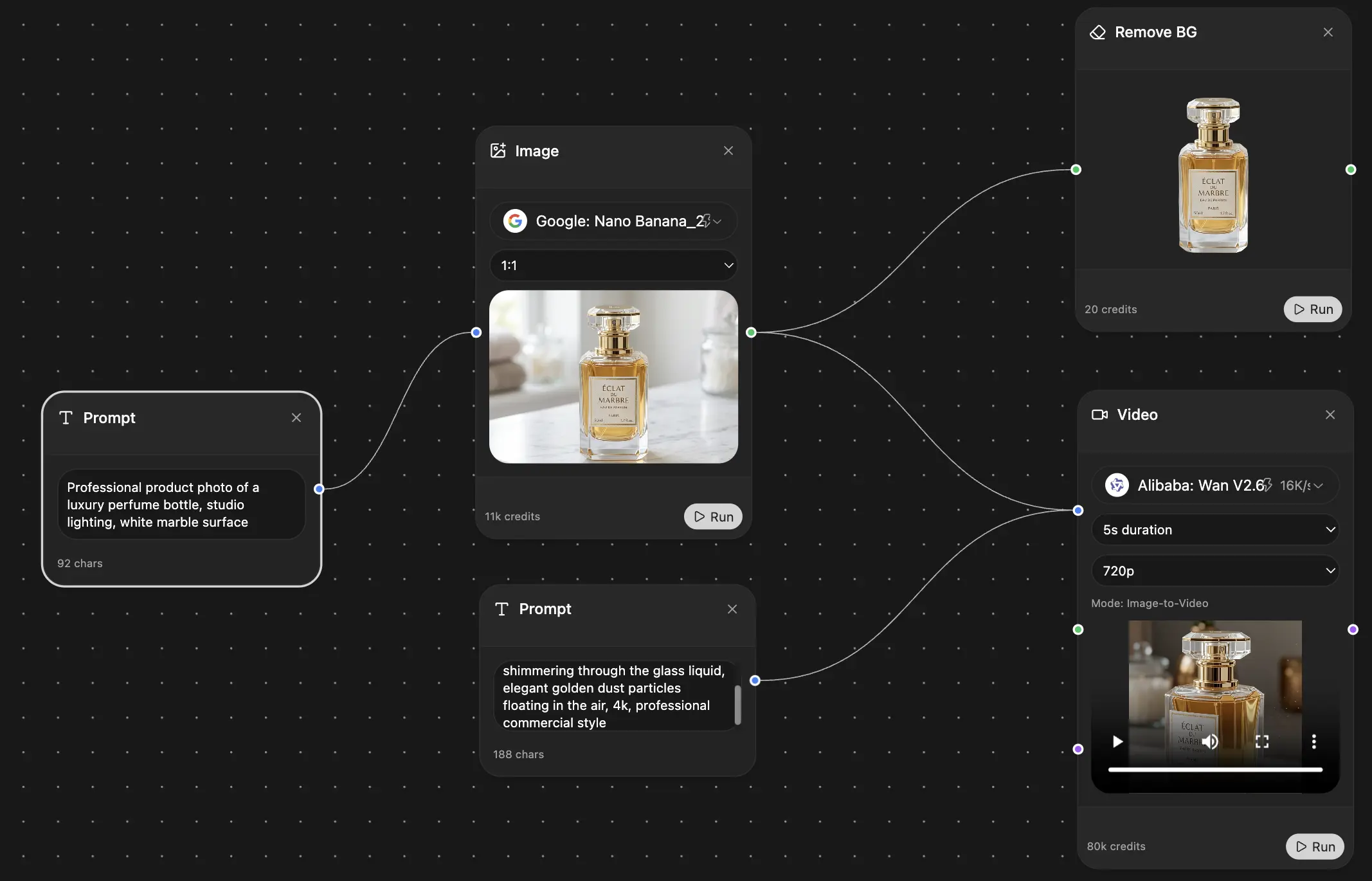
Save hours of work and research
Transparent, High-Value Pricing
Trusted by teams at






Free
No credit card required
- 100 credits daily
- 3 AI models to try
- Basic AI chat
Plus
- 1,000,000 credits/month
- 25+ AI models — GPT, Claude, Gemini, Grok & more
- Agent Mode with web search, computer tools and more
- Creative Studio: image generation and video generation
- Project Library: chat with document, website and youtube, podcast generation, flashcards, reports and more
- Workflow Studio and FocusOS
Professional
- Everything in Plus, and:
- 2,100,000 credits/month
- Pro-exclusive models (Claude Opus, Grok 4, Sonar Pro)
- Motion Tools & Max Mode
- First access to latest features
- Access to additional offers
What Our Users Say
Great Tool after 2 months usage
"I love the way multiple tools they integrated in one platform. Going in the right direction."
— simplyzubair
Best in Kind!
"The quality of data and sheer speed of responses is outstanding. I use this app every day."
— barefootmedicine
Simply awesome
"The credit system is fair, models are perfect, and the discord is very responsive. Quite awesome."
— MarianZ
Great for Document Analysis
"Just works. Simple to use and great for working with documents. Money well spent."
— yerch82
Great AI site with accessible LLMs
"The organization of features is better than all the other sites — even better than ChatGPT."
— sumore
Excellent Tool
"It lives up to the all-in-one claim. All the necessary functions with a well-designed, easy UI."
— AlphaLeaf
Well-rounded platform with solid LLMs
"The team clearly puts their heart and soul into this platform. Really solid extra functionality."
— SlothMachine
Best AI tool I've ever used
"Updates made almost daily, feedback is incredibly fast. Just look at the changelogs — consistency."
— reu0691