
Will AI Replace My Job in 2026? What Anthropic's CEO Really Said
Anthropic's CEO predicts 50% of entry-level jobs could vanish by 2030. Here's what the data actually shows and how to prepare for AI's impact on your career.
Will AI Replace My Job in 2026? What Anthropic's CEO Really Said
TL;DR
What you need to know: Dario Amodei, CEO of Anthropic (makers of Claude AI), predicts 50% of entry-level white-collar jobs could be displaced within 1-5 years. But his timeline keeps shifting, and the evidence shows a more nuanced reality.
Key findings:
- 37% of companies expect to replace workers with AI by end of 2026 (up from 29% who already have)
- Engineers at Anthropic hand over 80-90% of their coding to AI, not 100% as claimed
- Displacement affects specific tasks first, not entire jobs (coding ≠ software engineering)
- AI tools like Claude Code automate tasks but still need human oversight for quality and context
- Best protection: Learn to work with AI rather than compete against it
Last week, Anthropic's CEO Dario Amodei published a nearly 20,000-word essay warning that humanity is entering the "most dangerous window in AI history." The essay, titled "The Adolescence of Technology", makes four bold predictions about our near future, including the claim that AI will go from automating individual tasks to automating entire job categories.
The essay went viral across Silicon Valley and tech circles. But here's what most coverage missed: Amodei's predictions have been quietly shifting backward, and the reality on the ground tells a more complex story than the headlines suggest.
What Amodei Actually Predicted
Amodei runs the company behind Claude, one of the most advanced AI models available today. His predictions carry weight because Anthropic just hit [15 billion in projected revenue for 2026](https://www.axios.com/2026/01/26/anthropic-ai-dario-amodei-humanity), up from 5 billion in 2025. That's 10x growth year over year, which is unprecedented even by Silicon Valley standards.
Here are his four main predictions:
1. AI Will Automate Entire Jobs (Not Just Tasks)
Amodei claims AI systems will go from automating individual tasks like writing code to automating entire job categories like software engineering, law, and finance. He cites "smooth and simple extrapolation of the scaling laws" as evidence that feeding more data and compute into AI systems produces a predictable increase in cognitive capabilities.
His timeline? He predicts this could happen in 1-2 years, with a "very strong chance" it comes before 2030.
2. 50% of Entry-Level Jobs Will Vanish
The essay warns that up to 50% of entry-level white-collar jobs could be displaced within the next 1-5 years, creating what he calls a "permanent underclass" of workers who can't compete with AI.
He specifically mentions this will affect "those of lower intellectual ability" more than others, though he doesn't explain how that squares with his prediction that even theoretical physicists will be mostly replaced within 2-3 years (according to Anthropic co-founder Jared Kaplan).
3. AI Could Enable Totalitarian Nightmares
Amodei foresees AI-based mass surveillance, fully autonomous weapons, and swarms of millions of armed drones controlled by AI. He argues strongly against selling advanced chips to China, saying it would give a "giant boost to the Chinese AI industry during this critical period."
4. AI Models Have Psychologies of Their Own
This is the most philosophical prediction. Amodei claims AI models inherit "human-like motivations or personas" from training on the internet, and Anthropic now trains Claude to "think of itself as a particular type of person" using what they call an "aspirational constitution."
What the Data Actually Shows
Here's where things get interesting. Let's fact-check these claims against what's actually happening in 2026.
The Shifting Timeline
In his October 2024 essay "Machines of Loving Grace," Amodei predicted transformative AI could arrive "as early as 2026." Nine months later, in this new essay, he says it could come in "1-2 years" (which would be 2027-2028) or "before 2030."
That's not a refinement. That's his prediction moving backward as we get closer to the dates he originally cited.
He does this twice more in the essay when discussing job displacement timelines. The original prediction was "1-5 years." The new essay still says "1-5 years," not "0-4 years" as you'd expect if the clock were actually ticking down.
The Coding Reality Check
Amodei claims that engineers at Anthropic are "handing over almost all of their coding to AI." But what does "almost all" actually mean?
An OpenAI engineer recently estimated that Claude's competitor Codex automates about 20% of their code. Andrej Karpathy, former director of AI at Tesla, reports it's about 80% for him. So even at the high end, we're talking 80-90%, not 100%.
More importantly, there's a massive gap between "writing code" and "doing software engineering." I use Claude Code nearly every day. Its best suggestions are brilliant and save me hours. Its worst suggestions would break any app instantly if I didn't catch them.
That's the difference between automating a task and automating a job. Software engineering includes:
- Understanding business requirements
- Architecting systems
- Making tradeoff decisions
- Code review and quality assurance
- Debugging complex issues
- Mentoring junior developers
AI can help with all of these tasks. It can't yet do all of them autonomously.
The Job Displacement Numbers
Here's what's actually happening in 2026:
- 37% of companies expect to replace workers with AI by end of 2026 (29% already have)
- 89% of senior HR leaders expect AI to reshape jobs in 2026
- The World Economic Forum projects 85 million jobs displaced by 2026, but also 170 million new jobs created by 2030
Notice the language: "reshape," not "eliminate." Even companies replacing workers with AI are often reassigning humans to higher-value tasks rather than simply cutting headcount.
Anthropic's own research tells a different story than Amodei's essay. Their 2026 Economic Index analyzed 2 million Claude AI interactions and found that AI "augments jobs by handling routine tasks, allowing humans to tackle complex ones."
That's augmentation, not replacement.
Why This Matters for Your Career
I'm not saying Amodei is wrong. I'm saying the reality is more nuanced than "AI will take your job in 1-2 years."
Here's what's actually at risk:
High risk (tasks being automated now):
- Repetitive data entry
- Basic customer support responses
- Simple content formatting
- Routine code generation
- Template-based writing
Medium risk (tasks being augmented):
- Research and analysis
- First drafts of reports or articles
- Basic graphic design
- Straightforward debugging
- Email management
Low risk (still requires human judgment):
- Strategic decision-making
- Client relationship management
- Creative problem-solving
- Quality assurance and review
- Teaching and mentoring
- Handling ambiguity and context
Notice that even "high risk" items are tasks, not jobs. Most jobs involve a mix of automatable and non-automatable tasks.
The Feedback Loop Problem
Here's something Amodei doesn't address: different jobs have different feedback loops.
In software engineering, you know within seconds or minutes if your code works. You run tests. You see errors immediately. This makes AI-generated code relatively safe because the feedback is instant.
In law, if AI misses a clause in a contract, you might not discover the problem for three years when a dispute arises. In consulting, if AI's analysis overlooks workforce dynamics, the consequences might not play out until the medium term. In content creation, if AI produces factually incorrect information, it could damage your reputation before you catch it.
The longer the feedback loop, the more human oversight you need. That's why coding is seeing faster automation than other knowledge work.
What AI Lab Leaders Actually Say
Amodei is increasingly an outlier among AI lab CEOs. Here's Google DeepMind CEO Demis Hassabis on the same scaling laws Amodei touts:
"Scaling laws are going very well... we're definitely seeing increased capabilities. May not be as fast as it was a couple of years ago. There's some talk of diminishing returns... there's a big difference between no returns and exponential. I think we're somewhere in the middle."
Hassabis also noted that reaching AGI (artificial general intelligence) may require "one or two big innovations still needed" beyond just scaling up existing approaches.
Even within Anthropic, the messaging is mixed. Their public research emphasizes augmentation. Their CEO's essays emphasize replacement. Which one reflects the actual product roadmap?
Should You Panic?
No. But you should prepare.
The smartest approach is what I call "hedged preparation":
-
Learn to work with AI - Use tools like Claude, ChatGPT, or Zemith daily. Understand their strengths and weaknesses. The people who thrive won't be those who ignore AI or those who panic about AI. They'll be the ones who get really good at using it.
-
Focus on judgment, not execution - AI is great at execution. It's terrible at knowing what to execute. Position yourself as the person who decides what to do, not just the person who does it.
-
Build skills with long feedback loops - Strategy, relationships, creative problem-solving, and contextual understanding are all areas where AI still struggles because the feedback loops are long and fuzzy.
-
Don't bet everything on the singularity - Yes, there's maybe a 30% chance we see massive disruption in the next 1-4 years. But there's a 70% chance we don't. Build your career for both scenarios.
-
Stay employable in the transition - Even if AI eventually automates your current role, the transition will take years. Use that time to build adjacent skills.
The Real Risk (That Nobody's Talking About)
Here's what worries me more than job displacement: young people making bad decisions because they believe the hype.
If you're 18-22 and you think you have "only a few months to escape the permanent underclass," you might:
- Drop out of college to chase crypto or AI startups
- Accumulate debt trying to "get rich quick"
- Burn out trying to master every new AI tool
- Make career choices based on fear rather than interest
That's the real danger. Not AI itself, but the panic around AI causing people to make short-term decisions that hurt their long-term prospects.
Why Amodei Might Be Biased
Let's be honest about incentives.
Anthropic's revenue is growing 10x year over year. They're competing directly with OpenAI, Google, and increasingly with Chinese AI labs like Alibaba (makers of the Qwen models).
What would most threaten Anthropic's growth? A Chinese model that's 97% as good as Claude but costs one-tenth the price.
Amodei's essay spends significant time arguing that we should "absolutely not be selling chips, chipmaking tools, or data centers to the CCP." He frames this as a safety concern. But it's also a business concern. If China develops competitive AI independently, Anthropic faces much stiffer price competition.
I'm not saying he's wrong about the chip export restrictions. I'm saying we should acknowledge that his company benefits enormously from policies that slow down Chinese AI development.
What About Zemith?
This essay has focused on Anthropic because that's where the viral predictions came from. But here's the reality: you don't need to use Claude specifically to prepare for an AI-augmented future.
The key is building a daily habit of using AI for tasks where it genuinely helps. Whether that's Claude, ChatGPT, or Zemith, what matters is developing fluency with AI assistance so you understand where it adds value and where it falls short.
Zemith offers instant access to AI chat, coding assistance, and agents without the complexity of multiple subscriptions or setups. If you're looking to build that daily AI habit, it's worth checking out.
The Bottom Line
Will AI replace your job in 2026? Probably not entirely. Will it change your job? Almost certainly yes.
Dario Amodei's predictions are worth taking seriously. He runs one of the leading AI companies and has unique insight into where the technology is headed. But his timelines keep shifting, his claims sometimes exceed the evidence, and his incentives aren't perfectly aligned with objective analysis.
The actual data shows AI is automating tasks within jobs, not entire jobs themselves. The transition is happening faster in some fields (coding) than others (law, consulting, creative work). The companies seeing the biggest productivity gains are using AI to augment workers, not replace them.
Your best move? Start using AI tools daily. Get good at working alongside them. Focus on developing skills that require human judgment and contextual understanding. And don't panic about timelines that keep getting pushed back.
The future of work is being rewritten. But it's being rewritten as a collaboration between humans and AI, not a replacement of one by the other.
At least not yet. And maybe not ever.
Sources
- Anthropic CEO's grave warning: AI will "test us as a species" (Axios)
- Anthropic CEO Dario Amodei warns AI's "adolescence" will test humanity (Fortune)
- The Adolescence of Technology - Dario Amodei's Full Essay
- Nearly 4 in 10 companies will replace workers with AI by 2026 (HR Dive)
- 77 AI Job Replacement Statistics 2026 (DemandSage)
- Anthropic's 2026 AI Index: Augmenting Jobs, Not Displacing Workers
- How will Artificial Intelligence Affect Jobs 2026-2030 (Nexford University)
- AI will impact jobs in 2026, say 89% of HR leaders (CNBC)
Explore Zemith Features
Every top AI. One subscription.
ChatGPT, Claude, Gemini, DeepSeek, Grok & 25+ more







Always on, real-time AI.
Voice + screen share · instant answers
What's the best way to learn a new language?
Immersion and spaced repetition work best. Try consuming media in your target language daily.
Voice + screen share · AI answers in real time
Image Generation
Flux, Nano Banana, Ideogram, Recraft + more

Write at the speed of thought.
AI autocomplete, rewrite & expand on command
Any document. Any format.
PDF, URL, or YouTube → chat, quiz, podcast & more
Video Creation
Veo, Kling, Grok Imagine and more

Text to Speech
Natural AI voices, 30+ languages
Code Generation
Write, debug & explain code
Chat with Documents
Upload PDFs, analyze content
Your AI, in your pocket.
Full access on iOS & Android · synced everywhere
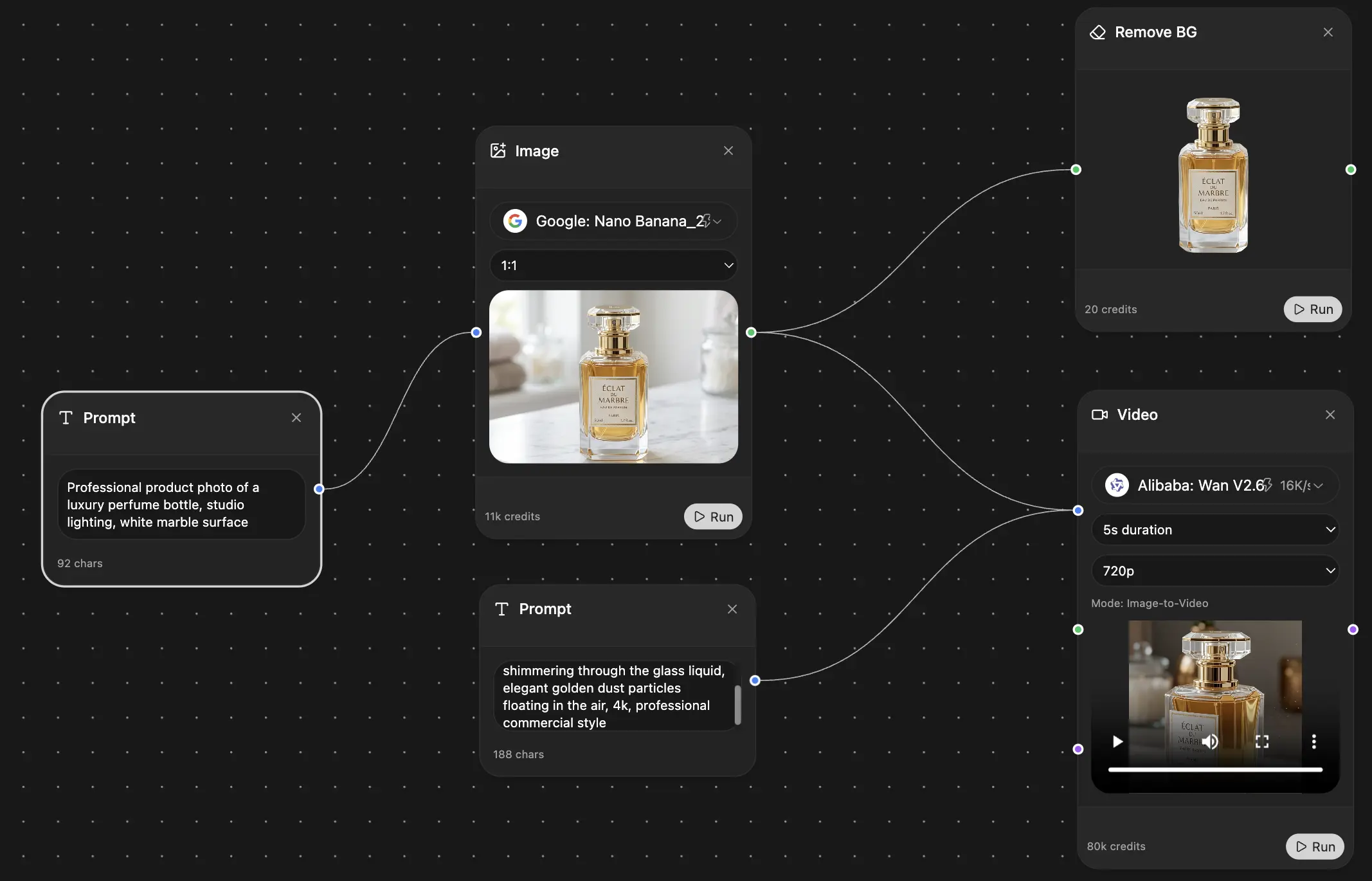
Your infinite AI canvas.
Chat, image, video & motion tools — side by side
Transparent, High-Value Pricing
Free
No credit card required
- Limited daily usage
- Selected AI models to try
- Limited features
Plus
- Choose from multiple leading models — GPT, Claude, Gemini and Grok.
- 25× more usage than Free.
- Create and edit images with Creative Studio.
- Connect your favorite apps and get work done in one place.
- Research the web and turn sources into clear answers.
- Turn documents, websites and YouTube into podcasts, flashcards and reports.
- Build repeatable workflows and stay focused with FocusOS.
Professional
- Everything in Plus, and:
- Unlock every model on Zemith, including GPT 6 Astra, Claude Opus and Sonar Pro.
- 50× more usage than Free.
- Create more with the full Creative Studio toolkit.
- Let agents work in the background — run Cloud tasks and schedule recurring work.
- Push further on complex work with Max Mode.
- First access to new features.
Trusted by teams at