


Every top model, with tools built in.
Search the web, run deep research, read files, create images and run code with GPT, Claude, Gemini, Grok and more.
Stop guessing and start winning. Download our proven content marketing strategy template and build a plan that drives real, measurable business growth.
Alright, let's get you set up with a content marketing strategy template you can download right now. This isn't just a document; it's the exact framework we're going to fill out together in this guide. Think of it as your blueprint for creating content that actually moves the needle, not just makes you feel busy.
Let's be real for a second. Creating content without a plan is a lot like shouting into the wind while juggling chainsaws. It's exhausting, a little dangerous, and mostly, nobody hears you. You spend hours crafting what you think is a killer blog post, you push it out on social media, maybe you even throw a little ad spend behind it, and then... crickets.
If that sounds painfully familiar, this section is your intervention. It's time to stop throwing content spaghetti at the wall and hoping something sticks. Instead, we're going to build a reliable engine that consistently attracts and converts the right people.

The signs of a missing strategy are painful and easy to spot: your messaging is all over the place, you're wasting precious time, and your blog is a ghost town. This "random acts of content" approach isn't just ineffective—it's a massive drain on your resources. To fix this, you first need a solid grasp of what is content marketing strategy at its core. That's the first real step toward making your work intentional and measurable.
It’s almost laughably simple, but just writing your strategy down makes a huge difference. Research from the Content Marketing Institute backs this up, showing that marketers who document their strategy are way more likely to be top performers.
For example, 47% of B2B marketers said they have a documented plan, while only 37% of their B2C peers do. And what are the successful ones doing? They’re aligning their content with business goals (62%) and getting serious about measuring performance (53%)—both things a good template will force you to do.
This data isn't just a bunch of numbers. It proves that a written plan is a direct line to better ROI and lead generation. It’s what separates guessing from knowing.
So, how do you get out of this content mess? You start with a simple, actionable framework. Our template brings that clarity by breaking everything down into digestible chunks: your goals, your audience, your content pillars, your channels, your workflow, and how you’ll measure success.
It’s a blueprint for building a cohesive content engine where every single piece has a purpose. This is a lot like how a good marketing campaign planning template organizes your broader promotional pushes.
The goal is to move from a chaotic content factory to a smooth-running content machine. A template provides the structure, and your insights provide the fuel.
This guide will walk you through, section by section, how to fill out the template you just downloaded. We'll use real-world examples and practical tips to help you build a strategy that’s right for your business. By the end, you won't just have a document; you'll have a clear path to creating content that consistently drives growth.
Alright, you've got the template open and ready to go. The temptation is to jump straight into brainstorming blog topics and social media posts, but hold on there, speedy. Before we get into the fun stuff, we need to build the foundation. That means getting brutally honest about why you're creating content and who you're creating it for.
So many strategies start with a goal like "get more traffic." That's not a goal; it's a wish. It's like hopping in a car for a road trip without a destination in mind. You'll burn a lot of gas and end up at a weird roadside diner. A solid content strategy is anchored to real business objectives—the kind of stuff that makes an impact on the bottom line.
Forget the fuzzy stuff. Your goals need to be specific, measurable, and tied directly to business growth. This is one of those times where the old-school SMART goal framework (Specific, Measurable, Achievable, Relevant, Time-bound) is genuinely your best friend.

Let's see this in action. I'll show you how to turn those common, mushy marketing wishes into sharp, actionable targets you can plug right into your content marketing strategy template. This is how you prove your content isn't just another expense.
Instead of: "Increase brand awareness."
Instead of: "Get more leads."
Instead of: "Engage our audience."
See the difference? Actionable goals give you a finish line. They give you a benchmark for success, which makes every decision you make from here on out so much clearer.
Once you've nailed down your why, it's time to get laser-focused on your who. And please, "millennials who live in cities" is not a target audience. It's a lazy demographic. We need to go way deeper and build out audience personas that feel like actual people you know.
Think of these personas as your imaginary best friends. They're semi-fictional characters, sure, but they're built on real data and deep research about your ideal customer. They’ll be your guide for your tone of voice, the topics you choose, and even the social media platforms you show up on. If you're new to this, learning how to create buyer personas is a crucial first step.
A truly useful persona answers questions like:
You want to know your audience so well that when they read your content, their first thought is, "Wow, it's like they're reading my mind." That’s the magic moment.
This kind of insight doesn't come from a crystal ball. It comes from good old-fashioned research. You need to actually talk to people. Chat with your sales team, interview your best customers, and dive into online reviews. For a more detailed walkthrough, our guide on how to conduct user research has you covered.
Actionable Insight: You can get a massive head start by using a tool like Zemith's research assistant. It instantly scours forums, social media, and search engines to uncover the burning questions your audience is already asking. This allows you to tap directly into their pain points and create content that solves their real problems from day one, skipping weeks of manual research.
Alright, you know who you're talking to and what you're trying to accomplish. Now for the fun part: deciding what you’re actually going to talk about.
This is the exact spot where most content strategies crumble. It quickly turns into a weekly scramble of, "Oh no, we need a blog post for Thursday... what should we write about what people actually search for online?" We're going to kill that chaos for good.
The secret is to stop thinking in terms of one-off blog posts. Instead, you need to build a smart, interconnected system using the pillar-cluster model. This approach does more than just simplify your content planning; it's a huge signal to search engines that you're a legitimate authority on your core subjects.
Think of it like producing a hit TV show. You don't just film a bunch of random, disconnected episodes. You start with a big, central theme for the season (that's your pillar). Then, you create individual episodes that dig into that theme from all sorts of different angles (those are your clusters).
Your content pillars are the 3-5 massive, foundational topics that are absolutely essential to your business and your audience. These aren't just keywords; they're the big-picture ideas you want to own in your industry. They live right at the intersection of what you're a genuine expert in and what your audience is desperately trying to figure out.
To nail down your pillars, just ask yourself a few simple questions:
Don't overthink this part. You're looking for broad categories that have enough meat on the bones to support dozens of smaller, more niche topics down the line.
Let's say you run a fintech SaaS company that helps new entrepreneurs get their finances in order. You've done the research and know that "Small Business Budgeting" is a massive headache for your ideal customer. Boom. That's a perfect pillar.
From that one single pillar, you can branch out and create an entire universe of related "cluster" topics. These are the specific, long-tail-keyword-focused pieces of content that answer very targeted questions your audience is typing into Google.
Pillar Page: The Ultimate Guide to Small Business Budgeting
Cluster Content (Blog Posts, Videos, Templates):
- How to Create a Cash Flow Forecasting Template
- Top 5 Accounting Software for Freelancers
- A Simple Guide to Reading a P&L Statement
- Common Bookkeeping Mistakes to Avoid (and how to fix them)
- How to Set Your First Business Budget Without Crying
See how that works? Each piece of cluster content links back to that main pillar page, creating a powerful web of internal links. This structure basically screams at Google, "Hey, we don't just know a little bit about small business budgeting—we're the experts."
Once you've locked in your pillars, the real creative work begins. It’s time to brainstorm a ton of cluster topic ideas. Let the ideas fly! Think about every possible question, problem, or "how-to" someone might have related to your pillar.
Actionable Insight: A tool like Zemith's AI Research Assistant can be a total game-changer here. You can feed it your pillar topic, like "how to build a small business marketing plan," and it will instantly spit back hundreds of related questions, popular search queries, and forum discussions from all over the web. It's like having a direct line into your audience's brain, showing you exactly what they want to learn about.
Once you have a giant list of ideas, start grouping them to find overlaps. For the ideas that make the cut, you've got to turn them into articles that people actually want to read. For a deeper look at that, check out our guide on how to write engaging content that really connects.
By filling out this section of your content marketing strategy template, you’re building an idea-generation machine. You'll go from content scarcity to content abundance, with a clear roadmap of what to create for months—or even years. Say goodbye to the weekly content panic and hello to a strategic, authoritative content plan. The only thing you'll be running out of is coffee.
So you’ve got a brilliant content plan built around solid pillars and clusters. Awesome. But let's be real—the most amazing content in the world is totally useless if it just sits on your blog gathering digital dust.
This is where we switch gears from being artists to engineers. It's time to build the machinery that gets your content in front of the right eyeballs, consistently.
Creating something great that nobody ever sees is a special kind of marketing heartbreak. Let's make sure that never happens to you.
First, let's talk distribution. This isn’t about just blasting your new post across every social media channel you can think of. It's about surgical precision. Where do your people actually hang out online? Are they scrolling LinkedIn on their lunch break, lurking in niche Slack communities, or bingeing industry podcasts on their commute?
Focusing your energy where your audience already is will give you 80% of your results with 20% of the effort. It's the smartest way to work.
Once you know where you’re going to share your content, you need a system to actually produce it without constant chaos. This is where we get tactical and map out a repeatable production workflow. The goal here is a smooth-running content machine, not a stressful, deadline-missing factory.
A solid workflow maps out every single step, from that first lightbulb moment for an idea to hitting "publish" and tracking what happens next. Think of it as the assembly line for your content.
This process ensures your pillar-and-cluster model actually works to build authority. You start with a broad pillar, then create specific cluster pieces that all point back to it, establishing you as an expert.
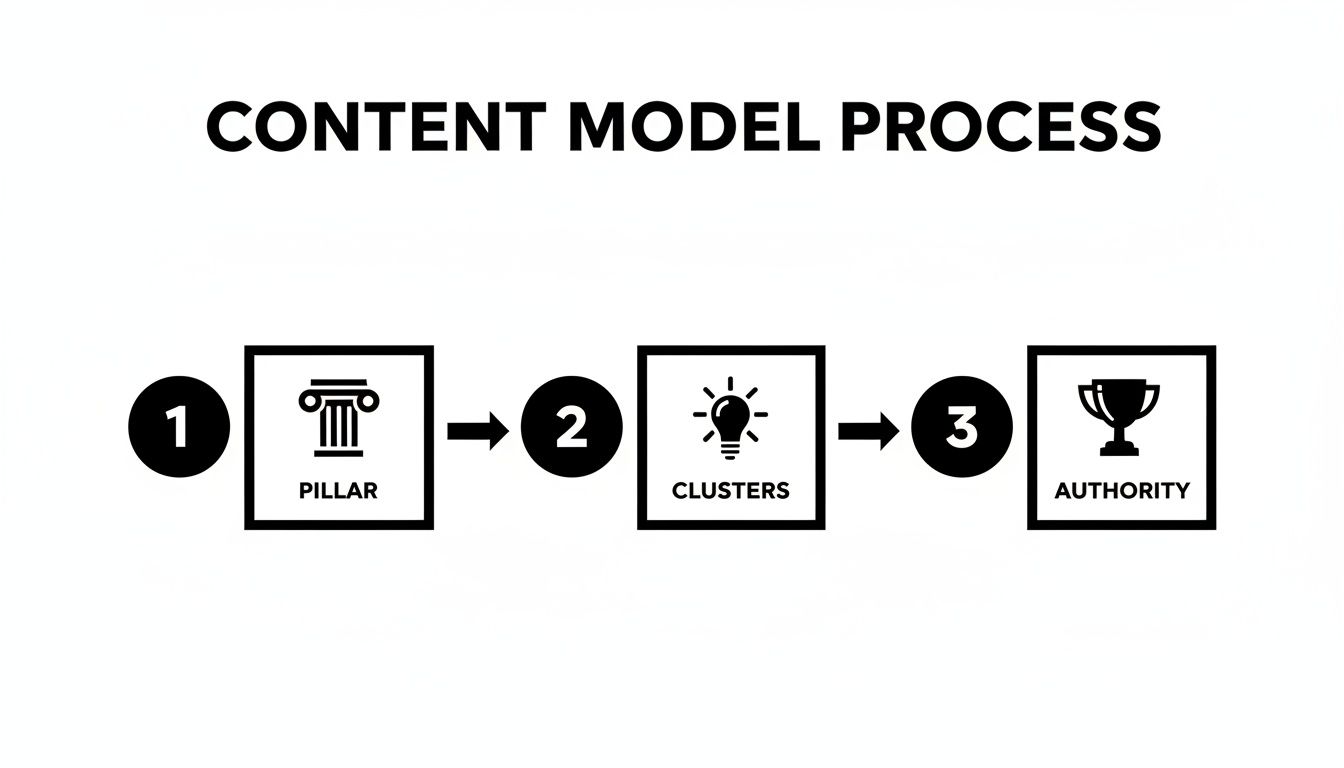
The key insight? Each cluster article isn't just a standalone post. It’s a building block that reinforces the strength of your main pillar, boosting your overall credibility and SEO juice.
For this to run smoothly, you have to define who does what. Assigning clear roles and setting realistic deadlines is the secret sauce. This prevents bottlenecks and the classic "I thought you were getting the images for that post" problem we've all experienced.
Here’s a sample workflow you can steal and tweak for your own team. I highly recommend filling this out in your content marketing strategy template to bring some much-needed order to the creative chaos.
This table breaks down a typical content creation process. Think of it as a starting point—adjust the roles and timelines to fit your team's size and speed.
Having a documented process like this means everyone knows their part, which makes the whole operation run like a well-oiled machine.
If your production workflow is the "how," your editorial calendar is the "when." A good calendar is so much more than just a list of publish dates. It’s your strategic command center, giving you a bird's-eye view of your entire content operation.
It helps you ensure a balanced mix of content formats, shows you're hitting different stages of the buyer's journey, and stops you from accidentally scheduling three posts about budgeting in the same week. (Unless that's your master plan, of course.)
At a minimum, your calendar should track:
A well-maintained editorial calendar is the ultimate cure for content creation anxiety. It lets you plan weeks or even months in advance, so you’re always ahead of the game instead of constantly reacting.
Of course, creating all this content on schedule requires efficiency. If you find your team constantly getting stuck during the writing phase, it's worth looking into systems that can help you move from outline to final draft more quickly. We’ve actually written a whole guide on how to write blog posts faster.
By mapping out your distribution and locking in a solid production workflow, you turn your strategy into a reliable, repeatable process. This is how you stop creating "random acts of content" and start building a powerful, predictable growth engine for your business.
You've built your content machine and have a solid plan for getting it out there. But here's the kicker—how do you prove any of it is actually working? This is where we connect your content directly to cash and turn your hard work from a "cost center" into a celebrated revenue driver.
It’s easy to get a rush from a post that racks up hundreds of likes, but that's a vanity metric. It feels good, but it doesn't pay the bills. The real goal is to measure the Key Performance Indicators (KPIs) that actually show how your content is impacting your business goals.
Let's be real, companies are pouring serious money into content. Worldwide content marketing revenue is projected to hit around $107.5 billion by 2026. At a company level, it's not unusual for firms to spend anywhere from $5,000 to $10,000 per month on content.
So, when you fill out your content marketing strategy template, including a section for ROI and KPIs is non-negotiable. This is a core business investment, not a side project. To see just how big this space has gotten, you can explore the full breakdown of content marketing statistics.
To track success the right way, you need to tie your KPIs to the different stages of the buyer's journey. A single metric just can't tell the whole story. Instead, think about what you want a person to do at each stage and measure that specific action.
Here’s a simple way to think about it:
Awareness Stage: The whole point here is to attract new eyeballs and introduce them to your brand. Your content should be answering their first-round questions.
Consideration Stage: Okay, they know you exist. Now, the goal is to build trust and get them to take a small step forward, like handing over their email address.
Conversion Stage: This is where the magic happens. The goal is turning an interested prospect into a lead or, even better, a customer.
The most powerful shift you can make is from measuring content performance to measuring business impact. Don't just report on pageviews; report on the leads generated from those pageviews.
Calculating the return on investment (ROI) for content can feel a bit fuzzy, I get it. But it doesn't have to be a mystery. The simplest way to start is by attributing leads to specific pieces of content. If someone downloads your ebook and then becomes a customer three months later, that ebook clearly played a crucial role in the sale.
Actionable Insight: This is where a platform like Zemith.com becomes incredibly valuable. By pulling your content performance, analytics, and customer data into one place, you can start connecting the dots automatically. You can see which articles are not just driving traffic, but are also driving the right kind of traffic—the kind that turns into paying customers. This approach is all about making smarter choices, a practice we dive into in our article on evidence-based decision making.
In your content marketing strategy template, make a simple dashboard section. List your top 3-5 KPIs for each stage of the journey. Then, figure out your baseline and set some realistic goals for improvement each quarter. This simple framework turns vague data into a clear story of progress you can share with stakeholders, proving your content isn't just noise—it's a powerful engine for growth.
It's completely normal if you still have a few things rattling around in your head. The first time you tackle a content marketing strategy template, it can feel a bit like you’re trying to assemble a puzzle with a few pieces missing.
Don't sweat it. I've got you covered. Here are the answers to some of the most common questions I hear when people are building out their strategic plans.
Your strategy isn't something you carve in stone and then forget about. It's a living document that needs to breathe and adapt. I always recommend a major, deep-dive review at least annually. This is where you zoom out and make sure everything still aligns with the company's big-picture goals for the next year.
But you can't just set it and forget it for 12 months. You need to be checking in on it much more often.
A quarterly review is perfect for making those tactical pivots. These check-ins are your chance to look at the data, see what’s working, what's a total flop, and adjust on the fly. Say a new social media platform suddenly blows up and your entire audience flocks there. Your quarterly review is the ideal time to figure out how to jump on that opportunity.
Your content strategy is your map, but the terrain is always changing. Quarterly check-ins make sure you don't steer your brand right off a cliff you never saw coming.
Our template actually makes this process pretty painless. You just revisit each section and tweak your assumptions, goals, or channels based on what your latest performance data is telling you.
This is a fantastic question, and getting the answer right is what separates the pros from the folks who are just throwing content at the wall and hoping something sticks.
Your Content Strategy is the "Why": Think of this as your high-level game plan. It’s where you define your goals, your ideal customer, your core content pillars, and how you’ll measure success. It's the North Star that guides every single content decision you make.
Your Editorial Calendar is the "What" and "When": This is where the rubber meets the road. It’s your day-to-day, tactical schedule, detailing specific blog post titles, video formats, publication dates, and which channels you're pushing them to.
Simply put, the strategy informs the calendar. A calendar without a strategy is just a random to-do list. A strategy without a calendar is a brilliant idea that never sees the light of day.
Yes! A thousand times, yes. In fact, for a small business or a solo entrepreneur, having a focused content marketing strategy template like this one is arguably more important.
When you're running on a shoestring budget with limited time and zero margin for error, every blog post and social update has to count. This template forces you to be brutally strategic, focusing only on the activities that will give you the most bang for your buck. You don't need a 50-page document; a solopreneur might have just one key persona, two content pillars, and a laser focus on a single marketing channel.
The template is designed to scale with you. It provides the essential structure that’s absolutely priceless when you’re juggling ten different jobs at once.
Ah, the million-dollar question. I wish I had a magic wand and could say "overnight," but content marketing is a long game. It's a marathon, not a sprint. While a social post might go viral and give you a quick win, the real, lasting results—the kind that come from SEO and building authority in your niche—take time.
As a general rule of thumb, you can expect to see real momentum in about 6 to 9 months. That's when you'll start noticing better organic keyword rankings and a steady, predictable climb in traffic and leads. The secret sauce is consistency. If you stick to the plan and publish high-quality stuff on a regular basis, your results will start to compound. Whatever you do, don't give up after month two!
Ready to stop guessing and start building a content engine that drives real growth? Zemith provides an all-in-one AI platform that can supercharge every step of your content strategy, from deep audience research and ideation to creation and analysis. Explore how Zemith can bring your new strategy to life at https://www.zemith.com.







Trusted by teams at






The top models, plus image, video and voice tools, in one plan.
Without Zemith
ChatGPT PlusUS$20.00Claude ProUS$20.00Google AI ProUS$19.99SuperGrokUS$30.00Perplexity ProUS$20.00 MidjourneyUS$10.00
 ElevenLabsUS$6.00Le Chat ProUS$14.99
 RunwayUS$15.00Kling StandardUS$8.80
 Gamma PlusUS$12.00
 Otter ProUS$16.99
 QuillBot PremiumUS$19.95
 Photoroom ProUS$12.99
 Quizlet PlusUS$7.99
Total if paying separatelyUS$234.70/mo
"I love the way multiple tools they integrated in one platform. Going in the right direction."
— simplyzubair
"The quality of data and sheer speed of responses is outstanding. I use this app every day."
— barefootmedicine
"The credit system is fair, models are perfect, and the discord is very responsive. Quite awesome."
— MarianZ
"Just works. Simple to use and great for working with documents. Money well spent."
— yerch82
"The organization of features is better than all the other sites — even better than ChatGPT."
— sumore
"It lives up to the all-in-one claim. All the necessary functions with a well-designed, easy UI."
— AlphaLeaf
"The team clearly puts their heart and soul into this platform. Really solid extra functionality."
— SlothMachine
"Updates made almost daily, feedback is incredibly fast. Just look at the changelogs — consistency."
— reu0691
Hand off the research, writing, design and follow-ups. Zemith picks the tools it needs and brings back finished work.
Search the web, run deep research, read files, create images and run code with GPT, Claude, Gemini, Grok and more.
Zemith keeps working in the cloud and pings you when it's done.
Notion, Linear, Canva, Airtable and more. It asks before it creates or changes anything.
Docs, slides, sheets and PDFs, ready to send.
Chain models and tools on a visual canvas, from one prompt to a finished promo video.
Briefings, reports and reminders run on a schedule and are ready when you need them.
Real-time voice that can see your camera or screen.
The best image and video models, in one studio.
Turn PDFs, links and YouTube videos into podcasts, quizzes, flashcards and mind maps.













 Podcast
 Quiz
Quiz Flashcards
 Mind map
 Infographic