


Every top model, with tools built in.
Search the web, run deep research, read files, create images and run code with GPT, Claude, Gemini, Grok and more.
Discover science-backed, practical tips for how to improve memory retention, including active recall and spaced repetition you can start today.
So, you want to figure out how to improve memory retention? Let's be real, the secret isn't some magic pill from a late-night infomercial or just hoping things stick. It's about training your brain like you'd train a muscle—with consistent, proven techniques. This means getting off the sidelines of passive reading and actually getting into the game.
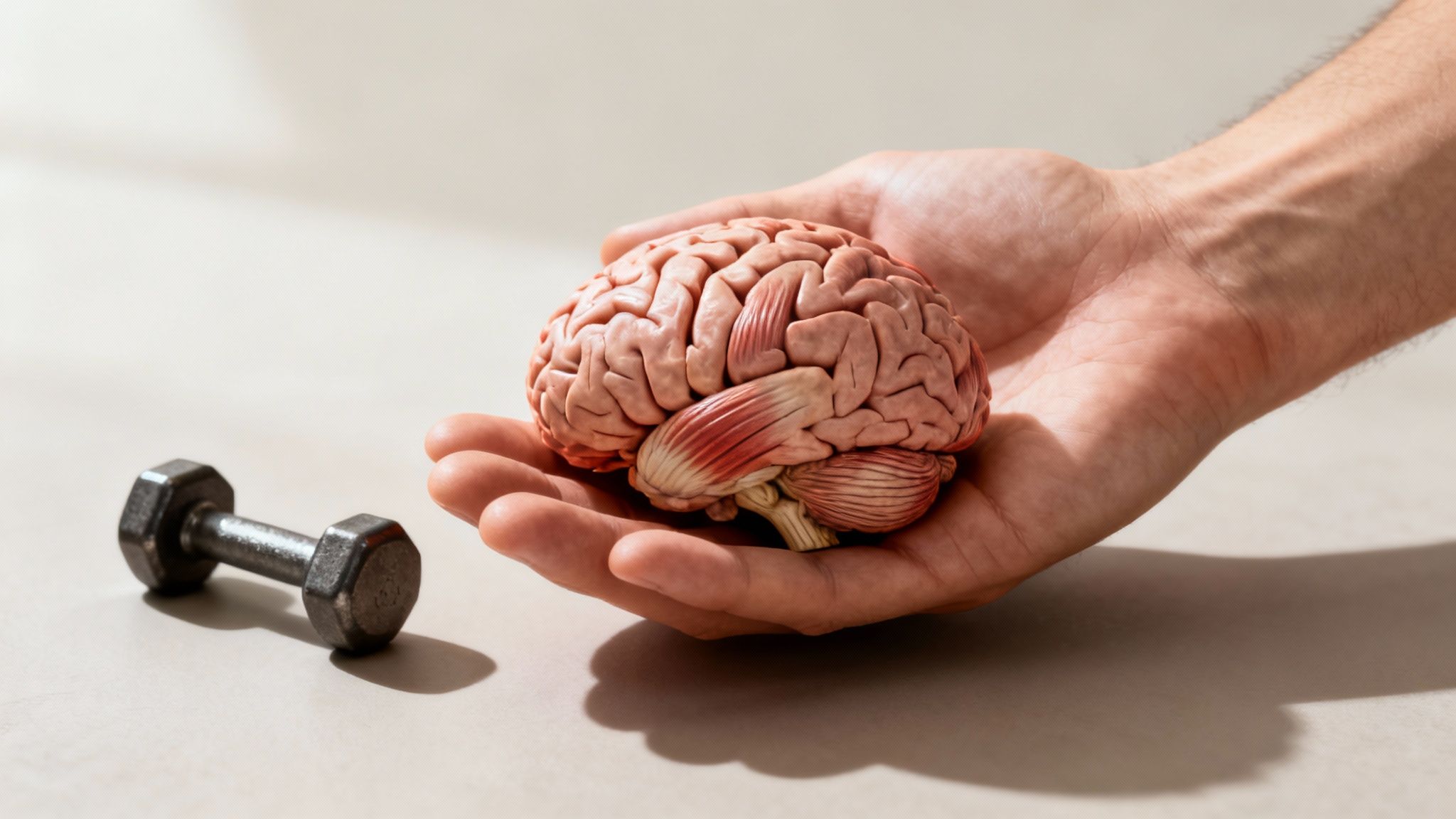
Let’s bust a myth right now. Forgetting where you put your keys doesn't mean your brain is failing (it probably just means you need more coffee). We tend to think of our memory as a big, dusty filing cabinet where information gets lost sometimes. That couldn’t be further from the truth.
A much better way to think about it is this: your brain is a muscle. And just like any other muscle, it grows stronger when you exercise it correctly. You wouldn’t just show up at the gym, stare at the weights, and expect to get stronger, would you? The same logic applies to remembering complex information.
To start improving your memory, it helps to know what’s actually happening under the hood. It’s basically a three-step process that’s always running in the background.
Here’s the key takeaway: Having a powerful memory isn’t about being born with a "good" or "bad" one. It's about getting good at the workout routine—the techniques that strengthen each of these three stages. Forgetting isn't a failure; it’s just your brain’s natural way of cleaning house.
Think of this guide as your personal trainer. We’re going to walk you through the most effective exercises for building mental muscle, like active recall and spaced repetition. But every good workout is better with the right equipment.
That's where a tool like Zemith comes in. It’s like having a high-tech home gym specifically for your brain. Instead of just reading about these memory techniques, Zemith helps you put them into practice instantly. You can generate flashcards from your notes or get a quick summary of a long document, turning theory into action with a couple of clicks.
It also helps to understand that we all learn differently. Digging into multimodal learning strategies can add another powerful layer to your mental fitness routine.
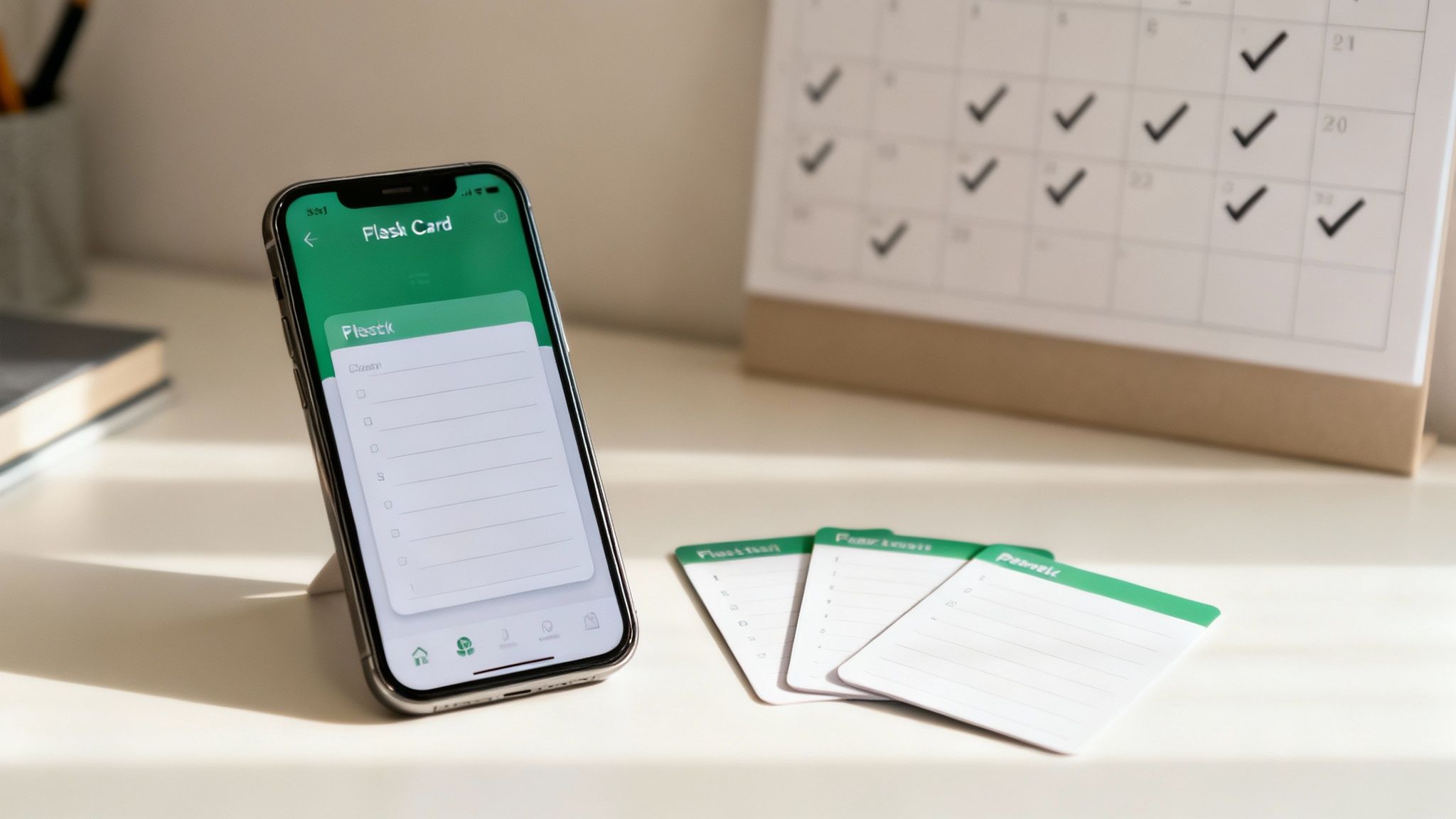
Ready for the one-two punch that memory champions swear by? If your brain is a muscle, then active recall and spaced repetition are the heavy lifting and the smart recovery schedule. Let's skip the dry, technical definitions and get right into how this powerful duo actually works to lock information in your head for the long haul.
Imagine you're trying to learn a new coding language, say Python. The old-school, passive way is to just re-read your notes over and over. Your brain goes into autopilot, nodding along thinking, "Yeah, yeah, I know this stuff." The problem is, you’re not really absorbing it—you’re just recognizing it. There's a huge difference.
Active recall flips that entire process on its head. It’s the act of pulling information out of your brain instead of passively pushing it in.
So, instead of re-reading your Python notes, you’d try to code a function from scratch, relying only on what you can remember. It’s harder, for sure, but that’s the whole point. This mental struggle is what forges strong, lasting neural pathways.
Think of it like this: Reading your notes is like watching a video of someone lifting weights. Active recall is you actually picking up the dumbbell. Which one builds muscle? Exactly.
This is where the infamous "Forgetting Curve" comes into play. Pioneered by Hermann Ebbinghaus way back in 1885, it showed that we can forget up to 90% of new information by the end of the day without any review. But here's the good news: modern studies show that truly interacting with your notes—discussing them, rewriting them, or quizzing yourself—within 24 hours can slam the brakes on that curve, restoring retention to nearly 100%.
The Big Idea: The goal isn't just to review information; it's to force your brain to retrieve it. This retrieval effort is what signals to your brain, "Hey, this is important! Don't throw it out!"
Now, active recall is powerful on its own, but when you combine it with spaced repetition, it almost feels like cheating. Spaced repetition is all about timing. Instead of cramming all your reviews into one frantic night, you strategically space them out over time.
You might test yourself on that Python function an hour after you learn it. Then again the next day. Then in three days. Then in a week. The intervals get progressively longer, which is key. This technique interrupts the forgetting process at just the right moment, reinforcing the memory each time it’s about to fade.
Here's a quick look at how these two methods stack up.
The difference in outcomes is pretty stark when you see it laid out like this. One method builds lasting knowledge, while the other is a recipe for short-term panic and long-term forgetting.
As you can see, spaced repetition isn't just more effective—it's also a much more sustainable and less stressful way to learn.
This approach is a game-changer for anything requiring deep memorization. It’s one of the cornerstones of the most effective science-backed methods for memorizing vocabulary for language learners, and it works just as well for any other subject.
Okay, this all sounds great in theory, but who has the time to manually create hundreds of flashcards and manage a complex review schedule? This is where technology becomes your best friend.
Zemith’s Document Assistant is built for this exact purpose. You can upload lecture notes, a dense article, or a textbook chapter, and it will instantly generate flashcards and quizzes for you. This completely removes the friction from practicing active recall.
Instead of spending hours just creating your study materials, you can spend that time actually learning.
This creates a seamless workflow:
It turns what used to be a chore into an effortless part of your daily routine. So, what are some long-term strategies for improving memory retention that go beyond just flashcards? Let's dive into one of the most powerful (and fun) techniques out there.
Alright, let's talk about unlocking a mental superpower that sounds like something out of a Sherlock Holmes story: the memory palace. It’s a real technique, officially known as the method of loci, and it’s way easier to get started with than you might think.
The whole idea is to hijack your brain's incredible spatial memory and use a familiar place to store and retrieve information. You’re basically turning boring, abstract facts into wild, unforgettable images that you "place" along a mental journey. Think about it—you can probably walk through your house in the dark without bumping into things. Your brain already has that blueprint locked down, so why not use it to remember other stuff?

First, you need a location. Don't get fancy here. Your own home is the absolute best place to start because you know it inside and out.
Next, you have to map out a very specific path you’ll take every single time. Consistency is everything. For example, your route could be:
Always follow the exact same path. Along this route, you’ll pick out specific spots, or loci, to store your memories. These could be the doormat, that wobbly coat rack, the big comfy sofa, the coffee table, and the kitchen sink. You get the picture.
Ready to try it? Let’s use a simple grocery list: milk, bread, avocados, eggs, and coffee. The secret here is to make the mental images as bizarre, interactive, and over-the-top as you can. Your brain ignores the normal but clings to the absurd.
Now, when you need to remember the list, you just take a mental stroll along your route. Those crazy images will pop right back into your head, bringing the grocery item with them.
This isn't just a party trick; it's incredibly powerful. A 2017 study showed that professional memory athletes could recall nearly 71 out of 72 words using techniques just like this one. Even better, after just six weeks of training, regular folks were able to perform at the same level. You can read more about how memory training bulks up the brain and see the science for yourself.
The more senses you can pull in—smell, touch, sound, even taste—the more vivid and "sticky" the memory will be. Don't just see the image; really try to experience the absurdity.
Once you nail a simple list, you can use this for almost anything—key points for a presentation, a string of historical dates, or complex scientific formulas. For even more creative ways to build these mental hooks, you could explore something like a mnemonic maker with letters to add another tool to your memory arsenal.
When you start working with more complex topics, it helps to have a way to keep things straight. Zemith's Whiteboard is perfect for this. You can actually draw out the floor plan of your palace, drop text boxes at each location, and even paste in images to help cement those bizarre scenes in your mind. It makes the whole process feel more concrete and gives you a visual map for your mental journeys.
Learning techniques like active recall and memory palaces are incredible tools. But they’re only half the battle. Think of them as high-performance software for your brain. If the hardware—your brain itself—is sluggish from poor sleep, bad food, or sitting around all day, even the best software won't run well.
Let's get into the non-negotiable habits that create the optimal conditions for your brain to learn, remember, and perform at its best.
Sleep isn't downtime for your brain. It's when the real memory magic happens. While you're asleep, your brain is working hard to consolidate everything you learned that day. It replays important neural patterns, strengthens connections, and moves information from your flimsy short-term memory into more permanent long-term storage.
When you cut sleep short, you’re hitting the “cancel” button on that critical transfer. The files never get saved properly. Making 7-9 hours of quality sleep a priority is one of the single most powerful things you can do for your memory.
Your brain is a hungry organ, and it’s picky about its fuel. A balanced diet is always a good starting point, but some foods are like rocket fuel for your neurons.
Here’s a simple rule I live by: What's good for your heart is great for your brain. Cutting back on processed junk and sugar isn't just about physical health; it's a direct investment in your mental clarity.
We all know exercise is good for us. But here’s a pro tip that directly ties into memory: exercise after you study. It turns out even a little physical activity can give your brain a massive boost in locking down new information.
Research shows that exercising after a learning session can improve memory consolidation by up to 20-30%. We're not talking about a marathon here—even just 5 minutes makes a difference. One study found that people who exercised right after learning a list of words remembered way more the next day compared to those who just sat still. Why? Exercise releases chemicals that tell your brain, "Hey, that stuff you just learned? That’s important. Keep it." You can read more about how our brains react to these boosts in this fascinating research.
This is a perfect opportunity to build a smarter routine with a tool like Zemith. You can set a dedicated study session with the Focus OS, then schedule a quick, active break right after. On your break, you could go for a walk and use Zemith's mobile app to flip through some flashcards you made earlier. You're stacking active recall on top of the memory-enhancing effects of exercise—that’s a seriously powerful combo. We cover more smart study habits in our guide on how to study for exams effectively.
All the theory in the world is useless if you don't know how to apply it. So, let’s get practical and walk through a real-world scenario to see how you can put these memory-boosting techniques to work.
Imagine you're a student prepping for a big paper on the American Revolution. You're swimming in a sea of dense articles, critical dates, and important names. Here’s how you can take that chaotic pile of information and actually remember it, turning passive reading into something much more powerful.
The first step is always gathering your materials. Instead of letting your browser tabs multiply into oblivion (we've all been there), you can use a feature like Zemith’s Deep Research to pull relevant academic papers and articles directly into your Library. Now everything is organized in one spot.
Once your documents are uploaded, the real magic begins. Pick a dense article and let the Document Assistant do the heavy lifting. It can give you an instant summary, highlight the key takeaways, and—this is the best part—create a full deck of flashcards from the text. This is active recall on easy mode.
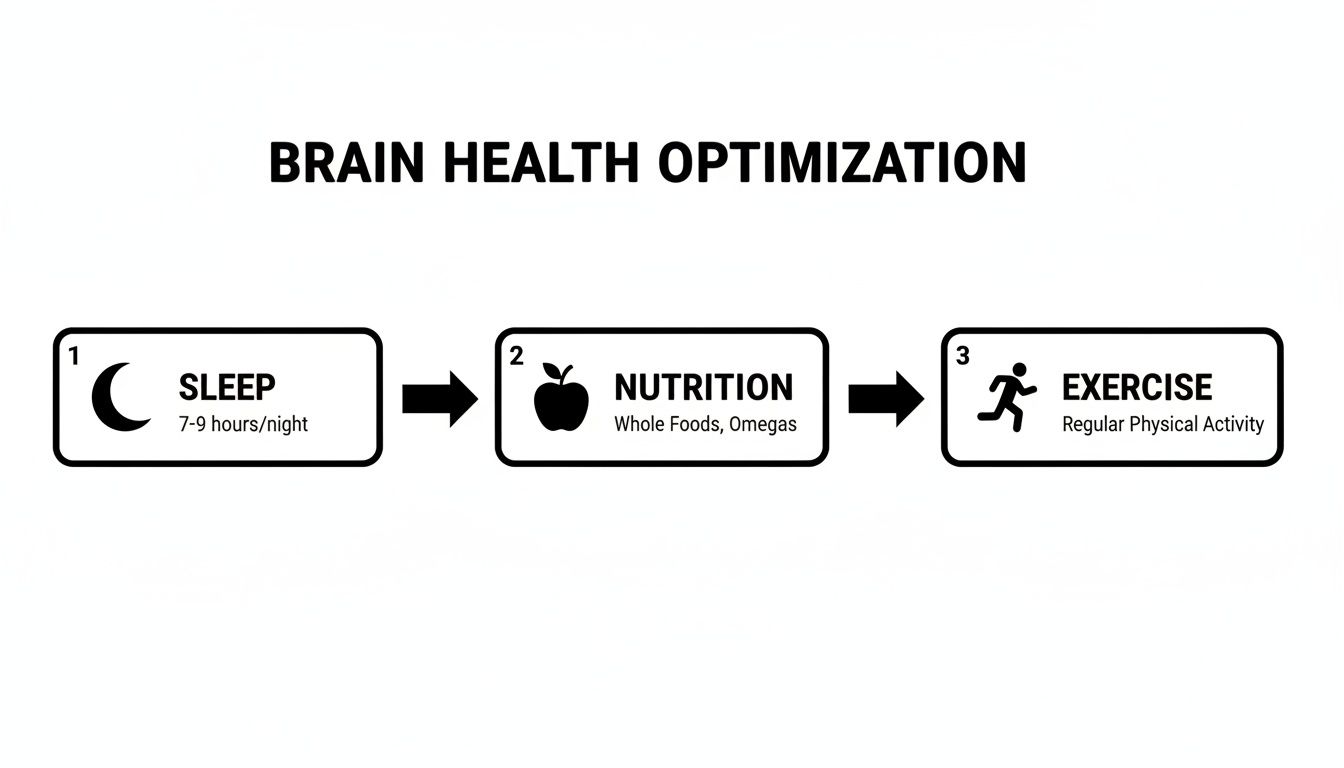
Remember, these study techniques work best when your brain is ready to learn. Solid sleep, good nutrition, and a bit of exercise are the foundation for everything else.
With your materials ready, it's time to build a study plan. Trying to remember the sequence of major battles? Use the Smart Notepad to sketch out a quick memory palace. If you want to dive deeper into why this works so well, there are some great guides on proven techniques for information retention that fit perfectly into this workflow.
Next up, schedule your study blocks with the Focus OS. This isn't about one marathon, caffeine-fueled cram session. The goal is to set focused periods with short, strategic breaks in between.
The real secret is what you do during those breaks. Instead of mindlessly scrolling social media, pull up the Zemith mobile app and flip through those flashcards you just made. This small action combines spaced repetition with your focused work, reinforcing the information a little bit at a time.
This approach transforms studying from a chore into a smart, strategic process. For more tips on making your flashcards as effective as possible, you'll find plenty of ideas on how to improve your memory retention for exams in our other posts.
Diving into new memory techniques can feel a bit like learning a new sport. You know what you're supposed to do, but putting it all together can be tricky. Let's walk through some of the most common questions and roadblocks people hit along the way.
This is always the first question, isn't it? The great news is that some wins happen almost instantly. The moment you start using active recall—say, by quizzing yourself on a chapter you just read—you're immediately strengthening those short-term connections.
But for the deep, lasting changes that come from habits like spaced repetition, it's more like hitting the gym. You won't look like a bodybuilder after one session. If you stay consistent, spending even just 20-30 minutes a day, you’ll likely feel a real, noticeable shift within 4-6 weeks.
A thousand times, yes. Your brain has this amazing ability called neuroplasticity, which is just a fancy way of saying it can build new pathways and connections at any age. That ability doesn't just switch off after a certain birthday.
It’s true that it might take a little more conscious effort to build the habit, but techniques like the method of loci can be incredibly powerful for older adults wanting to keep their minds sharp. In fact, tackling new mental puzzles is one of the best things you can do for long-term brain health.
The single most important thing is realizing it's never too late to start. A consistent routine and a belief that you can improve are your best assets, regardless of your age.
Yes! And this is where it gets fun. You don't need to be a creative genius to build a memory palace. The goal isn't to create a beautiful, coherent mental art gallery. The goal is to create images so weird, exaggerated, and ridiculous that they become impossible to forget.
Think less "art" and more "absurd." Don't just place a carton of milk on your mental couch. Instead, picture a giant cow doing a backflip onto your couch, splashing milk everywhere. It’s the shock and silliness that makes the memory stick, not how pretty it looks in your head.
The research on this is a slam dunk: short, focused bursts are dramatically more effective. This approach, famously known as the Pomodoro Technique (work for 25 minutes, break for 5), is your best friend for avoiding mental fatigue.
It keeps your brain fresh and your focus sharp. Plus, it works hand-in-glove with spaced repetition. You can use one study burst to learn something new and the next one to review what you learned yesterday. It’s a sustainable, powerful strategy for building long-term knowledge, unlike a brutal all-night cram session that you'll forget by the next afternoon.
Ready to put all this science into practice without the hassle? Zemith is built to be your memory co-pilot. You can instantly generate flashcards with the Document Assistant or map out a memory palace on the Whiteboard. It's time to stop juggling different tools and start building a better memory.
Explore all the Zemith features and see how it works.






Trusted by teams at






The top models, plus image, video and voice tools, in one plan.
Without Zemith
ChatGPT PlusUS$20.00Claude ProUS$20.00Google AI ProUS$19.99SuperGrokUS$30.00Perplexity ProUS$20.00 MidjourneyUS$10.00
 ElevenLabsUS$6.00Le Chat ProUS$14.99
 RunwayUS$15.00Kling StandardUS$8.80
 Gamma PlusUS$12.00
 Otter ProUS$16.99
 QuillBot PremiumUS$19.95
 Photoroom ProUS$12.99
 Quizlet PlusUS$7.99
Total if paying separatelyUS$234.70/mo
"I love the way multiple tools they integrated in one platform. Going in the right direction."
— simplyzubair
"The quality of data and sheer speed of responses is outstanding. I use this app every day."
— barefootmedicine
"The credit system is fair, models are perfect, and the discord is very responsive. Quite awesome."
— MarianZ
"Just works. Simple to use and great for working with documents. Money well spent."
— yerch82
"The organization of features is better than all the other sites — even better than ChatGPT."
— sumore
"It lives up to the all-in-one claim. All the necessary functions with a well-designed, easy UI."
— AlphaLeaf
"The team clearly puts their heart and soul into this platform. Really solid extra functionality."
— SlothMachine
"Updates made almost daily, feedback is incredibly fast. Just look at the changelogs — consistency."
— reu0691
Hand off the research, writing, design and follow-ups. Zemith picks the tools it needs and brings back finished work.
Search the web, run deep research, read files, create images and run code with GPT, Claude, Gemini, Grok and more.
Zemith keeps working in the cloud and pings you when it's done.
Notion, Linear, Canva, Airtable and more. It asks before it creates or changes anything.
Docs, slides, sheets and PDFs, ready to send.
Chain models and tools on a visual canvas, from one prompt to a finished promo video.
Briefings, reports and reminders run on a schedule and are ready when you need them.
Real-time voice that can see your camera or screen.
The best image and video models, in one studio.
Turn PDFs, links and YouTube videos into podcasts, quizzes, flashcards and mind maps.










 Podcast
 Quiz
Quiz Flashcards
 Mind map
 Infographic