


Every top model, with tools built in.
Search the web, run deep research, read files, create images and run code with GPT, Claude, Gemini, Grok and more.
Learn how to write thesis statement that's sharp, debatable, and guides your paper with actionable tips and real examples.
Think of your thesis statement as the GPS for your entire paper, not just a vague suggestion of where you're going. It's that one critical sentence that tells your reader, "Here's my point, and here's exactly how I'm going to prove it." Sound important? That's because it is.
Honestly, the term "thesis statement" can sound a little stuffy and academic. But get past the formal name, and you'll find it's the most powerful tool in your writing arsenal. It's the difference between a paper that wanders aimlessly and one that makes a beeline for its destination, convincing everyone along the way.
Too many writers make the classic mistake of announcing their topic instead of arguing a point. A statement like, "This paper is about Shakespeare's sonnets," doesn't give the reader a destination. It's like saying, "I'm going to the store," but not mentioning what you're buying or why. A real thesis makes a bold, specific promise that you'll spend the rest of the paper backing up with evidence.
A weak or non-existent thesis is a recipe for a rambling, unfocused paper. Without that clear destination, your paragraphs will meander, and your reader will get hopelessly lost (and probably bored). A strong thesis, however, is the foundation for an argument that actually lands with impact.
It’s the difference between a forgettable book report and a truly persuasive analysis.
Here's why it matters so much:
This isn't just a hunch. A huge 2007 meta-analysis showed that students who got direct instruction on planning and setting goals—which is exactly what thesis creation is—produced writing of a significantly higher quality. Mastering this one sentence gives you a proven edge.
Let's look at some real-world examples to see the difference between a simple announcement and a powerful, arguable thesis. The first just states a fact; the second takes a stand.
See the difference? The weak statements are just facts. You can't argue with them. The strong ones, on the other hand, take a debatable position that must be proven with evidence and analysis.
Brainstorming your way to that final, polished thesis can feel like a real slog. This is where a tool like Zemith’s Smart Notepad can be a lifesaver. You can dump all your messy, half-formed ideas in one place and use its AI features to help you refine them into a sharp, arguable claim. When you're trying to figure out how to organize research notes, having that central thesis as your guide makes everything fall into place.
Think of it this way: your thesis is the roadmap for your reader, much like how a good executive summary guides a busy decision-maker. If you want to dive deeper into crafting punchy, clear introductions, exploring some strategies for writing executive summaries can offer some surprisingly relevant insights. It’s all about setting expectations right from the very beginning.
Ready to cook up a thesis statement that actually grabs your reader's attention? Forget the complicated formulas. You really only need three core ingredients: a specific topic, a debatable claim, and a hint of the roadmap ahead. Think of it as a recipe for a compelling argument.
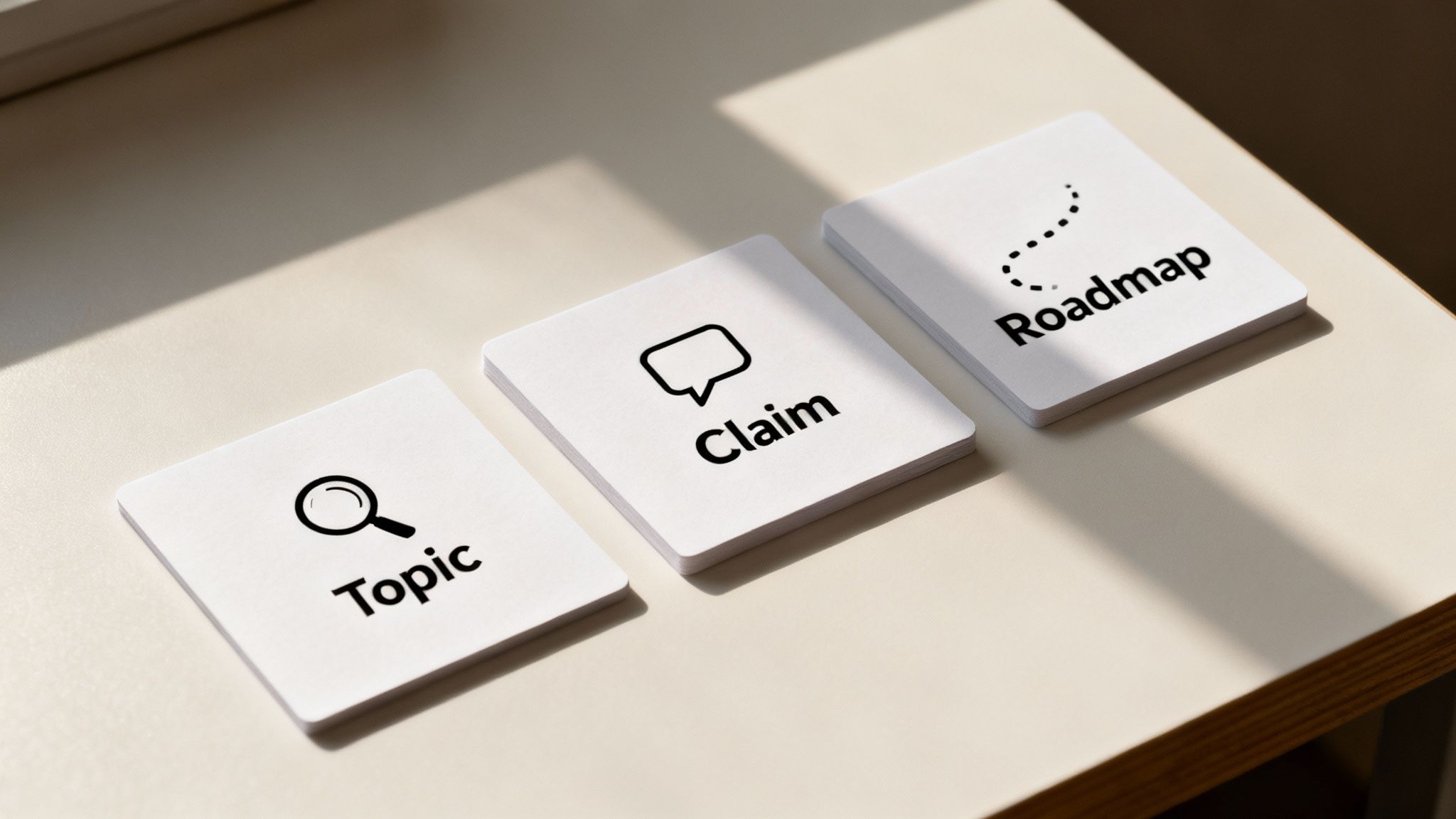
Let's break down each component so you know exactly what you're working with.
First things first, you need a topic that’s focused enough to manage. A broad subject like "social media" is a sprawling, unwieldy beast. You could write a dozen books on it and still barely scratch the surface.
The trick is to zoom in. Think of it like using a microscope. Instead of "social media," you might narrow your focus to "the impact of Instagram's algorithm on small business visibility." Now that is a topic you can actually tackle in a single paper.
Here's where the magic really happens. Your thesis can't just be a fact; it has to be an arguable claim. A statement like "Instagram uses an algorithm" is true, but it's also a dead end. There’s nothing to discuss or prove. It’s like saying, “The sky is blue.” Thanks, Captain Obvious.
A debatable claim, on the other hand, takes a stand that someone could reasonably challenge. It invites conversation and, more importantly, requires you to back it up with evidence. This is what turns a boring report into a persuasive argument.
A powerful thesis makes a claim that isn’t self-evident. It presents a perspective that needs defending, turning your paper into a compelling case rather than a simple list of facts.
Let’s turn our boring fact into a spicy, arguable claim:
See the difference? The second one has a point of view. It’s a stance you can build an entire paper around, full of evidence and analysis.
Finally, the best thesis statements give your reader a little sneak peek of the "how" or "why." This part acts as a mini-outline, showing them the structure of your argument. It’s the roadmap that tells them which turns you’ll be making.
Let’s add a roadmap to our claim:
The bolded parts are the main points you’ll explore in your body paragraphs. Your reader now knows exactly what to expect.
Brainstorming these three ingredients can be tricky. This is a perfect time to use a tool like Zemith's Smart Notepad. You can jot down your broad topic, then use its AI features to generate specific angles and refine bland facts into compelling, debatable claims until you find one that truly shines.
Every great thesis starts out as a messy, half-formed thought. Let's be real—nobody's first draft is a work of genius. The magic happens when you start refining that initial spark, polishing it until it becomes a sharp, arguable statement that can actually carry an entire paper.
This is where we get our hands dirty. I'm going to walk you through some of the most common thesis traps I've seen over the years and show you exactly how to climb out of them.
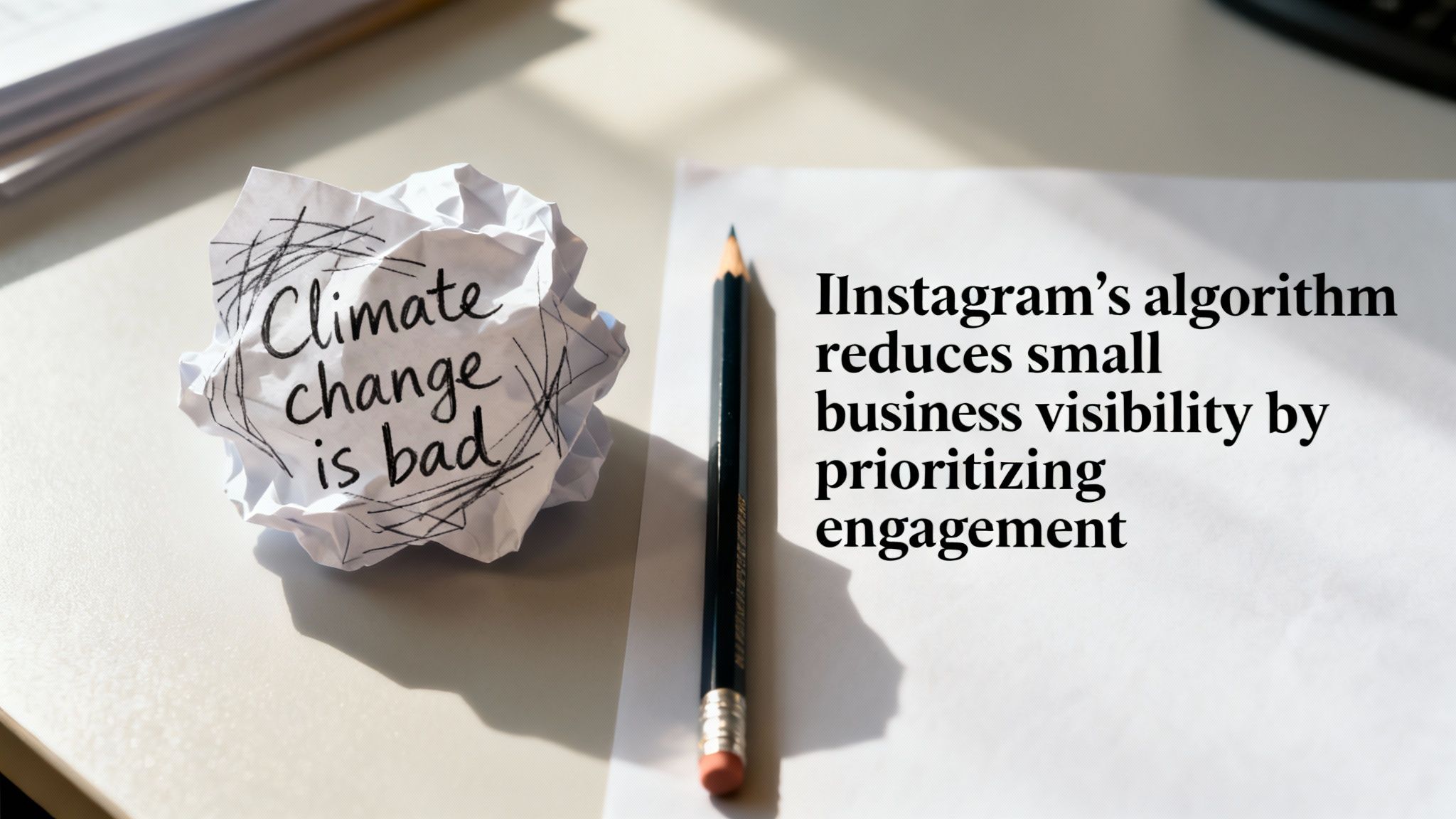
By far, the biggest mistake is starting way too broad. A statement like "Climate change is bad" might be true, but it’s completely unarguable. It's a dead end. Even a slightly better version, like "The earth is getting warmer," is just a fact. You can’t build an interesting argument on something everyone already agrees with.
Your goal is to land on a claim that someone could reasonably disagree with. That's where the good stuff is.
To get there, you need to ask a couple of simple but incredibly powerful questions about your initial idea:
Let's see this transformation in action with an example.
Before: "Social media has an effect on teenagers' mental health." Okay, that's a statement of fact. It's too broad and doesn't offer a specific point of view.
After: "While often viewed as a source of anxiety, platforms like TikTok and Instagram provide essential social support for marginalized teens, significantly reducing feelings of isolation by fostering niche communities that are unavailable offline." Now we're talking. This is a real argument. It takes a specific stance, brings in some nuance, and gives you a clear roadmap for the rest of your paper. The stronger your thesis, the easier your entire writing process becomes. Each paragraph will have a purpose. Speaking of which, our guide on how to write better paragraphs shows how to make sure every single one supports this central claim.
It turns out, making that jump from a simple topic to a truly arguable claim is a major hurdle. One study found that while 61% of first-year college students could spot a thesis in someone else's writing, a mere 28% could actually write a focused, arguable one themselves.
As the folks at Indiana University point out, a topic like "sugar consumption" isn't a thesis at all. It only becomes one when you refine it into a specific, debatable claim about what should be done about it. They have a great example of a revised thesis on their site that's worth checking out.
The journey from a vague idea to a sharp thesis is all about adding layers of specificity and perspective. You're not just stating a topic; you're entering a conversation with a clear, defensible point of view.
Stuck staring at a blank page, trying to make that leap? This is where technology can be a massive help. Instead of banging your head against the wall, you can use a tool like Zemith's Document Assistant. Just feed it your vague idea—something like "remote work is different now"—and ask it to generate ten more specific, arguable versions. What used to be a frustrating roadblock can now be a quick brainstorming session, giving you a whole list of strong potential claims to start with.
You’ve finally done it. You wrestled with your ideas, sharpened your claim, and hammered out a thesis statement you're proud of. So… now what?
While burying it on page five might seem like a fun scavenger hunt for your professor, they probably won’t be amused. Trust me. There’s a universally recognized sweet spot for your thesis that makes your entire paper stronger and clearer from the get-go.
That prime real estate is the last sentence of your introductory paragraph.
Placing it right there works wonders. It wraps up your intro beautifully, tells the reader exactly what to expect, and gives them a solid anchor to return to as they read through your arguments. Think of it as the destination you plug into your GPS before you start driving.
So, why is this specific spot so effective? It’s all about creating a logical roadmap for your reader. The job of your introduction is to hook them, give a little background, and then funnel everything down to your core argument. Your thesis is the perfect climax to that setup.
This structure immediately signals how your paper will be organized. The thesis states the topic, and its controlling idea points to the direction your argument will take. According to the writing experts at the University of Maryland Global Campus, this isn't just a stylistic preference—it’s a powerful tool for clarity.
This is a well-established practice for a reason. Purdue University's OWL, one of the most trusted writing resources out there, explicitly advises that a thesis statement usually appears at the end of the first paragraph. This simple placement makes your argument easy to find, understand, and follow.
Is this rule set in stone? Not exactly, but you should only break it with extreme caution and a very good reason.
In certain types of writing, like journalism or a narrative essay, an author might hold back the thesis for dramatic effect, building suspense before the big reveal. For most academic papers, however, straying from this convention just ends up confusing your reader and weakening the impact of your argument before it even begins.
Here are a few rare exceptions where you might see the thesis moved:
For the vast majority of academic work, sticking to the end-of-the-intro rule is your safest and most effective bet. It shows you're confident and clear about your argument right from the start.
If you’re ever second-guessing your paper's structure, Zemith's Document Assistant can act as your personal structural engineer. It analyzes your draft to see if your thesis is well-placed and clearly articulated, making sure your foundation is solid before you build the rest of your paper on it. Be sure to check out our other research paper writing tips to make every part of your paper just as strong.
Alright, let's talk about the classic blunders we all make when writing a thesis statement. Seriously, everyone's been there. Spotting these common pitfalls is the quickest way to get better, transforming a shaky argument into something that really stands its ground.
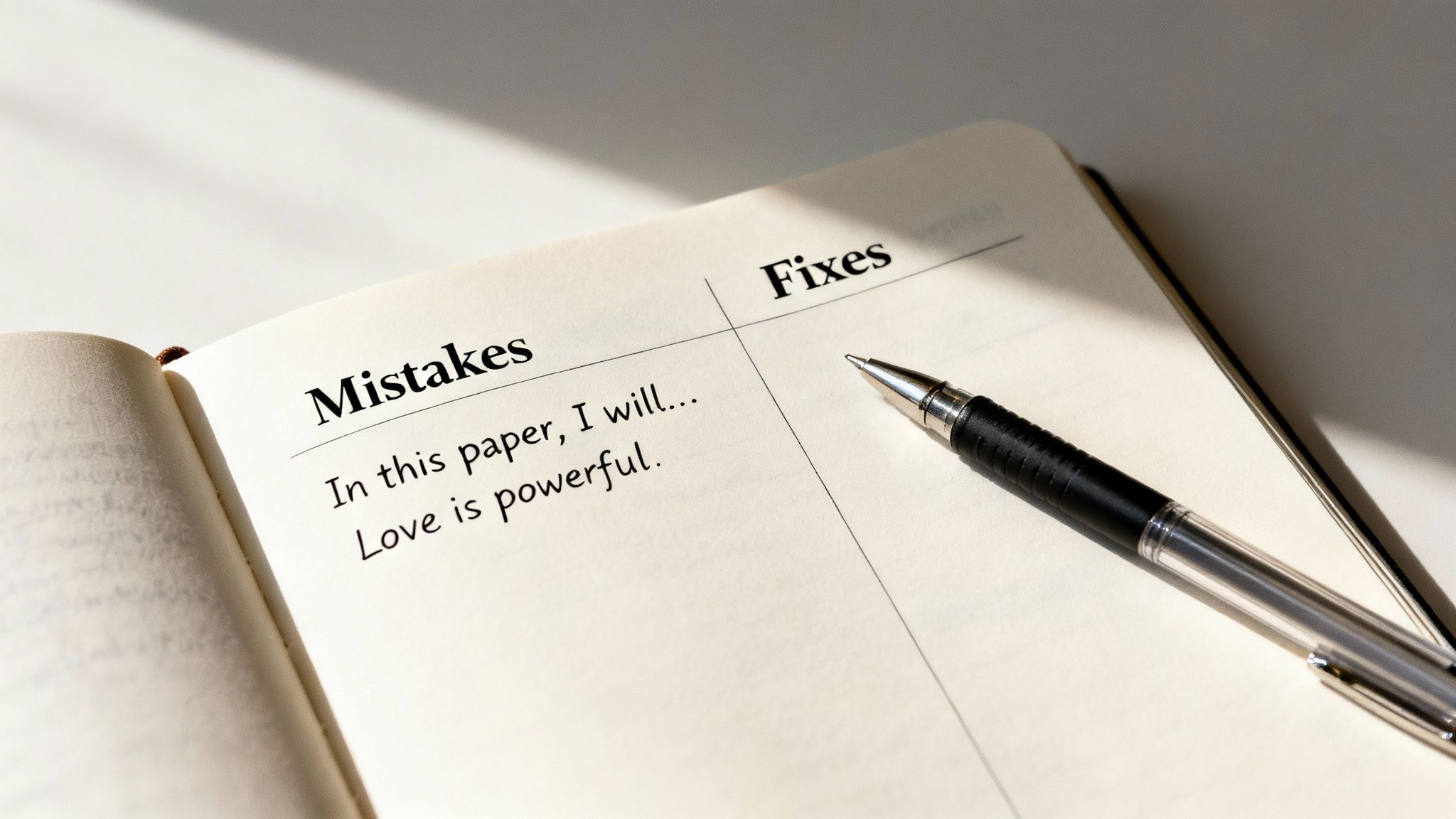
First up, we have "The Big Announcement." This is when your thesis sounds like a stuffy emcee telling the audience what's coming next. It's a dead giveaway of a first draft.
See the difference? The new version doesn't just talk about the topic; it makes a specific, debatable claim about why it's happening.
Next on the list is the "Vague Platitude." This kind of thesis is a broad, feel-good statement that everyone agrees with but says absolutely nothing. Think of it as the greeting card of thesis statements.
A strong thesis avoids universal truths. Instead, it dives into a specific, contestable interpretation. It’s your unique angle, not something everyone already knows.
Getting good at spotting these mistakes in your own drafts is a massive step forward. Once you can see the weak spots, fixing them becomes second nature. If you're looking for more ways to tighten up your prose, our guide on how to edit writing has some great strategies.
This is also where a tool like Zemith can feel like having a writing coach over your shoulder. Its rephrasing suggestions are brilliant at catching that passive, "announcement" language and offering stronger, more assertive alternatives. It helps you catch these common slip-ups before they have a chance to weaken your argument.
Still have a few questions rattling around in your head? Good. That means you’re really thinking this through. Let's clear up some of the most common hangups people run into when they’re figuring out how to nail a thesis statement.
In a word: no. A thesis statement has to be a declarative sentence that takes a stance. You can definitely use a question to hook your reader in the intro, but the thesis itself needs to be the answer to that question.
Keep it punchy. The sweet spot is almost always one single, focused sentence. On rare occasions, a really complex paper might need two, but that’s the exception, not the rule. If you find yourself writing a whole paragraph, you haven't boiled your argument down to its core yet.
Think of it as the elevator pitch for your entire paper. You get one shot to land your point.
Your thesis is your paper's foundation. A single, solid sentence creates a much stronger base than a wobbly, multi-sentence explanation. It forces you—and your reader—to focus on what truly matters.
Not only is it okay, but you absolutely should. A thesis isn't set in stone. It’s a living part of your writing process. As you dig deeper into your research, you’ll find new evidence, and your perspective will naturally shift and sharpen.
Consider your first attempt a "working thesis." It's just a starting point to get your research engine running. This back-and-forth is also a huge part of figuring out how to write a literature review, because what you learn from other scholars will directly shape the argument you decide to make.
This is the big one, and it trips a lot of people up. A topic is just a general area of interest. A thesis is your specific, arguable point about that topic.
See the difference? The topic is the "what." The thesis is the "so what?"
Feeling like you're drowning in research notes trying to find that perfect thesis? The Zemith AI platform is built to be your academic sidekick. Let the Document Assistant summarize your sources, then use the Smart Notepad to brainstorm, draft, and polish your thesis until it’s sharp, debatable, and ready to anchor your paper. Check out Zemith today and start turning those rough ideas into powerful arguments.







Trusted by teams at






The top models, plus image, video and voice tools, in one plan.
Without Zemith
ChatGPT PlusUS$20.00Claude ProUS$20.00Google AI ProUS$19.99SuperGrokUS$30.00Perplexity ProUS$20.00 MidjourneyUS$10.00
 ElevenLabsUS$6.00Le Chat ProUS$14.99
 RunwayUS$15.00Kling StandardUS$8.80
 Gamma PlusUS$12.00
 Otter ProUS$16.99
 QuillBot PremiumUS$19.95
 Photoroom ProUS$12.99
 Quizlet PlusUS$7.99
Total if paying separatelyUS$234.70/mo
"I love the way multiple tools they integrated in one platform. Going in the right direction."
— simplyzubair
"The quality of data and sheer speed of responses is outstanding. I use this app every day."
— barefootmedicine
"The credit system is fair, models are perfect, and the discord is very responsive. Quite awesome."
— MarianZ
"Just works. Simple to use and great for working with documents. Money well spent."
— yerch82
"The organization of features is better than all the other sites — even better than ChatGPT."
— sumore
"It lives up to the all-in-one claim. All the necessary functions with a well-designed, easy UI."
— AlphaLeaf
"The team clearly puts their heart and soul into this platform. Really solid extra functionality."
— SlothMachine
"Updates made almost daily, feedback is incredibly fast. Just look at the changelogs — consistency."
— reu0691
Hand off the research, writing, design and follow-ups. Zemith picks the tools it needs and brings back finished work.
Search the web, run deep research, read files, create images and run code with GPT, Claude, Gemini, Grok and more.
Zemith keeps working in the cloud and pings you when it's done.
Notion, Linear, Canva, Airtable and more. It asks before it creates or changes anything.
Docs, slides, sheets and PDFs, ready to send.
Chain models and tools on a visual canvas, from one prompt to a finished promo video.
Briefings, reports and reminders run on a schedule and are ready when you need them.
Real-time voice that can see your camera or screen.
The best image and video models, in one studio.
Turn PDFs, links and YouTube videos into podcasts, quizzes, flashcards and mind maps.











 Podcast
 Quiz
Quiz Flashcards
 Mind map
 Infographic