IT Staffing Miami: The Local Guide for 2026
A practical 2026 guide to IT staffing Miami — agencies, pricing, salaries, legal checks, and smart hiring moves for engineering leaders.
You're probably staring at two tabs right now, one with a half-decent candidate, one with a staffing vendor pitch that sounds polished and says almost nothing. The role is urgent, the hiring manager wants someone “senior but affordable,” and every agency swears they know Miami. They all do, until you ask for the license number, the bill rate, and the last time they filled a role in Brickell without hand-waving.
IT Staffing Miami in 2026 is not a directory exercise. It's a buying decision with real trade-offs, and the cheapest pitch usually turns into the most expensive mistake. If you're hiring in Miami, you need to know where the talent is, what it costs, how Florida's rules work, and which model fits the seat you're trying to fill.
Table of Contents
- Why IT Staffing in Miami Feels Different in 2026
- The Miami IT Staffing Market by the Numbers
- Choosing Between Contract, Contract-to-Hire, Direct Hire, and Managed Services
- How to Evaluate and Vet a Miami IT Staffing Partner
- How TekRecruiter Can Help
- Miami IT Salary Benchmarks and What They Mean for Your Requisition
- Interviewing, Onboarding, and Retaining IT Talent in Miami
- How to Build a Staffing Plan That Actually Works in Miami
- Miami IT Staffing FAQ, Local Resources, and Common Mistakes
[blocked]
Why IT Staffing in Miami Feels Different in 2026
A Brickell fintech needs two Python engineers in 30 days. A Wynwood startup just lost its DevOps lead to a remote-first Austin company that can pay more and still call the arrangement “local-ish.” That is the Miami market in plain English, and it is why generic staffing advice falls apart fast.
[blocked]
The local pool is real, but it is not deep enough for lazy hiring
Miami has a sizeable and still expanding staffing ecosystem. A September 2026 industry database identified 263 IT staffing firms headquartered in Miami, while the local tech labor market showed more than 1,000 IT jobs listed in Miami and 300+ IT jobs on a major job board around the same time Miami job-market analysis. That tells you two things. There are plenty of vendors. There are plenty of buyers too, which is why the best candidates get crowded quickly.
The labor base is not thin either. A 2024 Miami Tech Works gap analysis estimated 31,872 jobs for software and web developers, programmers, and testers in the region, plus 16,764 computer support specialists, 10,480 computer and information analysts, and 10,223 database and network administrators and architects Miami Tech Works gap analysis. The same report projected around 2,700 openings for software and web developers, programmers, and testers, the highest projected opening count in the analysis. That is not a niche market. It is a broad technical hiring machine.
[blocked]
Remote offers changed candidate behavior
Miami candidates do not compare your offer only to local employers anymore. They compare it to remote jobs from Austin, New York, and everywhere else that can hire in Florida without asking them to sit in traffic on I-95. A staffing pitch built around “Miami market familiarity” is incomplete unless it also explains how the candidate will be won against outside offers.
Practical rule: if a vendor cannot explain why a strong candidate would accept your offer instead of a remote one, they are not recruiting, they are forwarding résumés.
The smarter buyer also checks how fast the market is being screened and sourced. AI tools can help with market research and recruiter workflow, but only if you use them to pressure-test claims instead of dressing up bad process. Start with AI tools for recruiting and research, then compare what the tool surfaces against what the vendor is promising. Miami staffing rewards the buyer who asks for proof, not the one who buys the pitch.
[blocked]
The Miami IT Staffing Market by the Numbers
A Miami hiring manager who ignores the numbers usually ends up paying for it twice, once in a slow search and again in a weak hire. The market here runs hot because demand is broad, supply is uneven, and vendor quality varies a lot. That is the story buyers should care about.
[blocked]
Demand is broad, and the market is still absorbing it
Independent labor-market data cited in a Miami tech workforce analysis showed the region's Information supersector at 51.4 thousand jobs in July 2026, down 1.5326% year over year, while Professional and Business Services reached 531.1 thousand jobs and grew 0.5490% year over year Miami job-market analysis. That matters because IT hiring in Miami sits inside a larger professional-services economy, not in a neat little tech silo. It also explains why firms staffing enterprise IT, consulting work, internal product teams, and support roles keep competing for the same pool.
Local unemployment also stays tight. A Miami job-market report citing BLS data said the metro unemployment rate was 3.2% in February 2026, down from 3.5% a year earlier and below the national average of 4.1% Miami job-market report. Low unemployment does not guarantee quality, but it does punish slow screening and sloppy scheduling. If your process drags, candidates disappear.
[blocked]
The market has enough vendors, but not all are truly local
Miami has plenty of staffing firms, and plenty of them brand themselves as local while routing the work somewhere else. Buyers should check who is on the ground. That matters when the role needs bilingual communication, compliance awareness, or client-facing people who understand Brickell, Coral Gables, Doral, and the wider Miami-Dade market.
The practical takeaway is simple. Mid-level technical roles should move quickly if your process is clean. Architects and specialized engineers take longer because the local supply is not endless, and the best candidates already have options. If a vendor prices every requisition as if Miami had one standard rate, they are selling convenience, not judgment.
[blocked]
Choosing Between Contract, Contract-to-Hire, Direct Hire, and Managed Services
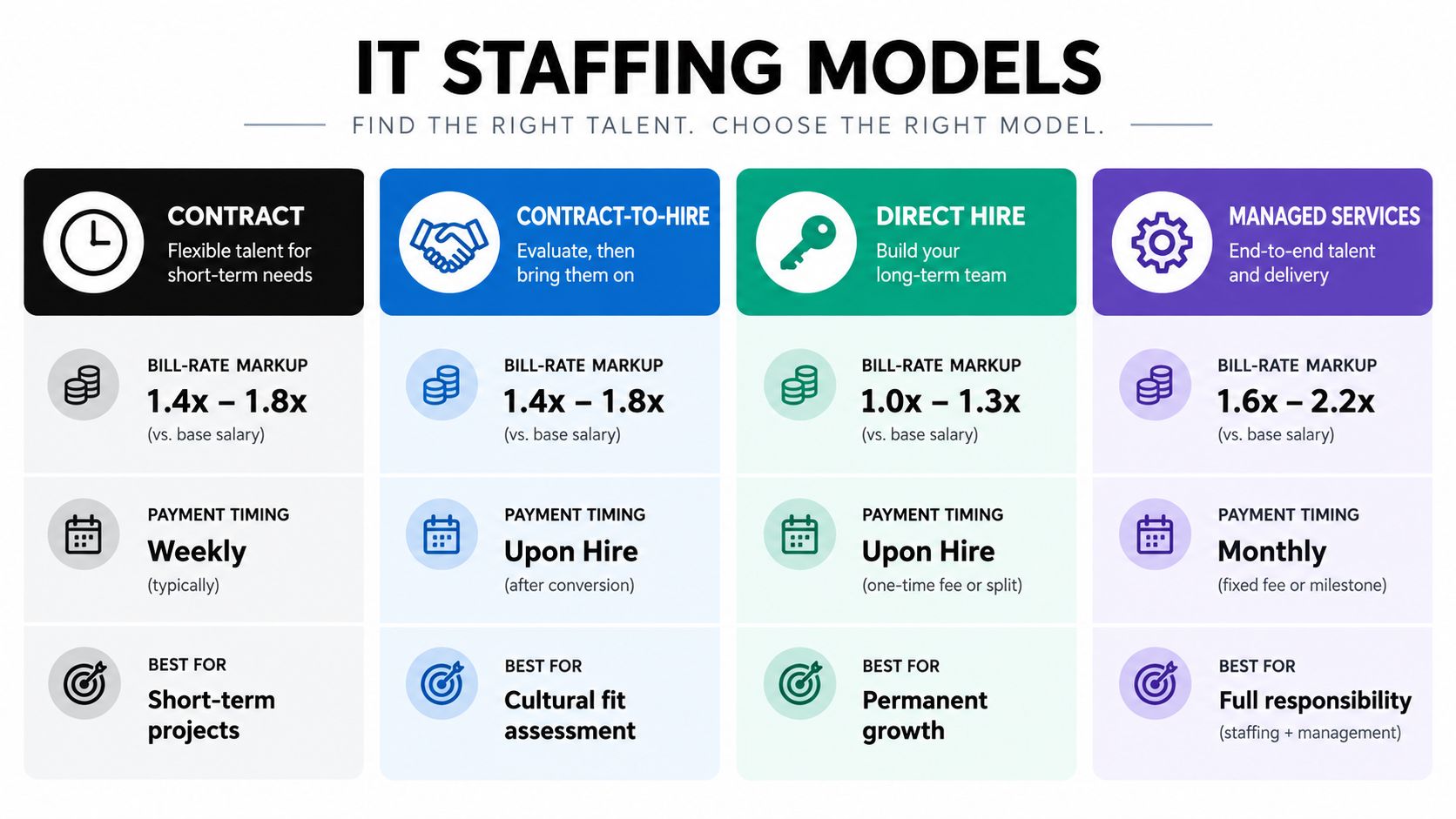
A vendor that talks about “staffing” as one bucket is usually hiding trade-offs. In Miami, the model you choose affects speed, compliance, cost, and how much control you keep over the work. Buy the wrong model and you pay for it twice.
[blocked]
Contract work is a speed play, not a forever plan
Use contract staffing for immediate coverage, short projects, or a gap you need filled now. It works when the business cannot wait for a permanent search. You are paying for speed and flexibility, and in South Florida that premium shows up fast because payroll load, benefits, and employee-leasing costs are real.
[blocked]
Contract-to-hire buys you a test drive
Contract-to-hire makes sense when the role has culture risk, team-fit risk, or visa sensitivity. It gives both sides a trial period before anyone commits to a full-time offer. If the candidate looks good on paper but you want proof they can work with your team, this is the cleanest way to reduce the guesswork.
[blocked]
Direct hire is the right move for strategic seats
Direct hire is the model for a permanent role where retention, ownership, and long-term cost matter. The recruiter fee feels heavier up front, but that cost usually makes sense for a core engineer, a product-critical architect, or anyone who will shape the roadmap. If the seat matters to the business, stop pretending a temporary answer is good enough.
[blocked]
Managed services fit outcome work
Managed services or a statement-of-work engagement fits work with defined outputs, not just a body count. Use it for a multi-skill product squad, a platform buildout, or a delivery function where you care about the result more than who sits on payroll. It also keeps every gap from turning into a separate recruiting scramble.
Decision rule: under three months, use contract. Permanent backfill with culture risk, use contract-to-hire. Strategic full-time seats, use direct hire. Multi-skill project work, use managed services.
Florida's employee-leasing rules make this a compliance question, not just a pricing question. A company or controlling person cannot operate in the state without a license from the Department of Business and Professional Regulation, and the company must have a registered agent and at least one licensed controlling person Florida statute on employee leasing. The state also publishes application fees of $900 for an employee leasing company, $1,500 for a group, and $600 for a controlling person, with licenses expiring on April 30 of each even-numbered year Florida licensing summary. If a vendor brushes past that, keep moving.
[blocked]
How to Evaluate and Vet a Miami IT Staffing Partner
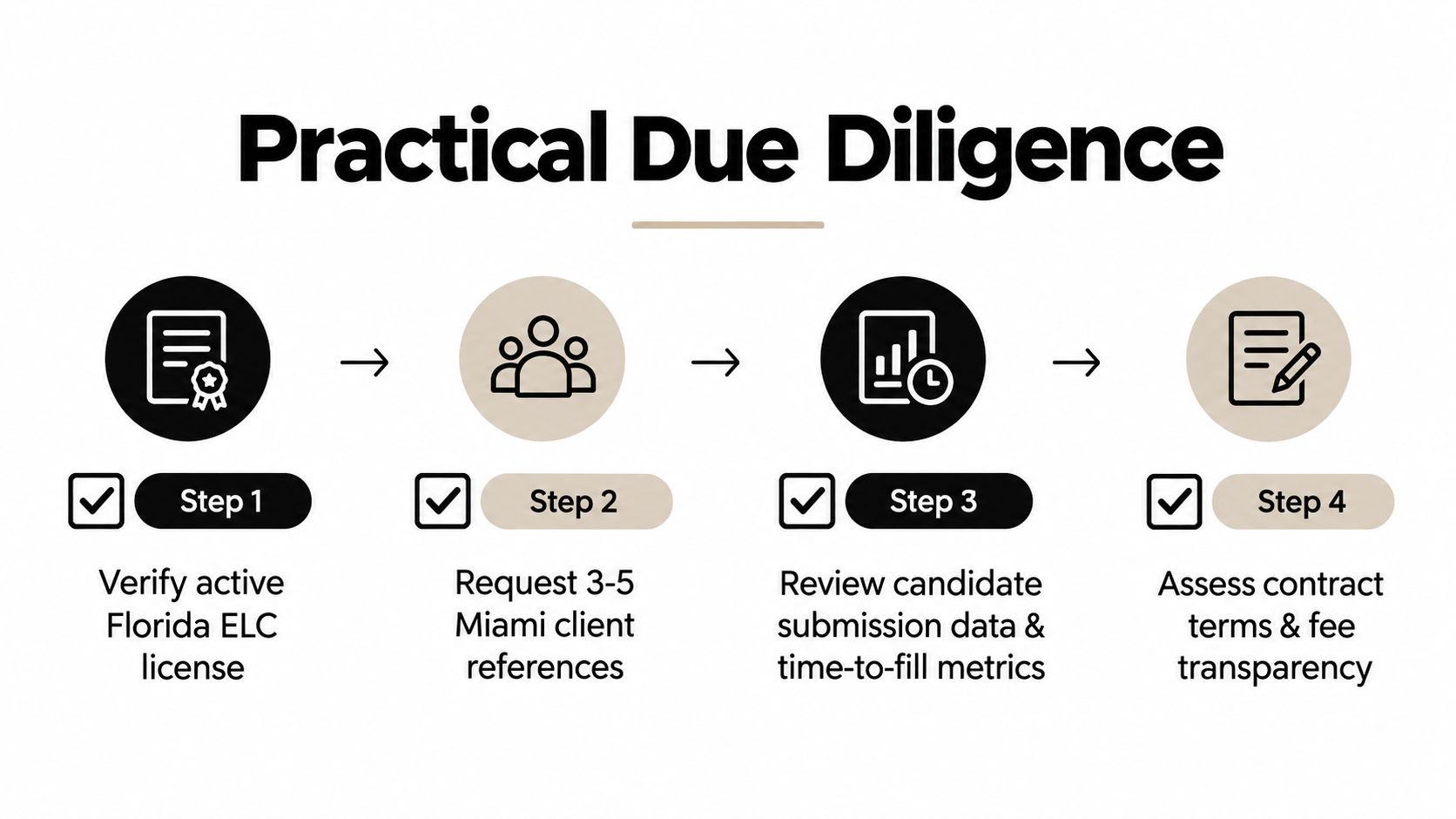
A glossy pitch deck is not due diligence. It is marketing dressed up as operations. If you are buying IT staffing Miami services, check whether the firm can legally operate, fill roles, and stop hiding bad contract terms behind vendor jargon.
[blocked]
Start with the license, not the logo
Ask for the active Florida Employee Leasing Company license number and verify it yourself. In Florida, employee leasing companies need the right license, plus a registered agent and at least one licensed controlling person. If a vendor cannot answer that cleanly, stop there.
Then ask who is on W-2 payroll. If the vendor is dropping 1099 subs into a role that should be staffed through a real employment relationship, you inherit risk you do not need. Ask for workers' comp, E&O coverage, and a plain explanation of replacement support when a placement fails.
[blocked]
Ask for proof, not promises
You want three recent client references from your industry, and you want direct answers. Ask about submittal-to-hire ratios, replacement terms, whether offshore bench recruiters were disclosed up front, and what happened when a candidate missed the mark. That tells you more than any culture slogan ever will.
Practical rule: if a vendor will not give you three reference calls from similar clients, they are asking you to trust branding instead of delivery.
[blocked]
Read the contract like a buyer, not a fan
Red flags usually sit in plain sight. Non-solicit periods over 12 months are too aggressive. Broad indemnification language is a trap. Any markup on background checks above $50 should make you ask why a standard screening became a profit center.
Request the candidate's actual hourly pay separately from the bill rate. That shows whether the markup is fair or padded because the vendor assumes you will not ask. You do not need a law degree here, just discipline and a refusal to be dazzled by jargon.
If you want a cleaner intake process, use a one-page scorecard and force every vendor to answer the same fields, license status, fill time, replacement terms, candidate quality, and cultural fit. If you need a place to organize that workflow, Zemith's contact page is a practical starting point for centralizing the pieces instead of juggling them across email.
[blocked]
How TekRecruiter Can Help
TekRecruiter is a Miami-headquartered technology staffing and recruiting firm built around a simple thesis, engineers recruit engineers. That matters in a market where generic screening can miss the difference between someone who can talk architecture and someone who can ship it. The firm's model is built on technical conversations, not trivia tests, which is exactly what serious hiring teams need when they're trying to avoid expensive mis-hires.
[blocked]
Where it fits best
TekRecruiter's strongest use case is when the role is technical enough that a generic recruiter will waste everyone's time. Its specialties include software engineering, AI engineering, DevOps, SRE, platform engineering, cloud and systems engineering, data and data analytics engineering, Salesforce engineering, ERP engineering, and cybersecurity engineering. That's a useful spread if you're hiring across the stack and don't want to explain basic tooling to a vendor every ten minutes.
The firm offers direct hire, staff augmentation, on-demand, and managed services. The on-demand bench is presented as 30,000+ pre-vetted engineers, which, if true in practice for your search, is the kind of scale that helps when you're trying to fill niche roles fast. The company's founder, Ron Smith, comes from an engineering background, so the sales pitch starts with technical fluency rather than recruiter theater.
For buyers, the value is not “we know Miami.” The value is a tighter screen, better role matching, and less waste on both sides of the table. If you want a deeper vendor overview before you commit, the firm's best IT staffing firm in Miami page is worth reading because it frames the market from a provider that lives in it.
[blocked]
Miami IT Salary Benchmarks and What They Mean for Your Requisition
A Miami hiring budget falls apart fast when someone uses a national pay band and pretends it fits Brickell, Coral Gables, or a remote-first candidate who never plans to come in. Use local numbers as your starting point, then price the role by seniority, specialty, and the competition you are facing.
[blocked]
Convert base pay into a real hiring number
For software developers in the Miami metro, the median annual wage sits at $132,650, with the middle 50% between $102,710 and $165,710, and the 10th to 90th percentile range from $80,440 to $199,280 Miami software developer wages. That spread tells you everything you need to know. A single “Miami rate” is sloppy buying.
Price the requisition from the ground up. Start with base pay, add employer taxes and benefits, then add recruiter margin. That is why a staffing quote can look a lot higher than the salary alone. If a vendor gives you a number without showing the loaded math, they are asking you to sign off on a guess.
[blocked]
The market still has pockets where Miami underprices itself
Some mid-level software talent in Miami still looks cheaper on paper than in tougher coastal markets, but the savings shrink once you factor in scarcity and speed. Salary data also shows that IT staffing jobs in Miami average about $48,785 a year, with most workers around $40,600 to $56,000, which is far below what you will need for cloud, software, or cybersecurity specialists Miami IT staffing salary data. That gap catches buyers all the time. They see a low headline and assume the whole market is cheap.
Local geography still matters. Brickell, Coral Gables, and Weston tend to push offers higher than broad county medians because commute burden and lifestyle expectations shape candidate decisions. If your requisition ignores that, your recruiter ends up carrying the cost of a budget that was never realistic.
A useful requisition is defended with a compensation band and a hiring plan, not a hunch. If a vendor cannot explain why the number lands where it does, they do not understand the market well enough to fill it.
[blocked]
Interviewing, Onboarding, and Retaining IT Talent in Miami
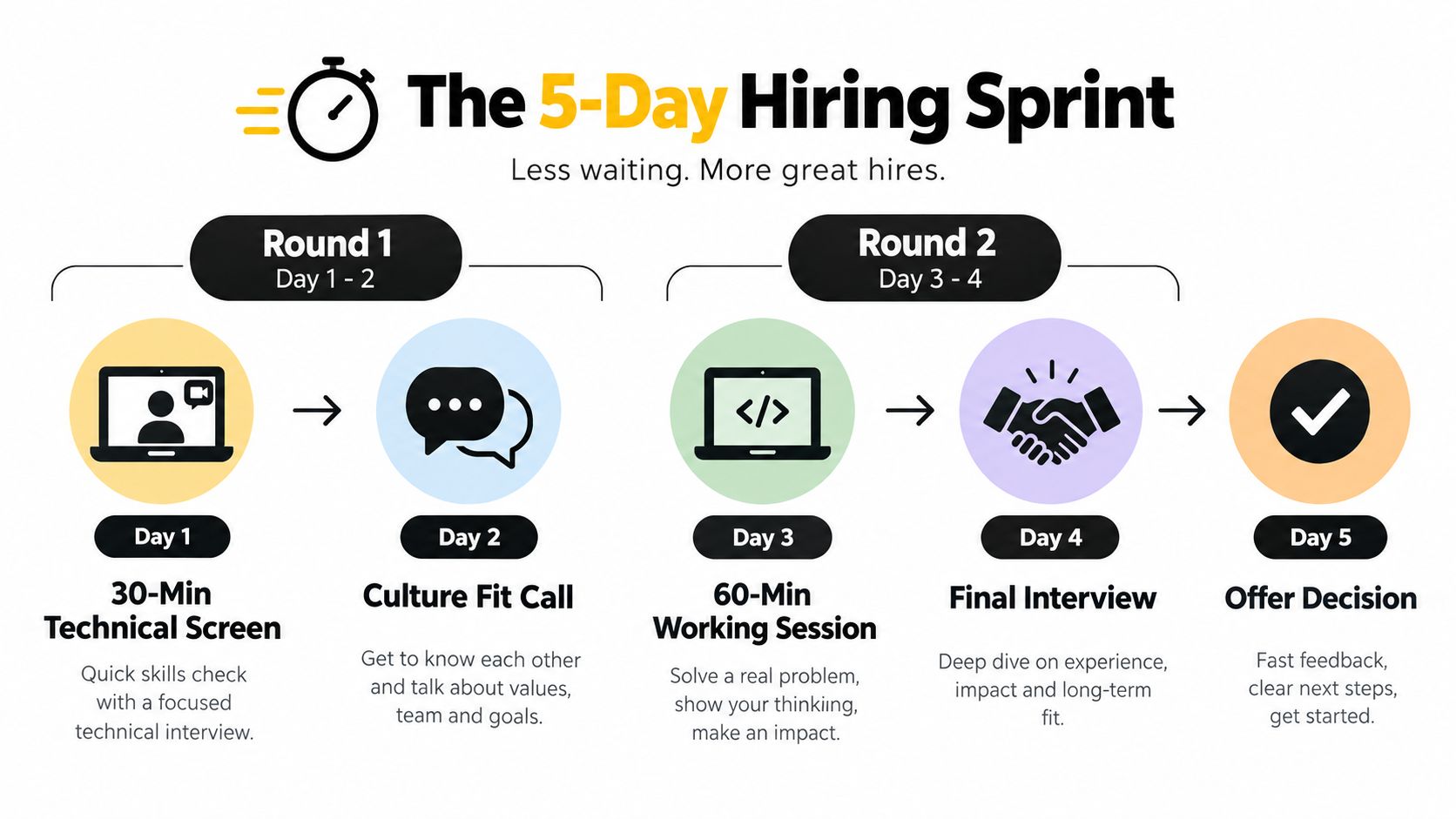
Miami candidates move fast because they can. If your process drags, they'll take another offer and call it “a better fit,” which is recruiter code for “your calendar was annoying.” Speed is no longer a nice addition, it's the hiring strategy.
[blocked]
Run a five-day decision window
A good Miami hiring process should finish in five business days from first screen to offer. One 30-minute technical screen is enough to tell you whether the candidate can reason through real work. The next step should be a panel that tests systems thinking and team fit, not trivia. Long take-homes are a waste unless they're short enough to respect the candidate's time.
[blocked]
Make onboarding short and useful
The first month should create momentum. Give the new hire a buddy on day one, line up stakeholder introductions in week one, and get them into a meaningful commit by day ten. That's how you compress ramp time without pretending the person already knows your system.
The goal isn't to impress new hires with process. It's to make them useful before they start wondering if the company is real.
[blocked]
Retention starts before the first complaint
Flexible hybrid schedules matter in Miami because commute friction is real. So do quarterly professional-development stipends and a visible path into fintech or healthtech leadership circles. Candidates stay where they can see growth, not where they're told to “own the journey.”
The biggest flight signals are boring, which is why companies miss them. Slow first-project assignment, skipped one-on-ones, and competing offers timed around year-end bonuses are all warning lights. If you catch them early, you can still save the hire. If you ignore them, you'll be back in the market with another requisition and another round of vendor excuses.
For teams experimenting with better interview notes and decision consistency, Zemith's multi-AI model chat use case is a practical way to organize prep and compare perspectives without bouncing between tools.
[blocked]
How to Build a Staffing Plan That Actually Works in Miami
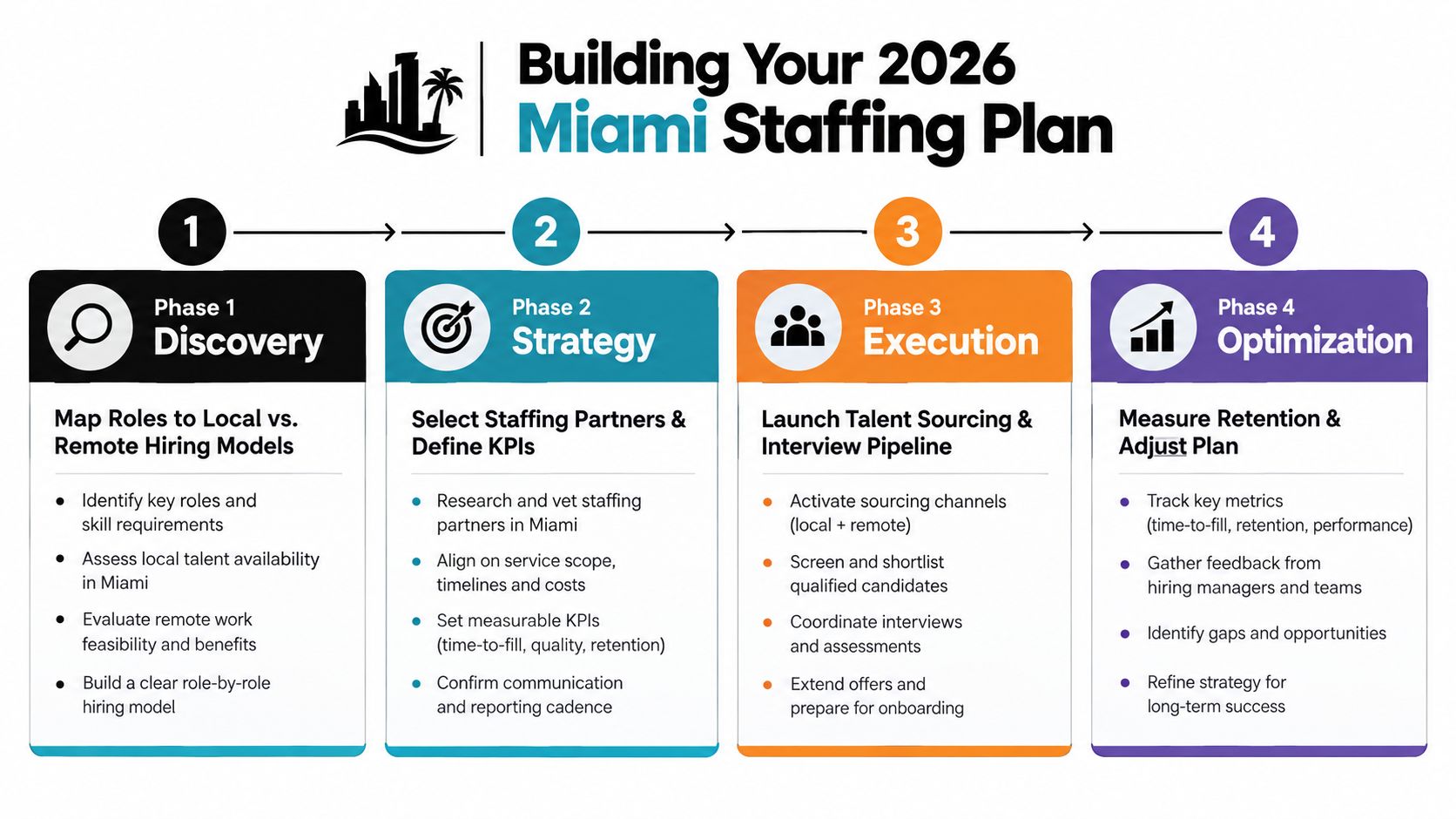
A Miami staffing plan fails when it treats every role like the same puzzle. It doesn't work that way. You need a model that matches the role, the salary pressure, and the risk of sourcing only locally.
[blocked]
Map the role before you choose the model
Start with the seat, not the vendor. If the role is urgent and short-term, local contract staffing is fine. If the role needs cultural fit and you're not sure yet, contract-to-hire makes sense. If the role is strategic, go direct hire. If the work is a multi-skill buildout, use managed services or a blended team.
[blocked]
Build for the market you actually have
Miami Tech Works estimates 75,806 technology job openings versus 66,034 retained graduates from 2024 to 2034, leaving a deficit of 9,773 workers if those patterns hold South Florida tech talent gap. That gap means local sourcing alone won't cover demand. You need relocation support, remote hiring, or both, especially for niche roles.
[blocked]
Set targets and hold vendors to them
Use a 90-day sprint for critical backfills, a six-month buildout for culture-sensitive roles, and a parallel remote track for niche stacks. Keep a local candidate buffer of about 25% so you're not stuck if the first choice takes another offer. Tie vendor contracts to outcomes like days-to-fill and days-to-productivity, not vague “partnership” language.
Quarterly review matters because Miami's hiring mix won't stay stable. Cloud, AI, and cybersecurity demand shifts quickly, and your staffing plan should change with it. If a vendor can't review performance against real fill metrics, they're just recycling résumés with nicer subject lines.
If you want a simpler way to keep hiring notes, sourcing data, and vendor comparisons in one place, use Zemith's AI-powered note use case to keep the plan tidy instead of letting it disappear into Slack archaeology.
[blocked]
Miami IT Staffing FAQ, Local Resources, and Common Mistakes
Miami buyers should ask the questions vendors hope you skip. That is where budget leaks start, and where glossy pitches fall apart fast. Ask directly and you will separate real delivery help from résumé recycling.
[blocked]
Fast answers to the questions that matter
When does local talent beat remote? For client-facing roles, bilingual work, compliance-heavy seats, or teams that need people in Brickell, Doral, or Coral Gables. Local fit matters when speed of communication and office presence affect delivery.
Why do some roles sit open forever? Salesforce, MLOps, and mainframe-adjacent roles often stay open because the pool is small and candidates already have other options. Buyers who want those people need a tighter process and a better offer.
Should payroll or leasing vendors be licensed? Yes, if they are operating as employee leasing companies in Florida. Check the licensing and registration rules early, then verify the vendor before you sign.
What's the cost of a bad contract-to-hire conversion? It is not just the fee. You lose time, frustrate the hiring manager, and start over. If the vendor will not define replacement terms clearly, the risk stays with you.
Is it smarter to hire an in-house recruiter? Only when volume justifies it. If your hiring needs are bursty or specialized, external support is usually the cleaner move.
[blocked]
Local resources worth using
- Workforce Florida for statewide labor and workforce context.
- Miami-Dade College tech programs for early-career pipeline building.
- CareerSource South Florida for regional hiring support.
- FAU and FIU engineering pipelines for broader technical sourcing.
- Miami Tech ecosystem directories for local network mapping.
- Zemith's blog hub for keeping research, vendor notes, and hiring process ideas in one place.
[blocked]
Common mistakes that burn budgets
- Chasing the lowest bill rate. Cheap recruiters often cost more in delays and bad fits.
- Skipping reference checks on contract staff. You will feel it later.
- Ignoring co-employment risk. That is how simple staffing turns into a compliance mess.
- Forgetting to budget for Florida reemployment tax on temporary labor. If you do not account for it, your pricing model is already wrong.
If you are building a repeatable hiring process instead of improvising one role at a time, keep your research and workflow notes in one place. It is the fastest way to compare vendors without getting buried in Slack archaeology.
Explore Zemith Features
Every top AI. One subscription.
ChatGPT, Claude, Gemini, DeepSeek, Grok & 25+ more








Always on, real-time AI.
Voice + screen share · instant answers
What's the best way to learn a new language?
Immersion and spaced repetition work best. Try consuming media in your target language daily.
Voice + screen share · AI answers in real time
Image Generation
Flux, Nano Banana, Ideogram, Recraft + more

Write at the speed of thought.
AI autocomplete, rewrite & expand on command
Any document. Any format.
PDF, URL, or YouTube → chat, quiz, podcast & more
Video Creation
Veo, Kling, Grok Imagine and more

Text to Speech
Natural AI voices, 30+ languages
Code Generation
Write, debug & explain code
Chat with Documents
Upload PDFs, analyze content
Your AI, in your pocket.
Full access on iOS & Android · synced everywhere
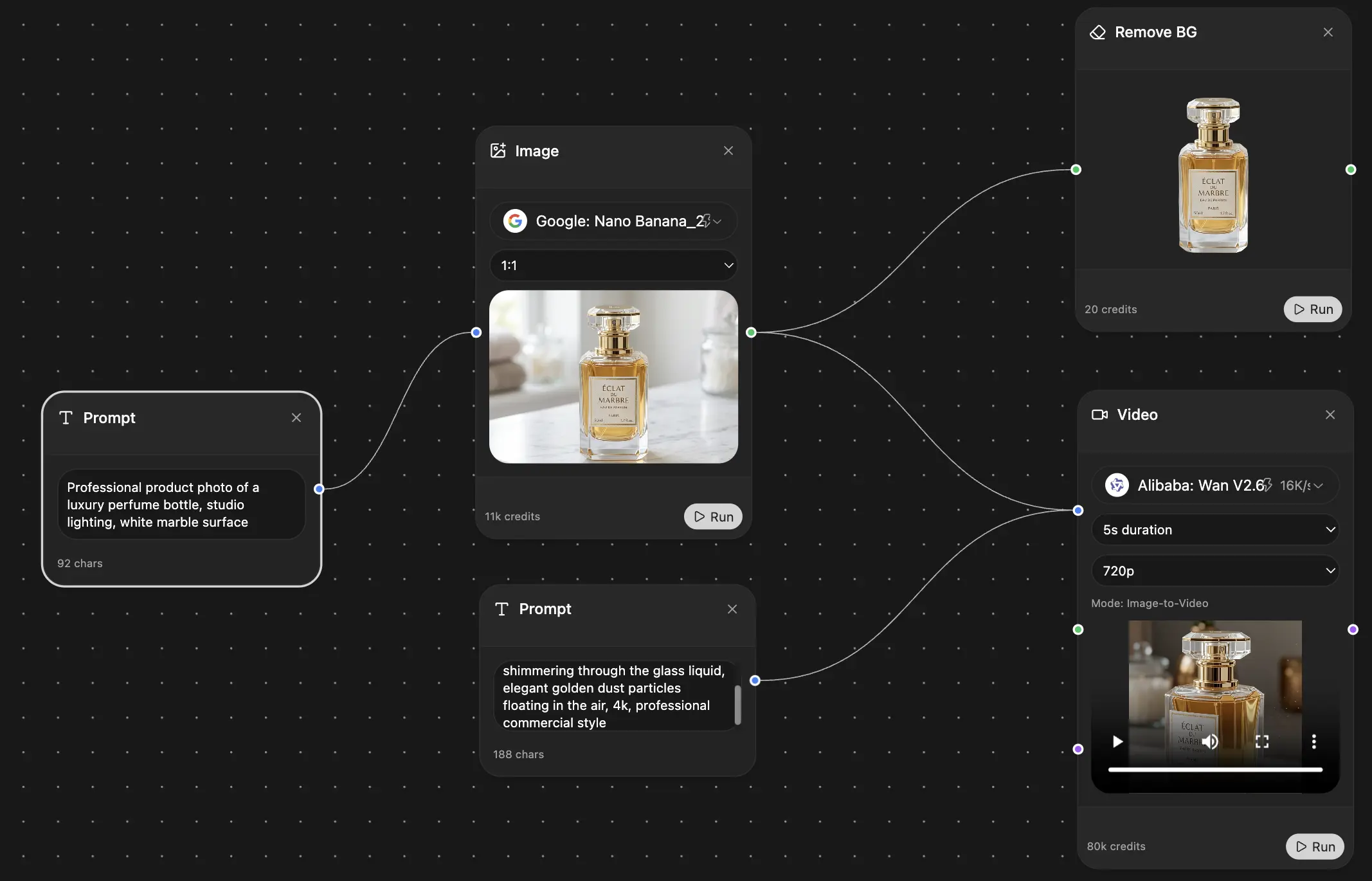
Your infinite AI canvas.
Chat, image, video & motion tools — side by side
Save hours of work and research
Transparent, High-Value Pricing
Trusted by teams at






Free
No credit card required
- 100 credits daily
- 3 AI models to try
- Basic AI chat
Plus
- 1,000,000 credits/month
- 25+ AI models — GPT, Claude, Gemini, Grok & more
- Agent Mode with web search, computer tools and more
- Creative Studio: image generation and video generation
- Project Library: chat with document, website and youtube, podcast generation, flashcards, reports and more
- Workflow Studio and FocusOS
Professional
- Everything in Plus, and:
- 2,100,000 credits/month
- Pro-exclusive models (Claude Opus, Grok 4, Sonar Pro)
- Motion Tools & Max Mode
- First access to latest features
- Access to additional offers
What Our Users Say
Great Tool after 2 months usage
"I love the way multiple tools they integrated in one platform. Going in the right direction."
— simplyzubair
Best in Kind!
"The quality of data and sheer speed of responses is outstanding. I use this app every day."
— barefootmedicine
Simply awesome
"The credit system is fair, models are perfect, and the discord is very responsive. Quite awesome."
— MarianZ
Great for Document Analysis
"Just works. Simple to use and great for working with documents. Money well spent."
— yerch82
Great AI site with accessible LLMs
"The organization of features is better than all the other sites — even better than ChatGPT."
— sumore
Excellent Tool
"It lives up to the all-in-one claim. All the necessary functions with a well-designed, easy UI."
— AlphaLeaf
Well-rounded platform with solid LLMs
"The team clearly puts their heart and soul into this platform. Really solid extra functionality."
— SlothMachine
Best AI tool I've ever used
"Updates made almost daily, feedback is incredibly fast. Just look at the changelogs — consistency."
— reu0691