


Every top model, with tools built in.
Search the web, run deep research, read files, create images and run code with GPT, Claude, Gemini, Grok and more.
Tired of dull summaries? Learn how to write a summary of an article that's clear, concise, and actually useful. Get actionable tips and real examples.
Let's be real—you're drowning in information. From academic journals and industry reports to the endless firehose of online news, who actually has the time to read it all? This is where mastering the art of the summary comes in. It’s not just some stuffy skill you flunked in high school; it’s a modern-day superpower for anyone trying to stay informed and get ahead without losing their mind.
A killer summary helps you slice through the noise, letting you grasp complex ideas quickly, remember what actually matters, and share those insights with your team without making their eyes glaze over. Think of it as the ultimate productivity hack, turning a dense, time-sucking report into knowledge you can actually use.
The sheer volume of content we face every single day is staggering. To put it in perspective, global scientific publications alone hit around 3.3 million articles in 2022. That's a 59% jump in just one decade. You can dive deeper into the data, but the conclusion is obvious: just "keeping up" has become a full-time job.
This is precisely why knowing how to properly summarize an article is so valuable. It gives you the power to:
A well-crafted summary isn't just a shorter version of the original. It's a strategic tool for managing knowledge. It sharpens your own understanding and makes it incredibly easy to share that clarity with others.
Of course, not all summaries are created equal. We've all seen the bad ones—they misrepresent the author's point, get bogged down in useless details, or sneak in the writer's personal opinions. A bad summary is like a bad joke: it's confusing and nobody gets the point.
A strong summary, on the other hand, is a thing of beauty. It's a masterpiece of clarity and precision that boils an article down to its absolute essence, making the information portable and powerful.
This skill is also the cornerstone for so many other tasks. For instance, creating a solid summary is the first step in most content repurposing strategies, turning one big asset into a dozen smaller ones.
To help you nail it every time, here's a quick breakdown of what makes a summary work—and what makes it fall flat.
Think of this table as your north star. If you stick to the "Essentials" and steer clear of the "Pitfalls," you're already 90% of the way to a perfect summary.
And you don't have to go it alone. Tools like Zemith's Document Assistant can give you a massive head start. Just upload your article, and it will help you quickly pull out key themes and arguments, providing a solid, accurate foundation before you even start writing your own draft.
Let's be honest. If you just glance over an article and jump straight into writing, you're not really summarizing. You're just creating a jumbled echo of the original. The secret to a killer summary doesn't even start with writing—it starts with how you read.
Think of yourself as a detective arriving at a crime scene. You wouldn't just give the room a once-over and start scribbling a report, right? No way. You'd methodically search for clues, piece together the main story, and figure out which pieces of evidence actually matter. Reading for a summary demands that same active, investigative approach.
Before you get bogged down in the details, give the article a quick flyover. This isn't about deep understanding just yet; it's about creating a mental map of the territory. This initial skim usually takes just a minute or two and gives you a huge advantage.
On this first pass, your eyes should be scanning for a few specific things:
This quick scan gives you the "shape" of the article. When you go back for a closer look, you’ll already know where the most critical information is likely hiding.
Okay, now it's time for the real detective work. On your second read, you’re no longer just scanning; you're actively hunting for the article's core components. Your mission is to find the central nervous system of the text.
Here's what you're looking for:
The biggest mistake I see people make is treating every sentence as if it has equal weight. Active reading is all about filtering. You have to consciously separate the foundational arguments from the decorative fluff.
As you do your deep dive, you need a system to capture what you find. Simply highlighting everything in yellow is a classic rookie mistake that just creates a colorful, useless mess. You need an active annotation method.
This is where a tool like Zemith's Smart Notepad can be a total game-changer. Instead of juggling sticky notes or a separate chaotic document, you can grab quotes, jot down your thoughts, and organize key points all in one place, right alongside the article. It's the productivity boost you didn't know you needed.
This screenshot shows just how easy it is to instantly pull a key concept from the source and start building out your summary's main points directly in your workspace.
By tagging key info as you go—labeling the thesis, numbering the supporting arguments, and flagging the conclusion—you're basically building the skeleton of your summary in real-time. This prep work is what makes the actual writing process feel almost effortless. Plus, this entire process sharpens your ability to digest information, a key skill we cover more in our guide on how to improve reading comprehension. When you’ve read and annotated this way, the summary practically writes itself.
Okay, you've done the hard work of reading and organizing your notes. Now it's time to actually write the thing. If the thought of a blank page gives you a cold sweat, just relax. This part is less about creating a perfect masterpiece and more about assembling the pieces you’ve already found.
Think of it like you're explaining the article to a friend who's short on time. You wouldn't use the author's exact, sometimes complicated, phrasing. You'd cut straight to the chase in your own words. That’s all we’re doing here.
Your first sentence is critical. It does all the heavy lifting by introducing the article's title, the author, and their main point (the thesis). Get this sentence right, and the rest of the summary flows so much more easily.
Here’s a simple formula that works almost every time:
In "[Article Title]," author [Author's Name] argues that [the article's main thesis].
Let's say we just read an article called "The Sleep Deficit" by Dr. Anya Sharma, where she claims that modern work culture is the main culprit behind our collective exhaustion.
And just like that, you're off to a running start. Your reader knows exactly what the article is about and what point it's trying to make.
Once your opening is solid, it's time to build out the body of your summary. Head back to your notes and pull out those key supporting arguments you identified. Your goal is to arrange them logically, showing how each one backs up the main thesis you just introduced.
The golden rule here is to use your own words. This is what makes a summary, a summary. It's not about swapping a few words around—it’s about showing that you've processed the ideas and can explain them yourself.
If you hit a wall and find yourself just staring at the screen, don't sweat it. Writer's block is completely normal. Sometimes, checking out a few tips on how to overcome writer's block is all you need to get the words flowing again.
This whole pre-writing process is about gathering your raw materials before you start building.
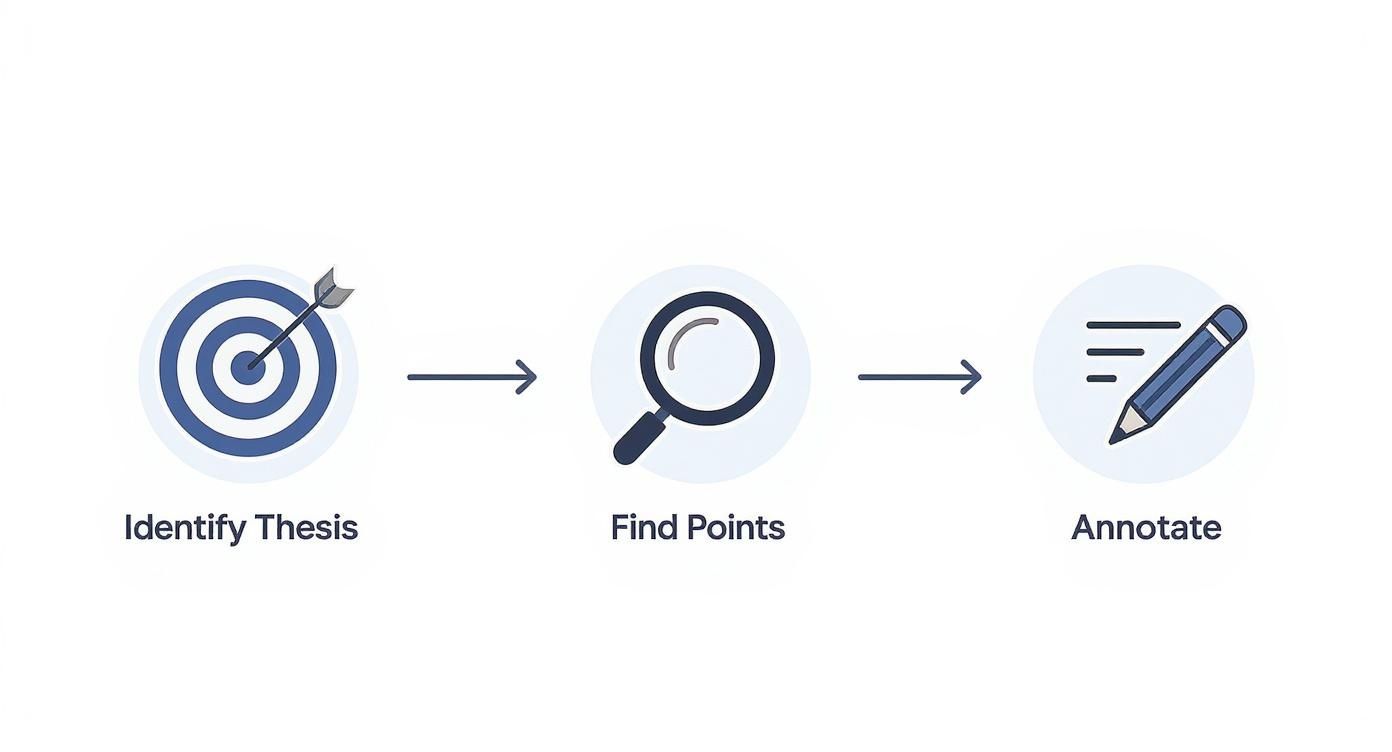
Breaking it down into these three steps—finding the thesis, locating the supporting points, and annotating—ensures you have everything you need before you even write that first sentence.
"So, how long should this be?" It’s the classic question, and the honest answer is... it depends. The right length is tied to the original article’s length and complexity, plus what you need the summary for.
A summary for your own notes will be way shorter than one you’re turning in for a grade. But as a general rule of thumb, aim for your summary to be about 10% to 25% of the original text's length.
To give you a better feel for it, here’s a quick guide that breaks down summary length by the type of article you’re working with. This can help you find that sweet spot between being too brief and too long-winded.
Ultimately, your summary needs to be concise but accurate. Don’t get too hung up on the word count during your first draft—just focus on getting the key points down. You can always trim the fat later.
Just as a great summary gets to the heart of a topic, knowing how to structure a compelling presentation can help you communicate those key points with maximum impact in a different format.
Alright, you’ve got a first draft. That's a huge win! But don't fire it off just yet. The first draft is really just for you—it’s where you get all the main ideas down on the page. The real work, the part that makes a summary shine, happens during the editing process.
This is where you sharpen a rough collection of points into a clear, compelling summary that anyone can understand instantly. Think of it like bringing a blurry photo into sharp focus. The final result is worth the effort.
This final polish is what separates an okay summary from a great one. Let's walk through a few passes that will make all the difference.
Before you start fiddling with words and flow, you need to put on your fact-checker hat. Ask yourself one brutally honest question: Does my summary faithfully represent the author's ideas?
It's surprisingly easy to accidentally let your own opinion slip in or misinterpret a key argument. Put your summary side-by-side with the original article and double-check a few things:
If anything feels even a little off, fix it now. An inaccurate summary is worse than no summary at all.
Facts are straight? Good. Now it's time to get ruthless. Your goal is to hunt down and destroy every single unnecessary word, clunky phrase, and repetitive point. Great summaries are lean.
This is the core challenge of knowing how to write a summary of an article for work or how to write an article summary for college. For example, news articles often have a median length of 664 words, but their own single-paragraph briefings average just 87 words. The takeaway is clear: you have to make every word pull its weight.
Here’s what to look for:
This isn't just about making your summary shorter; it's about making it more powerful. Each word you cut makes the ones that remain stand out even more.
Now for a pro tip: read your summary out loud. Seriously. Your ears will catch awkward phrasing and abrupt transitions that your eyes skim right over. Does it sound natural, like something a person would actually say? Or does it sound like a robot stitched it together from a list of facts?
This is where you connect the dots. Use transitional words and phrases to guide the reader seamlessly from one point to the next.
Before: The author says work culture is a problem. They mention technology. They conclude sleep is important.
After: The author argues that a toxic work culture is the primary issue. Furthermore, they explain that technology has worsened the problem by erasing boundaries. Ultimately, they conclude that prioritizing sleep is the only viable solution.
See the difference? A few simple tweaks can turn a choppy list into a coherent story. If you want to dive deeper into this, check out our complete guide on how to edit writing for maximum clarity.
You're in the home stretch! You've done the heavy lifting—you checked for accuracy, trimmed the fat, and smoothed out the flow. The last step is to catch those sneaky typos and grammar goofs that can sabotage all your hard work.
Use a grammar checker, but don't blindly trust it. Your own eyes are still the best tool for the job. One last, careful read-through will ensure your summary comes across as professional and polished.
Don't skip this. A single typo in an otherwise perfect summary is like finding a bug in a great salad. It just ruins the whole experience.
Not all articles are created equal, so why would you summarize them the same way? A one-size-fits-all approach is a fast track to a weak, generic summary. The strategy you use for a dense scientific paper just won't work for a fiery opinion piece.
Think of it like being a chef. You wouldn't use the same cooking method for a delicate fish as you would for a tough cut of meat. To really master how to write a summary of an article, you’ve got to adapt your technique to the specific "ingredient" you're working with. That means identifying the article type first, then homing in on what truly matters within that structure.
Let's break down the game plan for three of the most common article types you'll run into.
Ah, the academic paper. Often dense, filled with jargon, and structured with military precision. Trying to summarize one of these without a plan is like trying to assemble IKEA furniture without the instructions—frustrating and likely to end in a mess.
Your mission here is to slice through the fluff and extract the scientific core. It's easy to get bogged down in the lengthy literature review or the super-specific details of every experiment, but you have to resist.
Instead, zero in on these four key areas:
When summarizing academic work, your job is to be a translator. You're taking complex, specialized information and making it accessible and concise without losing the essential scientific narrative.
News articles are a completely different beast. They’re designed for speed and clarity, built around a structure known as the "inverted pyramid." This just means the most critical information—the who, what, when, where, and why—is packed right into the first couple of paragraphs.
This structure actually makes your job way easier. Your summary should mirror it.
Focus your energy on clearly stating the main event or finding. Dig into those first few paragraphs to pull out the essential facts, then lightly touch on the key context or consequences mentioned later in the article. You can safely ignore most of the quotes from random eyewitnesses or lengthy background details unless they are absolutely critical to understanding the main point.
The world of academic writing is also constantly changing, presenting new challenges for summary writing. For example, a recent analysis showed a major thematic shift in publications between 2020 and 2025, with a huge focus on generative AI and concerns about academic integrity. You can learn more about these emerging complexities and how they impact the field.
Opinion pieces, or op-eds, are all about the argument. Unlike a neutral news report, the author is actively trying to persuade you to see the world their way. Your summary needs to capture the heart of that argument, not just the topic.
Forget about objectivity in the source material; it's not there. Instead, concentrate on these elements:
When tackling non-traditional content, like videos, specific tools like a dedicated YouTube Summarizer can extract the key information for you. Your summary should be a neutral report on their argument, not an agreement with it.
Alright, you've got the process down and you've seen what a good summary looks like. But maybe a few questions are still bouncing around in your head. It’s completely normal to wonder about the finer points or specific "what if" scenarios.
Let's clear up some of that confusion. Here are the answers to the most common questions people ask when they're learning to summarize articles. This should give you that extra bit of confidence before you dive in.
This is a hard no. In fact, it's probably the biggest rule of all. A summary needs to be a completely objective and neutral reflection of what the original author said.
The second you start injecting your own analysis, thoughts, or critiques, you're no longer writing a summary. You've veered into writing a review or a response paper. Your only job here is to accurately report on the source material. Save those brilliant insights for another type of assignment!
Great question. They're related, but they do very different jobs.
You’ll definitely use your paraphrasing skills while writing a summary, but remember that the summary itself is a condensed version of the whole piece, not just a rewritten sentence.
Think of it this way: a summary is the movie trailer, while a paraphrase is like reshooting a single scene in your own style. Both use your words, but their purpose and scope are worlds apart.
Yes... but you have to be smart about it. AI tools can be incredible time-savers for getting a first draft on the page. They’re fantastic for spotting key points you might have overlooked or helping you find new ways to phrase complicated ideas.
However, you should never just copy and paste an AI-generated summary. Always treat it as a rough starting point. You still need to read the original article to make sure the AI got it right, then edit the summary for clarity, flow, and tone. For tricky formats, our guide on how to use AI to summarize a PDF offers some specific strategies.
Think of AI as a very capable assistant, not a replacement for your own brainpower and writing skills.
Ready to stop juggling tools and start summarizing faster and smarter? Zemith integrates a powerful Document Assistant and Smart Notepad into one seamless workspace. Interact with any article, pull key points instantly, and draft your summary without ever leaving the page. Experience the future of productivity at Zemith.com.







Trusted by teams at






The top models, plus image, video and voice tools, in one plan.
Without Zemith
ChatGPT PlusUS$20.00Claude ProUS$20.00Google AI ProUS$19.99SuperGrokUS$30.00Perplexity ProUS$20.00 MidjourneyUS$10.00
 ElevenLabsUS$6.00Le Chat ProUS$14.99
 RunwayUS$15.00Kling StandardUS$8.80
 Gamma PlusUS$12.00
 Otter ProUS$16.99
 QuillBot PremiumUS$19.95
 Photoroom ProUS$12.99
 Quizlet PlusUS$7.99
Total if paying separatelyUS$234.70/mo
"I love the way multiple tools they integrated in one platform. Going in the right direction."
— simplyzubair
"The quality of data and sheer speed of responses is outstanding. I use this app every day."
— barefootmedicine
"The credit system is fair, models are perfect, and the discord is very responsive. Quite awesome."
— MarianZ
"Just works. Simple to use and great for working with documents. Money well spent."
— yerch82
"The organization of features is better than all the other sites — even better than ChatGPT."
— sumore
"It lives up to the all-in-one claim. All the necessary functions with a well-designed, easy UI."
— AlphaLeaf
"The team clearly puts their heart and soul into this platform. Really solid extra functionality."
— SlothMachine
"Updates made almost daily, feedback is incredibly fast. Just look at the changelogs — consistency."
— reu0691
Hand off the research, writing, design and follow-ups. Zemith picks the tools it needs and brings back finished work.
Search the web, run deep research, read files, create images and run code with GPT, Claude, Gemini, Grok and more.
Zemith keeps working in the cloud and pings you when it's done.
Notion, Linear, Canva, Airtable and more. It asks before it creates or changes anything.
Docs, slides, sheets and PDFs, ready to send.
Chain models and tools on a visual canvas, from one prompt to a finished promo video.
Briefings, reports and reminders run on a schedule and are ready when you need them.
Real-time voice that can see your camera or screen.
The best image and video models, in one studio.
Turn PDFs, links and YouTube videos into podcasts, quizzes, flashcards and mind maps.













 Podcast
 Quiz
Quiz Flashcards
 Mind map
 Infographic