


Every top model, with tools built in.
Search the web, run deep research, read files, create images and run code with GPT, Claude, Gemini, Grok and more.
Learn how to write product descriptions that convert. This guide covers SEO, psychology, and using AI tools like Zemith to craft copy that sells.
At its heart, writing a product description is about one thing: connecting a customer's problem to your product's solution. It's about getting inside your ideal buyer's head, figuring out your brand's unique voice, and writing copy that shouts benefits, not just features. If you can get this foundation right, you're already way ahead of most of your competition—who are probably still just listing specs and wondering why nobody's buying.
Before a single word hits the page, we need to sort out the strategy. A great product description isn't just a laundry list of specs; it's a genuine conversation with your ideal customer. Rushing this part is like trying to bake a cake without mixing the ingredients first—you'll end up with a mess. This is all about nailing the why behind copy that actually converts.
You absolutely have to know who you’re talking to. And no, "everyone" is not a valid answer. We're talking about building a detailed customer persona. Forget the basic demographics for a second and dig into what truly makes them tick.
What problems keep them up at night? What are they secretly hoping your product will do for their life? Are they looking for ways to save time on meal prep or for the perfect sustainable running shoes for beginner trail runners? Once you understand their real-world struggles and aspirations, you can craft copy that feels like it was written just for them.
Okay, so you know who you're talking to. Now, how are you going to talk to them? Your brand voice is your store's personality, plain and simple.
Are you the witty, playful friend? Or the calm, sophisticated expert? There's no right or wrong answer here, but whatever you choose, you have to be consistent. This voice needs to show up in every single headline, bullet point, and call-to-action you write. A sudden personality switch is as jarring as finding a pickle in your ice cream.
Key Takeaway: A strong foundation isn't just about what you sell, but who you're selling to and how you talk to them. Nailing your customer persona and brand voice makes the actual writing process ten times easier and way more effective.
All this foundational work—customer personas, voice guidelines, competitor notes—can get messy fast. It’s incredibly frustrating to have to hunt through a dozen different apps and files every time you need to write. An organized workspace isn't a luxury; it's essential for your sanity.
This is exactly where a tool like Zemith's Document Assistant becomes your central hub. You can drop all your brand guidelines and customer research into one spot, making it instantly available whenever you start a new description. It's like having a perfectly organized brand bible at your fingertips.
This is a perfect example of how to keep all your critical brand and customer information neatly organized and ready to go, ensuring your entire team stays on the same page.
Getting this foundation right is critical, especially in today's market. The copywriting industry is projected to hit a staggering USD 42.83 billion by 2030, and e-commerce is a massive driver of that growth. Your descriptions are a direct line to tapping into that.
To really connect with your audience and get them to click "buy," you have to understand the core principles of great copy. You can learn more about how to write a product description that sells. And if you just want to sharpen your writing skills in general, check out our guide on how to improve your writing ability.
Okay, let's stop talking theory and actually start building this thing. You've done the prep work—you know who you're talking to and how you want to sound. Now we need a solid framework to hang all those brilliant ideas on.
A great product description structure isn't about being rigid. It's about guiding your customer on a smooth journey from "Hmm, what's this?" to "Heck yes, I need this." The goal is to grab their attention, build a genuine desire for the solution you're offering, and make the purchase feel like the most natural next step. This isn't about pushy sales tactics; it's all about clarity and connection.
Think of your headline as the gatekeeper. If it's boring, confusing, or just plain generic, nobody is going to bother reading the rest of your beautifully written copy. It’s the bouncer at the club—it has to be compelling enough to let people in.
Your headline's main job is to make a promise and spark curiosity. Sure, it should be loaded with the primary keyword your customer is searching for, but it has to do more than just please Google. It has to connect with a person.
Pro Tip: Don't just describe the product in your headline. Hint at the incredible outcome the customer will get. Frame it around the main benefit or the problem it wipes out.
For example, instead of "Durable All-Weather Camping Tent," try something punchier like "Your Indestructible Shelter for Unforgettable Adventures." See the difference? One is a label, the other is a feeling. If you need a bit more inspiration, we have a whole guide on how to write better headlines that'll get the ideas flowing.
Once the headline gets them past the velvet rope, your opening paragraph is your chance to make a real connection. This is where you look your customer in the eye and say, "I get you."
Start by hitting on their biggest pain point or their most significant dream. Are they fed up with clunky software that eats up their day? Start there. Do they dream of finally getting their chaotic life organized? Lead with that. This immediate empathy builds trust and shows that your product isn't just another item on a digital shelf—it's a solution built for their world.
Before we dive into the nitty-gritty, it's worth remembering the foundation we're building on.
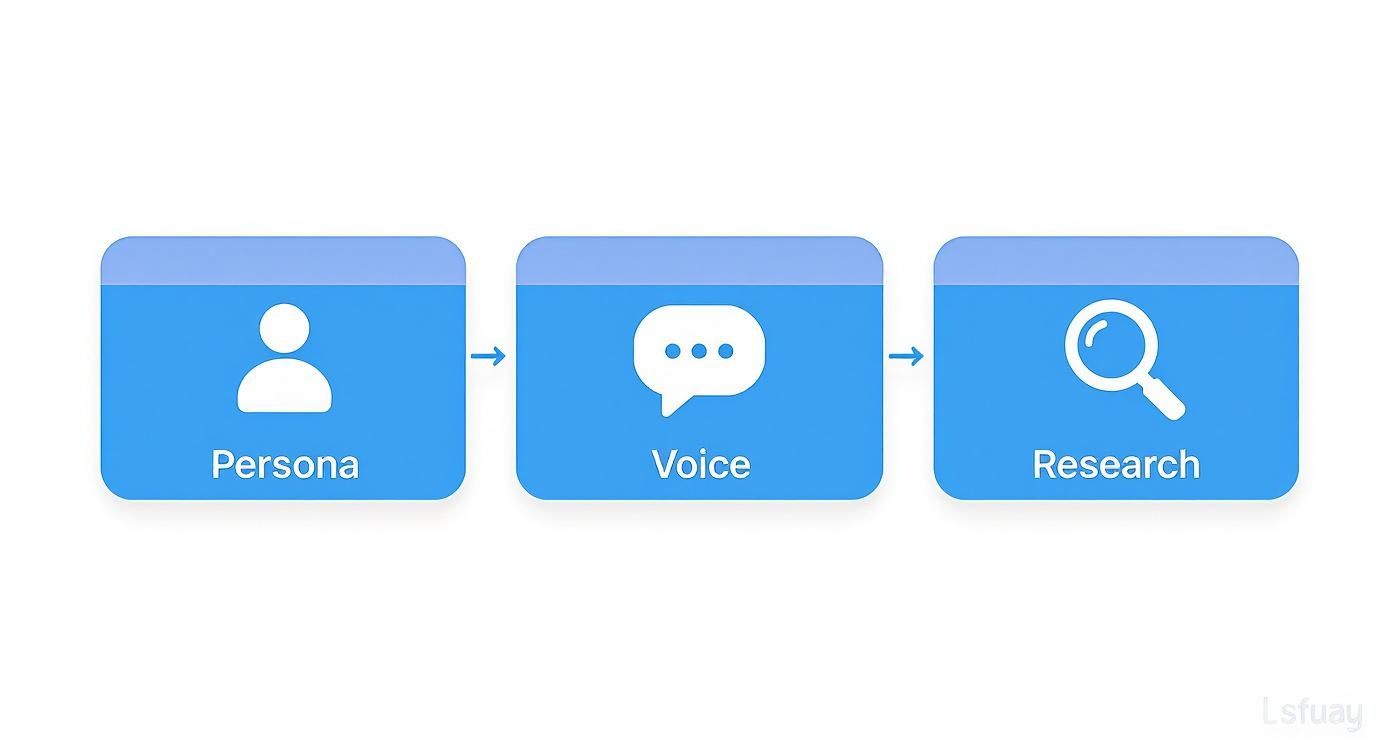
This little visual is a great reminder that everything—from your headline to your final call-to-action—is built on a deep understanding of your audience, a consistent voice, and solid research.
Let’s be real: people don't read online; they scan. Huge walls of text are the digital equivalent of a "Do Not Enter" sign. This is where the magic of bullet points comes in. They break up your copy and make your product's core value digestible in seconds.
But here’s the most common mistake I see people make: they list features, not benefits. A feature is what your product is. A benefit is what your customer gets.
Nobody buys a fabric spec sheet; they buy warmth and comfort. To make this translation second nature, think of it this way:
Framing every point around the customer's gain is a small shift in writing that makes a massive difference in conversion.
You've done all the hard work. You've grabbed their attention, built a connection, and showed them the value. Now, you need to tell them exactly what to do next.
Your Call-to-Action (CTA) shouldn't feel like a command. It should feel like a helpful suggestion that logically wraps up the conversation. Be clear, be direct, and use action-oriented language. "Add to Cart" and "Buy Now" are classics for a reason, but don't be afraid to get creative if it fits your brand voice. You could try "Start Your Adventure" or "Claim Your Calm."
Sometimes, a single structure won't fit every product. This is where you can get creative. Using a tool like Zemith's multi-model generation, you can feed it your core benefits and ask for different structural approaches—one as a set of punchy bullets, another as a short story, and a third in a classic Problem-Agitate-Solve format. This lets you quickly test what resonates best with your specific audience without starting from scratch every single time.
So, you’ve written a killer product description. That's great! But it won't do you any good if no one ever sees it. This is where we shift from being creative writers to strategic marketers. It’s time to get your descriptions found on Google and then make them absolutely irresistible once a shopper lands on your page.
This is about more than just cramming keywords into a paragraph and calling it a day. That old-school approach doesn't work anymore and, let's be honest, it makes you sound like a malfunctioning robot from a bad sci-fi movie. What we really need to do is figure out what your customers are actually typing into that search bar.
Solid SEO starts with understanding search intent. What problem is your customer trying to solve? Are they searching for "best running shoes for flat feet" or "eco-friendly waterproof hiking boots"? These aren't just random words; they're cries for help.
Your job is to answer that cry by naturally weaving these phrases into a few key places:
If you want to go deeper on optimizing the content on your product pages, including the descriptions themselves, you should definitely check out these on-page SEO best practices.
This is where a good AI tool can be your best friend. Instead of guessing, you can use a platform like Zemith to uncover Latent Semantic Indexing (LSI) keywords—those related terms that show Google you're a true expert on topics like "how to write a high-converting product description for fashion".
For instance, you can use Zemith's Smart Notepad to brainstorm and keep track of all these terms as you write.
Keeping your research and keyword ideas all in one place helps you weave them in naturally while ensuring your description is strategically optimized to get found.
Okay, so your SEO worked. They’re on your page. Hooray! Now, how do we nudge them to click that "Add to Cart" button? This is where the fun part begins: persuasion psychology. And no, we're not talking about manipulation—we're talking about connecting with fundamental human drivers.
Key Insight: People don't just buy products; they buy better versions of themselves. Your description needs to sell the feeling and the transformation, not just the physical item.
Let's break down a few powerful psychological triggers you can pull.
Social Proof: Why are customer reviews and testimonials pure gold? Because we're fundamentally social creatures. When we see that 1,500 people gave a product a five-star rating, our brain immediately thinks, "If it worked for them, it'll probably work for me." Don't be afraid to highlight your best reviews right in your description.
Scarcity and Urgency: This is the classic Fear Of Missing Out (FOMO). Phrases like "Limited Edition," "Only 3 left in stock," or "Sale ends Friday" create a sense of urgency that encourages people to act now. Just be sure to use it honestly. Fake scarcity can backfire and completely destroy trust.
Sensory Language: Your customers can't touch, smell, or taste your product online, so you have to paint a picture with your words. Use vivid, sensory adjectives that help them mentally "try on" the product. Don't just say "soft blanket"; try something like "a silky-soft, cloud-like blanket you can just sink into."
The quality of your writing here is everything. The growing demand for clear, compelling copy has fueled massive growth in the writing enhancement software market. Valued at USD 419.5 million in 2024, it’s expected to more than double by 2031—proof of just how critical polished writing is for selling online.
At the end of the day, both SEO and psychology boil down to understanding people. Before you can optimize a single keyword or use a psychological trigger, you have to know who you're talking to. To get this right, you first need a solid strategy. Check out our guide on how to conduct user research to build that essential foundation.
We’ve all been there. Staring at a blinking cursor on a blank page, fueled by lukewarm coffee and the slow-creeping dread of writer's block. It's the universal nightmare for anyone creating content, but let’s make sure it never happens to you again when you're on the hook for product descriptions.
The secret isn’t about suddenly becoming a literary genius overnight. It's about building a smart system that uses proven templates and a savvy AI partner to do the heavy lifting. This approach turns a tedious chore into a creative, efficient workflow that lets you crank out incredible descriptions at scale.
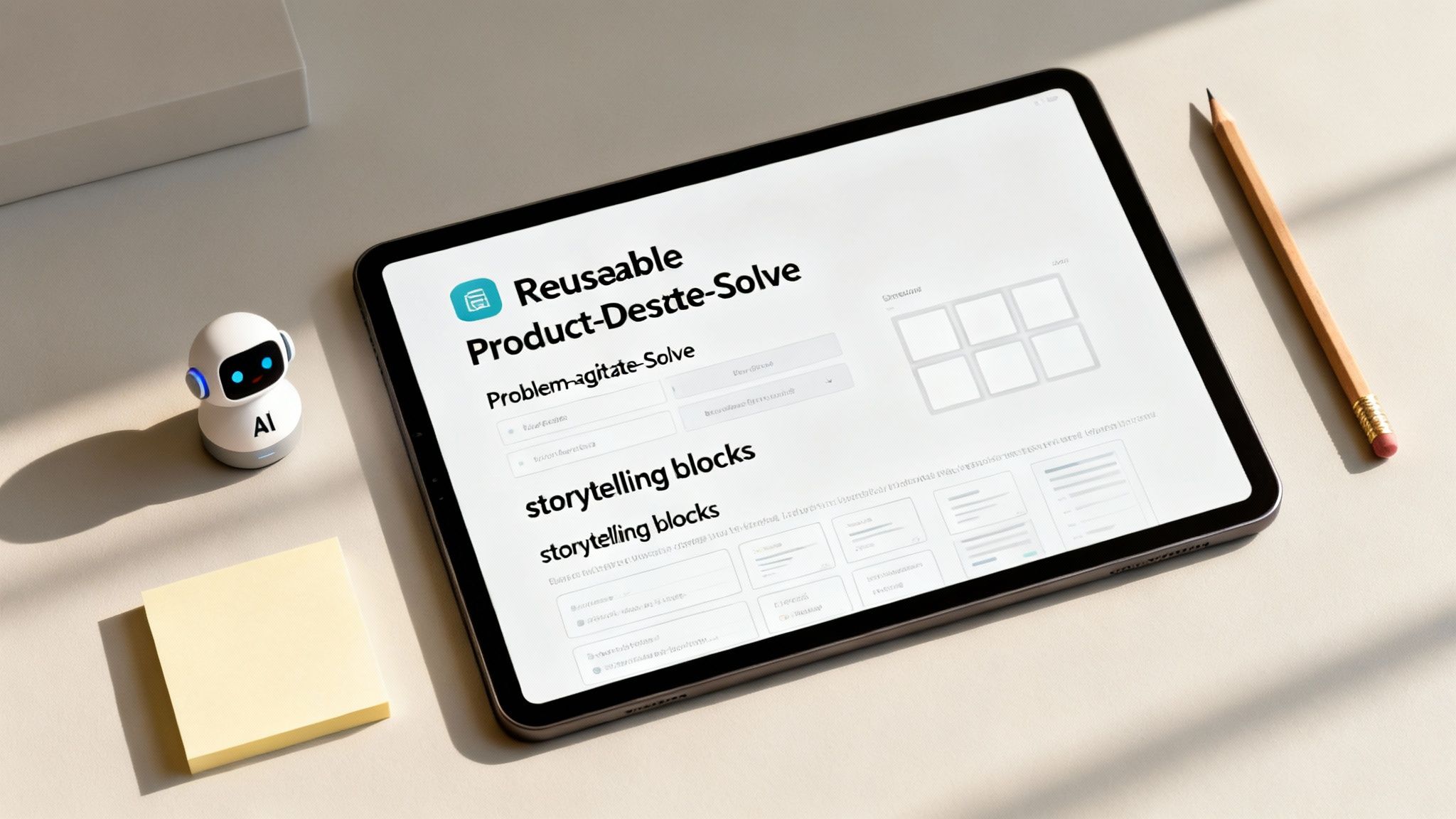
Look, you don't need to reinvent the wheel every single time. The best copywriters have been leaning on proven formulas for decades because these frameworks tap directly into human psychology. Think of them as recipes for persuasion.
Here are a couple of my go-to templates you can adapt for almost any product:
These formulas give you a solid structure and a jumping-off point to conquer that terrifying blank page. But a structure alone can still feel a bit skeletal. That’s where your new creative partner comes in.
Let’s get one thing straight: AI isn’t here to take your job. It’s here to be your super-powered brainstorming buddy and junior copywriter—one that runs on electricity instead of caffeine. This is all about working smarter, not harder.
Imagine you have a new product ready to go. Instead of trying to pull all the features and benefits out of thin air, you can use a tool like Zemith's Smart Notepad. Just drop in a messy list of specs, ideas, and random thoughts.
From there, the real fun begins. You can highlight those raw notes and ask the AI to:
My two cents: The goal isn't to have the AI write the final, perfect version for you. It’s about generating a fantastic first draft—or five of them—in seconds. This gives you high-quality clay to mold, saving you hours of painful effort and creative burnout.
Once you have a few solid drafts in hand, your role shifts from writer to editor and strategist. This is where your human touch is absolutely irreplaceable. Read through the options the AI gave you and pick the one that feels right.
Now, you can start refining it. Tweak the headline, punch up the bullet points, and inject your brand's unique personality. If a sentence feels a bit off or clunky, you don't have to wrestle with it from scratch. For instance, you can use an AI tool to rewrite text, making it clearer or more persuasive with just a click. If you want to see this in action, check out these different ways you can use AI to rewrite text to speed up your workflow.
This combination of proven templates and powerful AI creates a repeatable system. You get the speed of automation paired with the creativity and strategic eye that only a person can provide. The result? Way better descriptions, written in a fraction of the time.

Here’s a little secret the most successful e-commerce brands live by: hitting "publish" isn't the finish line. It's the starting gun. Your first draft, no matter how amazing you think it is, is really just your best educated guess. The real money is made in what comes next—the constant cycle of testing, tweaking, and optimizing your copy.
This is where writing stops being pure art and starts becoming a science. It's about letting your customers' actions tell you what works, not just your own gut instinct. Let's break down how you can make data-driven choices that actually grow your revenue, without needing a PhD in statistics to pull it off.
A/B testing (or split testing) sounds way more technical than it is. The concept is dead simple: you show one version of your description (Version A, the "control") to half your audience, and a slightly different version (Version B, the "variant") to the other half. Then, you just watch to see which one gets more people to click "Add to Cart."
The key is to be methodical. Don't just throw a bunch of random changes at the wall to see what sticks. Test one thing at a time.
Wondering where to start for the biggest impact? Try these:
My Two Cents: Don't get bogged down trying to test the placement of a single comma. Focus on the big-picture changes first—the headline, the CTA, the overall angle. These are the elements that create the biggest emotional swing and will have the most significant impact on your conversion rates.
So, what does this look like in the real world? Let's say you're selling a high-end coffee maker.
Your Control (Version A) headline might be something like: "Barista-Quality Espresso at Home with the AeroPress 5000."
Your Variant (Version B) could be: "Tired of Bitter, Burnt Coffee? The AeroPress 5000 is Your Fix."
You’d run the test for a week or two—long enough to get a meaningful number of visitors—and then check your analytics. If Version B resulted in a 15% lift in conversions, you've got a clear winner! Now, Version B becomes your new control, and you can move on to testing something else, like the CTA. This cycle of continuous improvement is how you turn a good product page into a great one.
To keep all this straight, you can set up simple workflows right inside a tool like Zemith. Create a project for your product, and use the Document Assistant to store both Version A and Version B of your copy. This keeps everything organized so you aren't hunting through random files trying to remember which version is which. It makes running these kinds of tests much less of a headache.
Testing isn't just for new products. Go pull up your analytics right now. See those product pages with decent traffic but a suspiciously high bounce rate or a conversion rate that's flatlining? Ding, ding, ding! Those are prime candidates for a copy refresh.
A "refresh" just means looking at your old descriptions with fresh eyes. You’re looking for things like:
This entire process is about making evidence-based decisions that directly improve your bottom line. If you want to dive deeper into this way of thinking, check out our guide on making smarter choices with data.
This focus on quality copy is only becoming more critical. The global content writing services market—which is heavily driven by e-commerce product descriptions—is projected to hit around USD 38.6 billion by 2033. That’s a massive leap from USD 19.9 billion in 2023. This explosive growth shows just how vital compelling copy has become for online success. This isn't just a "nice-to-have" skill anymore; it's a core business driver.
Alright, we've covered the frameworks, the psychology behind a great pitch, and the SEO tweaks. But I'm willing to bet a few questions are still rattling around in your head. That's totally normal.
Let's tackle those common "what ifs" and "how to's" right now. Think of this as your quick-hit FAQ for getting those descriptions done and dusted.
Ah, the million-dollar question. The honest answer? It depends. I know, I know—not the magic number you were hoping for, but a £10 tea tray just doesn't need the same word count as a £3,000 diamond ring.
The best approach I've found is to structure it in two parts:
This way, you cater to both the "I'm in a hurry" shopper and the meticulous researcher.
Please, for the love of all things marketing, don't do this. I'm practically begging you. Relying on the manufacturer's copy is a one-two punch that can really hurt your store.
First off, it���s a duplicate content nightmare. When Google sees the exact same text on a dozen different websites, it gets confused about who the original source is. This can seriously ding everyone's search rankings.
But more importantly, it's just a massive missed opportunity. That generic, feature-dump description has zero personality—and it definitely doesn't have your brand's voice. It wasn't written for your customers. Always, always take the time to write original copy. It's how you connect with people and make your brand memorable.
Stop thinking about a magic number. Seriously. Keyword stuffing is an old-school tactic that will make you sound like a robot and can even get you penalized by Google. The golden rule is to write for humans first, search engines second.
A much better way to think about it is natural placement. Here’s a simple guideline:
If it sounds clunky or forced when you read it out loud, cut it. Your top priority is always clarity and persuasion.
Key Takeaway: The single biggest mistake is listing features instead of selling benefits. A feature is what your product is (e.g., '100% merino wool'). A benefit is what the customer gets (e.g., 'Stay warm and comfortable without the itch'). Customers buy benefits, not features.
While keyword stuffing and lazy, generic descriptions are pretty bad, the absolute number one mistake I see people make is focusing on features instead of benefits. It’s such an easy trap to fall into.
Your customer doesn't actually care that your travel mug has a "dual-wall vacuum-insulated stainless steel build." What they really care about is that their coffee will still be piping hot three hours from now when they finally get a quiet moment to drink it.
Always ask yourself, "So what?" after you list a feature. The answer to that question is the benefit—and that's what you need to sell.
Ready to stop staring at a blank page and start writing product descriptions that actually sell? The right tools can make all the difference. With Zemith, you can manage your brand voice guidelines in the Document Assistant, brainstorm benefits with the Smart Notepad, and generate multiple high-quality drafts in seconds.







Trusted by teams at






The top models, plus image, video and voice tools, in one plan.
Without Zemith
ChatGPT PlusUS$20.00Claude ProUS$20.00Google AI ProUS$19.99SuperGrokUS$30.00Perplexity ProUS$20.00 MidjourneyUS$10.00
 ElevenLabsUS$6.00Le Chat ProUS$14.99
 RunwayUS$15.00Kling StandardUS$8.80
 Gamma PlusUS$12.00
 Otter ProUS$16.99
 QuillBot PremiumUS$19.95
 Photoroom ProUS$12.99
 Quizlet PlusUS$7.99
Total if paying separatelyUS$234.70/mo
"I love the way multiple tools they integrated in one platform. Going in the right direction."
— simplyzubair
"The quality of data and sheer speed of responses is outstanding. I use this app every day."
— barefootmedicine
"The credit system is fair, models are perfect, and the discord is very responsive. Quite awesome."
— MarianZ
"Just works. Simple to use and great for working with documents. Money well spent."
— yerch82
"The organization of features is better than all the other sites — even better than ChatGPT."
— sumore
"It lives up to the all-in-one claim. All the necessary functions with a well-designed, easy UI."
— AlphaLeaf
"The team clearly puts their heart and soul into this platform. Really solid extra functionality."
— SlothMachine
"Updates made almost daily, feedback is incredibly fast. Just look at the changelogs — consistency."
— reu0691
Hand off the research, writing, design and follow-ups. Zemith picks the tools it needs and brings back finished work.
Search the web, run deep research, read files, create images and run code with GPT, Claude, Gemini, Grok and more.
Zemith keeps working in the cloud and pings you when it's done.
Notion, Linear, Canva, Airtable and more. It asks before it creates or changes anything.
Docs, slides, sheets and PDFs, ready to send.
Chain models and tools on a visual canvas, from one prompt to a finished promo video.
Briefings, reports and reminders run on a schedule and are ready when you need them.
Real-time voice that can see your camera or screen.
The best image and video models, in one studio.
Turn PDFs, links and YouTube videos into podcasts, quizzes, flashcards and mind maps.












 Podcast
 Quiz
Quiz Flashcards
 Mind map
 Infographic