


Every top model, with tools built in.
Search the web, run deep research, read files, create images and run code with GPT, Claude, Gemini, Grok and more.
Discover 10 powerful rapid prototyping techniques to accelerate your projects. From 3D printing to AI code generation, learn how to innovate faster.
Ever had a brilliant idea but felt paralyzed by the thought of actually building it? You're not alone. The journey from a spark of inspiration to a tangible product can feel like trying to cross the Grand Canyon on a unicycle. It seems risky, slow, and probably ends in a spectacular, dusty failure. So, how do you make the leap?
What if you could build a solid bridge as you walked across? That’s the magic of modern rapid prototyping techniques.
This isn't just about making stuff; it's about learning, iterating, and validating ideas at lightning speed. Forget those soul-crushing, multi-year development cycles that burn through cash and motivation like a teenager with their first credit card. We're talking about going from a concept scribbled on a napkin to getting real user feedback in days, sometimes even hours. For creators building digital products, learning to accelerate this process is critical; a comprehensive mobile apps prototype guide for idea validation can be an invaluable resource to get started.
In this ultimate guide, we’ll break down 10 of the most impactful rapid prototyping techniques, covering everything from physical gadgets with 3D printing to cutting-edge software with AI. We'll explore not just what they are, but how you can use them today, complete with pros, cons, and insider tips to turn your 'what if' into 'what is.' We’ll even show you how a powerhouse AI tool like Zemith can act as your ultimate cheat code, supercharging every single one of these methods to get you to market faster. Ready to stop dreaming and start building? Let's dive in.
If you’ve ever wished you could just pull a physical object out of your computer screen, 3D printing is basically that wish granted by a friendly tech genie. Formally known as additive manufacturing, this technique constructs three-dimensional objects layer-by-layer from a digital file (like a CAD model). Think of it as a hot glue gun with a computer brain, meticulously building an object from the ground up using materials like plastic, resin, or even metal.
This method is the undisputed king of fast, physical iteration. It's one of the most accessible and versatile rapid prototyping techniques available, letting you turn a design into a tangible, hold-it-in-your-hand prototype in a matter of hours, not weeks.
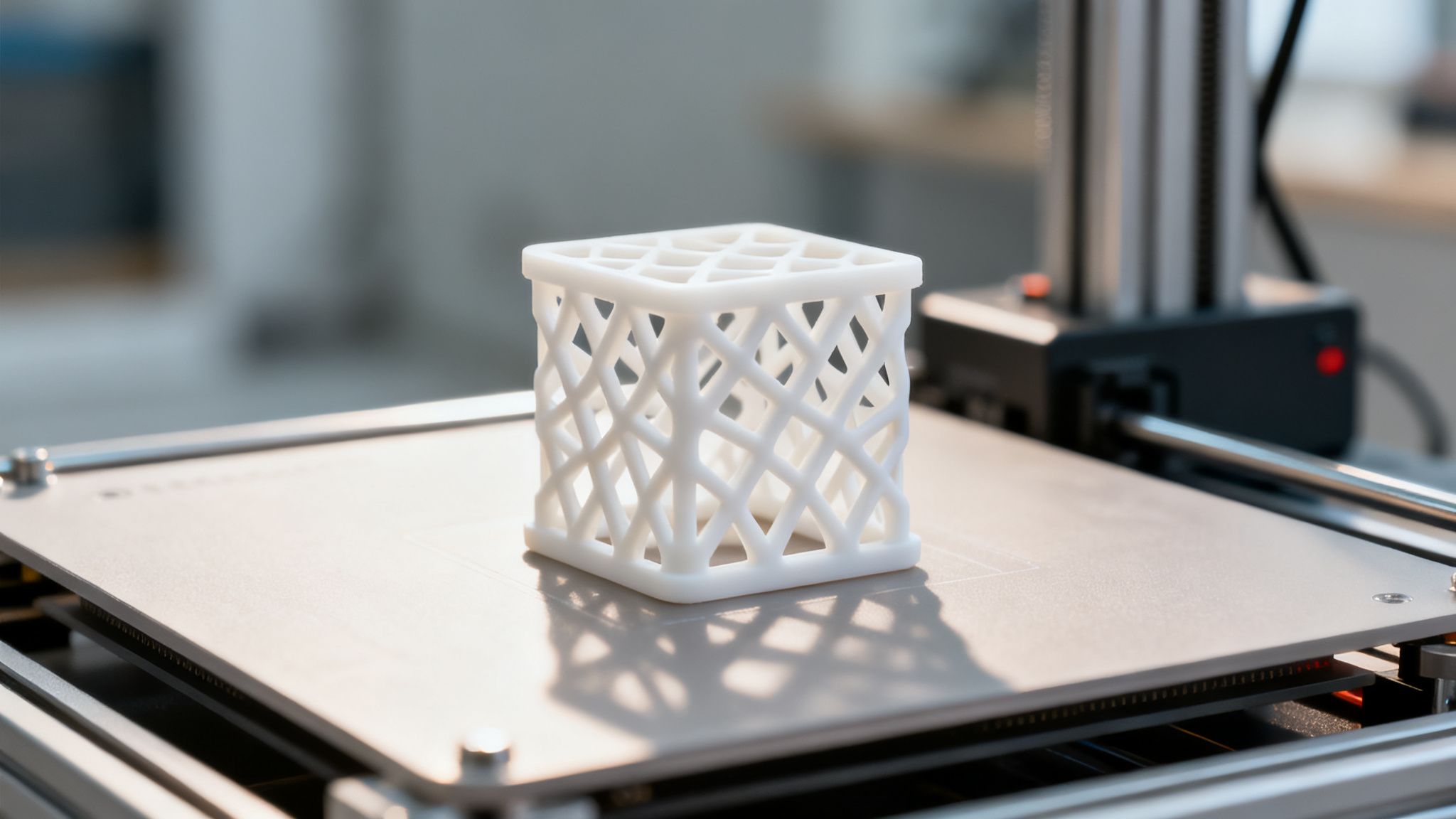
The beauty of 3D printing lies in its speed and relatively low cost for single parts, which is perfect for an iterative design process. Automotive giants like those working with Stratasys use it to prototype everything from door handles to engine components, drastically cutting development time. Similarly, medical device companies can print and test surgical instrument prototypes for ergonomic feel and function before committing to expensive tooling.
If 3D printing is pulling a physical object from a screen, wireframing is like sketching its soul on a napkin first. This technique creates simplified, schematic blueprints of digital interfaces. Using basic shapes and placeholder text, these low-fidelity mockups focus entirely on structure, layout, and user flow, intentionally ignoring aesthetics like colors or fonts. It’s the digital equivalent of an architect’s initial floor plan before they start picking out paint colors.
This approach is the champion of conceptual speed. As one of the most fundamental rapid prototyping techniques, wireframing lets you map out and test an entire application's user experience with almost zero technical overhead, allowing for lightning-fast changes based on early feedback. It’s all about the "what" and "where," not the "how it looks."
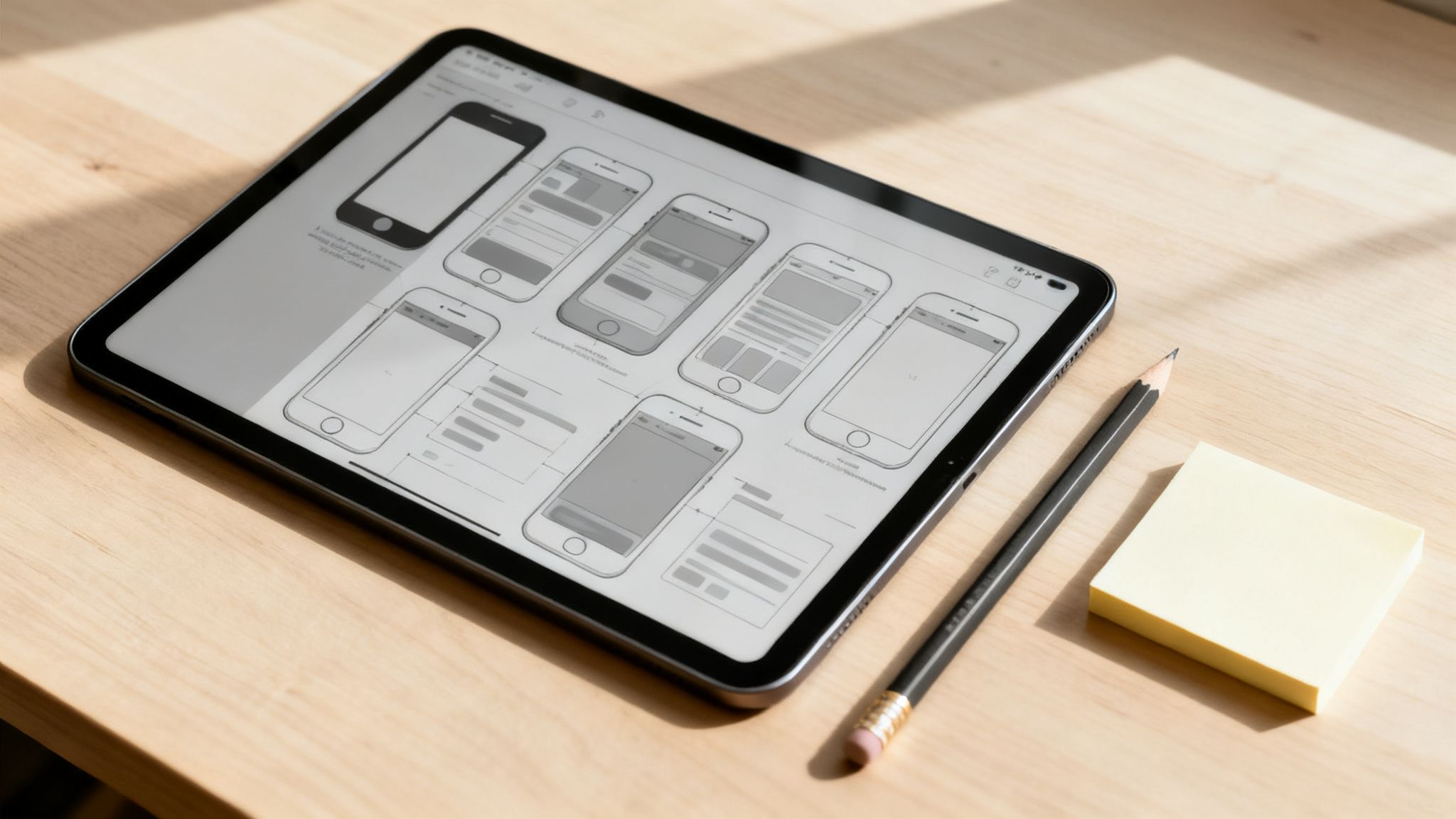
The power of wireframing is in its simplicity and cost-effectiveness. It separates the conversation about functionality from the conversation about visual design, preventing stakeholders from getting stuck on the wrong shade of blue. Spotify famously uses this process to refine navigation structures, ensuring users can find their doom-scrolling playlists effortlessly. It allows teams to fail fast and cheap, testing dozens of layout ideas before a single line of code is written.
If physical prototypes are about testing how something feels, clickable prototypes are about testing how an experience flows. This technique stitches static design screens (wireframes or high-fidelity mockups) together with interactive hotspots, transitions, and logic. The result is a simulation of a final app or website that users can click through as if it were the real thing, but without a single line of backend code. It’s like a movie set—looks real, but don't peek behind the curtain.
This method is the backbone of modern UX/UI design and a cornerstone of digital rapid prototyping techniques. It allows you to validate user journeys, test navigation, and gather crucial feedback on usability long before development kicks off. It's the difference between asking a user "Would this button make sense here?" and watching them actually try to use it.
The power of clickable prototypes is in their ability to uncover usability issues cheaply and early. Companies like Uber use them to prototype and test new driver and rider flows, ensuring a seamless experience before committing massive engineering resources. Similarly, an e-commerce platform can build an interactive mockup of its checkout process to identify friction points that might cause users to abandon their carts, directly impacting the bottom line.
If you've ever built something piece-by-piece, getting feedback as you go, you've experienced the core of Agile. This approach organizes development into short, fixed-duration cycles called sprints (usually 1-4 weeks). In each sprint, a cross-functional team builds, tests, and iterates on a small, functional slice of the final product. It’s like building a car by first delivering a working skateboard, then a scooter, then a bicycle, instead of waiting months to deliver the whole car at once.
Agile sprints are one of the most powerful rapid prototyping techniques for software and digital products. This method transforms the development process into a continuous loop of building, measuring, and learning, ensuring the final product actually solves the user's problem.
The magic of sprints is the rapid feedback cycle. Instead of waiting six months to find out a core feature is unwanted, you find out in two weeks. Spotify famously scaled this with their squad-based model, and Amazon's "two-pizza teams" use sprints to deliver new features with incredible speed. This iterative nature minimizes risk, prevents wasted effort, and keeps the team hyper-focused on delivering value. For teams new to this structure, engaging with dedicated Agile sprint-based development services can help establish a strong foundation.
Before you write a single line of code or open a complex CAD program, reach for the most powerful and ancient prototyping tool known to humankind: a pen and paper. Paper prototyping is the art of creating hand-drawn, tangible mockups of interfaces, products, or user flows. It’s the ultimate back-to-basics approach that puts speed and collaborative ideation above all else.
This method is the heart and soul of ultra-low-fidelity iteration. It’s one of the fastest and cheapest rapid prototyping techniques for testing core concepts, user journeys, and fundamental layouts. You can literally go from a vague idea to a testable "product" in the time it takes to brew a pot of coffee.
The sheer simplicity of paper prototyping makes it incredibly powerful. It strips away all technical barriers, inviting everyone on the team, from developers to marketers, to contribute. Design consultancies like IDEO famously use it in workshops to get immediate feedback. Even Google’s early Android interface concepts began as simple sketches, allowing them to explore countless ideas without getting bogged down by digital tools. It's perfect for validating an MVP concept before you even think about building it.
Instead of building a physical object, imagine building the absolute bare-bones version of a software product to test a core idea. That’s the essence of Minimum Viable Product (MVP) development. Popularized by Eric Ries in "The Lean Startup," this approach involves creating a version of a new product that allows a team to collect the maximum amount of validated learning about customers with the least effort. It's about getting a functional-but-basic product into the hands of real users as fast as possible.
An MVP isn't a clunky, half-finished product; it's a strategic experiment. As one of the most powerful rapid prototyping techniques for software and business models, it prioritizes real-world feedback over perfecting every feature. It answers the critical question: "Should we even build this thing?" before you sink millions into development.
The MVP approach is all about speed and learning. It drastically reduces the risk of building something nobody wants. Dropbox famously started not with code, but with a simple explainer video demonstrating its file-syncing concept. The video drove thousands of sign-ups overnight, proving people wanted the product before a single line of code was commercially deployed. Similarly, Airbnb’s MVP was just a basic website with photos of the founders' own apartment to test if people would pay to stay in a stranger’s home.
Imagine having a seasoned pair programmer who never sleeps, knows nearly every programming language, and can whip up a functional code snippet from a simple English sentence. That’s the magic of AI-powered code generation. This technique uses large language models to automatically write, complete, and even debug code, effectively acting as a supercharged assistant for developers. It's not about replacing programmers; it's about giving them superpowers.
This method has quickly become one of the most transformative rapid prototyping techniques for software development. By automating the tedious, boilerplate parts of coding, developers can focus on the complex logic and creative problem-solving needed to bring a digital product to life at lightning speed.

The core benefit of AI-powered development is raw speed. GitHub famously reported that developers using its Copilot tool write code up to 55% faster. This acceleration is crucial for rapid prototyping, where the goal is to build a Minimum Viable Product (MVP) quickly to test an idea. Instead of spending a week setting up a database and API endpoints, an AI assistant can generate that foundational code in minutes, letting teams build and validate their concepts faster than ever before.
If you build a prototype in the forest and no one is around to test it, does it even make sense? User testing is the critical process of putting your prototype, no matter how rough, in front of actual users to see how they react. It’s a reality check that moves you from "we think users want this" to "we know users need this."
This method is one of the most powerful rapid prototyping techniques for digital and physical products because it closes the gap between your assumptions and user reality. By creating a rapid feedback loop, you systematically gather insights, identify fatal flaws, and validate good ideas before you’ve spent a fortune building the final product.
The real value of user testing is its ability to save you from building the wrong thing. Apple is legendary for its obsessive, iterative user testing, which ensures their products feel intuitive from the first touch. Similarly, digital giants like Netflix continuously test UI variations on small user groups to optimize engagement, ensuring every tweak improves the user experience before it rolls out globally. This constant feedback is the engine of user-centered design.
This technique is less about a specific tool and more about a powerful mindset. Design thinking is a human-centered problem-solving framework where you empathize with users, define their needs, brainstorm solutions, and then rapidly prototype and test those ideas. It's the "why" behind the "what," forcing you to build prototypes with purpose.
Rather than just making a thing, design thinking ensures you're making the right thing. It treats prototyping not as a final step, but as a core part of the learning process. This makes it one of the most strategic rapid prototyping techniques, focusing on validating concepts with real user feedback from the earliest stages.
The power of design thinking is in its ability to de-risk innovation. By embracing a "fail fast, learn faster" mentality, it saves immense time and resources. IDEO famously used this process to redesign the shopping cart experience, and healthcare systems now use it to improve patient care pathways. It's about building low-fidelity prototypes quickly to test assumptions before a single line of production code is written or a single mold is made.
Ever felt like you have a million-dollar idea in your head but can't quite draw or code it into existence? Generative AI is like having a team of tireless, lightning-fast junior designers and developers at your beck and call. This approach uses AI models, like those from OpenAI or Midjourney, to generate designs, code, and content from simple text descriptions, also known as prompts.
This isn't just a sci-fi dream; it's one of the most transformative rapid prototyping techniques for the digital age. Instead of spending days mocking up a concept, you can type a description and get dozens of variations in minutes. It's the ultimate tool for exploding the "ideation" phase and exploring creative directions you might never have considered otherwise.
The sheer speed of variation is what makes generative AI so powerful. A product team can generate descriptions for multiple wireframe layouts to A/B test concepts before a single line of code is written. Marketing teams use it to brainstorm entire campaigns, generating ad copy, slogans, and visual concepts in a single afternoon. It dramatically lowers the barrier to entry for creating initial drafts, whether it's for an app interface, a blog post, or a product's visual identity.
We've just sprinted through a packed toolbox of rapid prototyping techniques, from the satisfyingly tangible feel of a 3D-printed model to the mind-bending speed of AI-generated code and design. We've sketched on paper, built clickable mockups, and even framed entire products as Minimum Viable Products (MVPs). If you take one thing away from this deep dive, let it be this: the most successful creators and innovators are not fortune tellers; they are masters of rapid learning.
The core purpose of every single method we discussed is to shrink the dangerous, expensive gap between a brilliant idea and real-world feedback. It’s about replacing the old "waterfall" model of spending months (or years!) building in a silo with a cycle of quick, informed, and iterative loops. You build a little, test a lot, learn even more, and repeat. This is how you outmaneuver the competition and avoid building something nobody actually wants. Remember that disastrous product launch from that one company? Yeah, they probably skipped the prototyping phase.
The beauty of this list is that you don't need to become an expert in all ten techniques at once. The real skill is knowing which tool to pull out for the job at hand. Think of it as a troubleshooting guide for innovation:
The overarching theme is a bias for action. The tools are here, they are more accessible than ever, and they are begging you to stop over-analyzing and start doing.
One of the most powerful threads weaving through modern rapid prototyping is the integration of artificial intelligence. From Generative AI helping you brainstorm initial concepts to AI assistants writing and debugging code, this technology acts as a massive force multiplier. It automates the tedious, accelerates the complex, and opens up creative avenues you might not have considered.
This is where having a centralized, AI-native workspace becomes a game-changer. Instead of juggling a dozen different apps for research, writing, coding, and collaboration, you can consolidate your entire prototyping workflow. Think about it: you can use an AI to brainstorm user personas, generate wireframe descriptions, write the code for a clickable element, and then draft the user testing script, all in one place. This isn't just about being faster; it's about being smarter, more cohesive, and more creative.
Ultimately, the best rapid prototyping techniques are the ones you actually use. Choose your starting point, embrace the idea of "good enough for now," and get your idea out of your head and into the world. Your next great breakthrough is just one quick prototype away.
Ready to unify your workflow and supercharge your creative process? Zemith is the all-in-one, AI-powered workspace designed to help you research, write, and code faster, making it the perfect companion for all your rapid prototyping needs. Stop switching between tabs and start building your next big idea by visiting Zemith today






Trusted by teams at






The top models, plus image, video and voice tools, in one plan.
Without Zemith
ChatGPT PlusUS$20.00Claude ProUS$20.00Google AI ProUS$19.99SuperGrokUS$30.00Perplexity ProUS$20.00 MidjourneyUS$10.00
 ElevenLabsUS$6.00Le Chat ProUS$14.99
 RunwayUS$15.00Kling StandardUS$8.80
 Gamma PlusUS$12.00
 Otter ProUS$16.99
 QuillBot PremiumUS$19.95
 Photoroom ProUS$12.99
 Quizlet PlusUS$7.99
Total if paying separatelyUS$234.70/mo
"I love the way multiple tools they integrated in one platform. Going in the right direction."
— simplyzubair
"The quality of data and sheer speed of responses is outstanding. I use this app every day."
— barefootmedicine
"The credit system is fair, models are perfect, and the discord is very responsive. Quite awesome."
— MarianZ
"Just works. Simple to use and great for working with documents. Money well spent."
— yerch82
"The organization of features is better than all the other sites — even better than ChatGPT."
— sumore
"It lives up to the all-in-one claim. All the necessary functions with a well-designed, easy UI."
— AlphaLeaf
"The team clearly puts their heart and soul into this platform. Really solid extra functionality."
— SlothMachine
"Updates made almost daily, feedback is incredibly fast. Just look at the changelogs — consistency."
— reu0691
Hand off the research, writing, design and follow-ups. Zemith picks the tools it needs and brings back finished work.
Search the web, run deep research, read files, create images and run code with GPT, Claude, Gemini, Grok and more.
Zemith keeps working in the cloud and pings you when it's done.
Notion, Linear, Canva, Airtable and more. It asks before it creates or changes anything.
Docs, slides, sheets and PDFs, ready to send.
Chain models and tools on a visual canvas, from one prompt to a finished promo video.
Briefings, reports and reminders run on a schedule and are ready when you need them.
Real-time voice that can see your camera or screen.
The best image and video models, in one studio.
Turn PDFs, links and YouTube videos into podcasts, quizzes, flashcards and mind maps.












 Podcast
 Quiz
Quiz Flashcards
 Mind map
 Infographic