


Every top model, with tools built in.
Search the web, run deep research, read files, create images and run code with GPT, Claude, Gemini, Grok and more.
Create a winning tone of voice guide with practical steps and Zemith tools. Perfect for brands wanting consistent, authentic communication.
“Just be yourself” is charming advice for a dinner party. It's lousy advice for a brand. Brands don't have one self. They have founders, freelancers, product managers, support agents, executives, agencies, and an alarming number of people who believe “professional” means adding “utilize” to every sentence.
A tone of voice guide turns personality into a working system. It defines the vocabulary, rhythm, emotional range, and situational behavior your team can repeat across marketing, product copy, documentation, support, and AI-assisted drafts. Tone-of-voice guidance became a formal part of brand identity practice during the 1970s, as agencies recognized that wording and sentence structure could shape how audiences perceived a brand's personality and values. Barnaby Benson's overview of tone-of-voice development traces that shift from visual identity alone toward language as a managed brand asset.

The business case is consistency, not literary decoration. A frequently cited Lucidpress study reported that consistent brand presentation can increase revenue by an average of 23%, with the upper range reaching 33%, while another summary says more than two-thirds of organizations running brand-consistency programs achieved double-digit revenue improvements. Those figures concern brand presentation broadly, not tone alone, so they don't prove that a tone guide independently creates a specific revenue lift. They do show why language governance belongs in the operating system, not in a forgotten folder called “Brand Stuff Final v7.”
For a platform such as Zemith, the challenge is sharper. Research, coding, creative work, education, and productivity each invite different language, but the audience should still recognize the same underlying personality. A useful guide protects that identity while letting tone adapt to the moment. If you're building the system from scratch, start with this practical guide to using AI for writing, then make sure the rules are specific enough for a human or an AI tool to follow.
“Be authentic” sounds wise because nobody wants an artificial brand. The trouble starts when authenticity becomes an excuse to avoid decisions. A company tells every writer to sound natural, then wonders why one landing page reads like a legal notice, the next email sounds like a stand-up comedian, and the support center speaks fluent robot.
Authenticity isn't a strategy. It's the raw material.
Your voice needs boundaries. Decide whether contractions are welcome, whether humor belongs in error messages, which technical terms need explanation, and how much enthusiasm fits a serious research result. Without those choices, every employee fills in the blanks with personal preference. The loudest personality wins, and the brand slowly becomes a group chat with a logo.
A consistent voice helps readers know what to expect. It also makes editorial review practical because a reviewer can assess observable behaviors instead of arguing about whether a sentence “feels right.” A guide can specify preferred vocabulary, sentence length, formality, emotional register, audience adaptations, and examples of effective and ineffective language. Nielsen Norman Group's guidance on voice and tone makes the essential distinction clear: voice is the stable personality, while tone changes with the situation.
Practical rule: If two competent writers can read your guide and produce noticeably different brands, you haven't written a guide. You've written a mood board.
That distinction matters for AI-assisted content too. A generator can produce fluent copy that sounds acceptable while flattening your personality, overstating certainty, or choosing language your audience wouldn't use. The answer isn't to ban AI. It's to give humans and tools the same written standards, approval rules, and examples.
A strong tone-of-voice guide becomes a competitive advantage because it shortens the distance between strategy and execution. New writers know where to start. Product teams stop inventing terminology. Support agents can respond with empathy without improvising a new personality. Marketing can move quickly without making the brand sound like it changed management overnight.
Forget “friendly, professional, and original.” Those adjectives are so broad they could describe a bank, a dentist, or a company selling artisanal dog shampoo. A useful framework turns personality into decisions people can test.
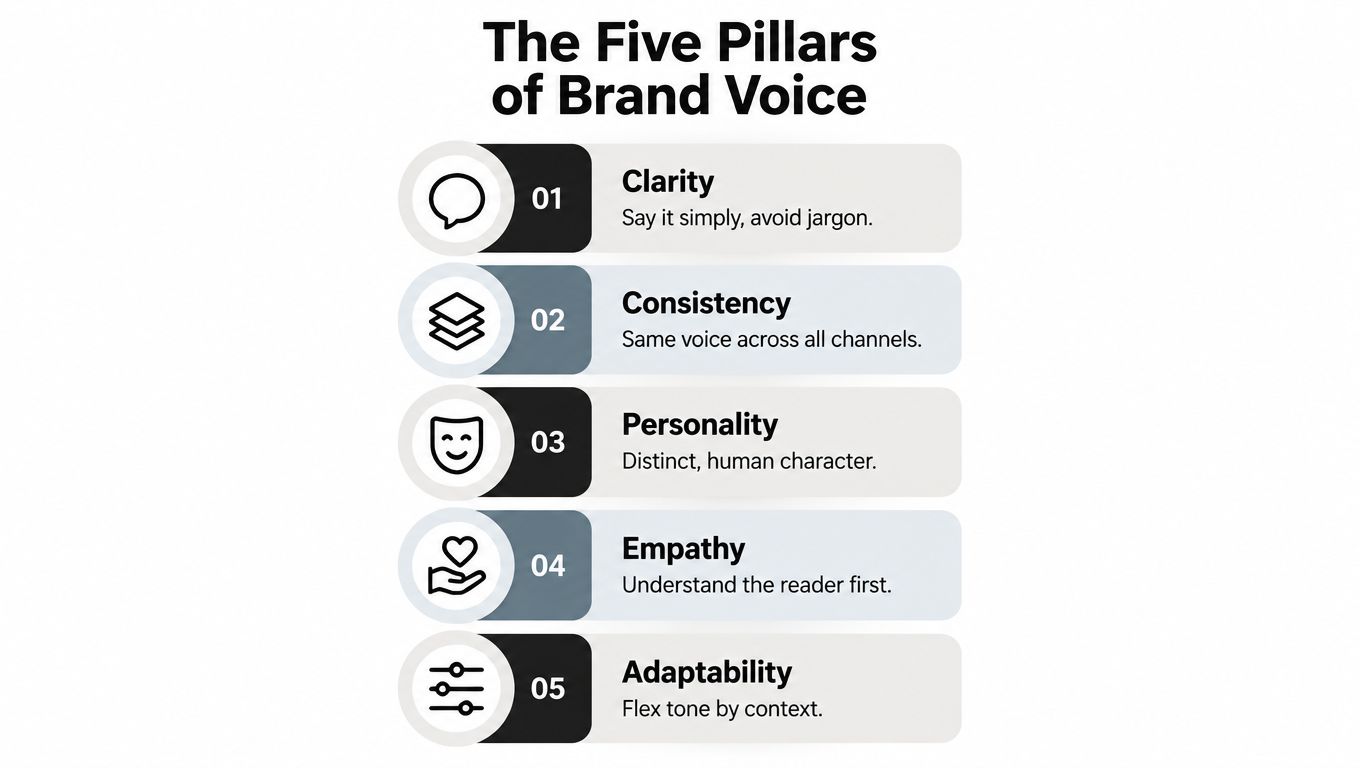
List words your brand uses, words it avoids, and terms that require explanation. Zemith might choose “research,” “workspace,” “draft,” and “try again,” while avoiding inflated phrases such as “revolutionary synergy” or “seamless paradigm.” The point isn't to create a precious little dictionary. It's to remove repeated arguments from everyday writing.
Include terminology rules for product names, feature descriptions, interface labels, and user references. If marketing calls people “creators” while support calls them “accounts,” decide whether that distinction matters or whether everyone should use one term.
Sentence structure creates rhythm. Short sentences feel direct. Longer sentences can show nuance and respect a technical reader's attention, provided they don't wander into the forest and lose the subject.
Define whether writers may use fragments, how often they should use active voice, whether contractions are normal, and how much passive construction is acceptable in documentation. “Use plain English” isn't enough. Show the difference:
Voice stays stable, but tone shifts with context. Use conversational formality and moderate enthusiasm in onboarding. Use restrained enthusiasm and high respectfulness in billing issues, research disclaimers, and error states. Humor belongs in exploratory content only when it won't increase confusion or make a frustrated person feel mocked.
Experts and beginners don't need identical explanations. They do need the same underlying values. A developer may appreciate precise terminology, while a student may need the term defined before seeing an example. Accessibility also requires more than readable fonts. Tate's guidance on clear and accessible communications distinguishes physical access from cognitive access and shows why idioms, dense syntax, jargon, and weak structure can exclude readers.
An ad can be expressive. A help article should be patient. A social post can be compact. A security notice should be measured. The personality remains recognizable, but the amount of personality changes.
For teams managing many campaign variations, operational consistency matters beyond copy. Resources such as one-click bulk ad uploads can help organize production across advertising workflows, but the underlying language rules still need a human-owned guide. Use the channel as a constraint, not as permission to become a different company.
A practical writing style guide template can help turn these pillars into vocabulary tables, tone ranges, examples, and review questions instead of a page full of decorative adjectives.
A tone-of-voice guide doesn't need a branding retreat, a scented candle, or a consultant who describes punctuation as “a journey.” You can build a useful version by studying what you already publish, making deliberate choices, and testing those choices against real situations.
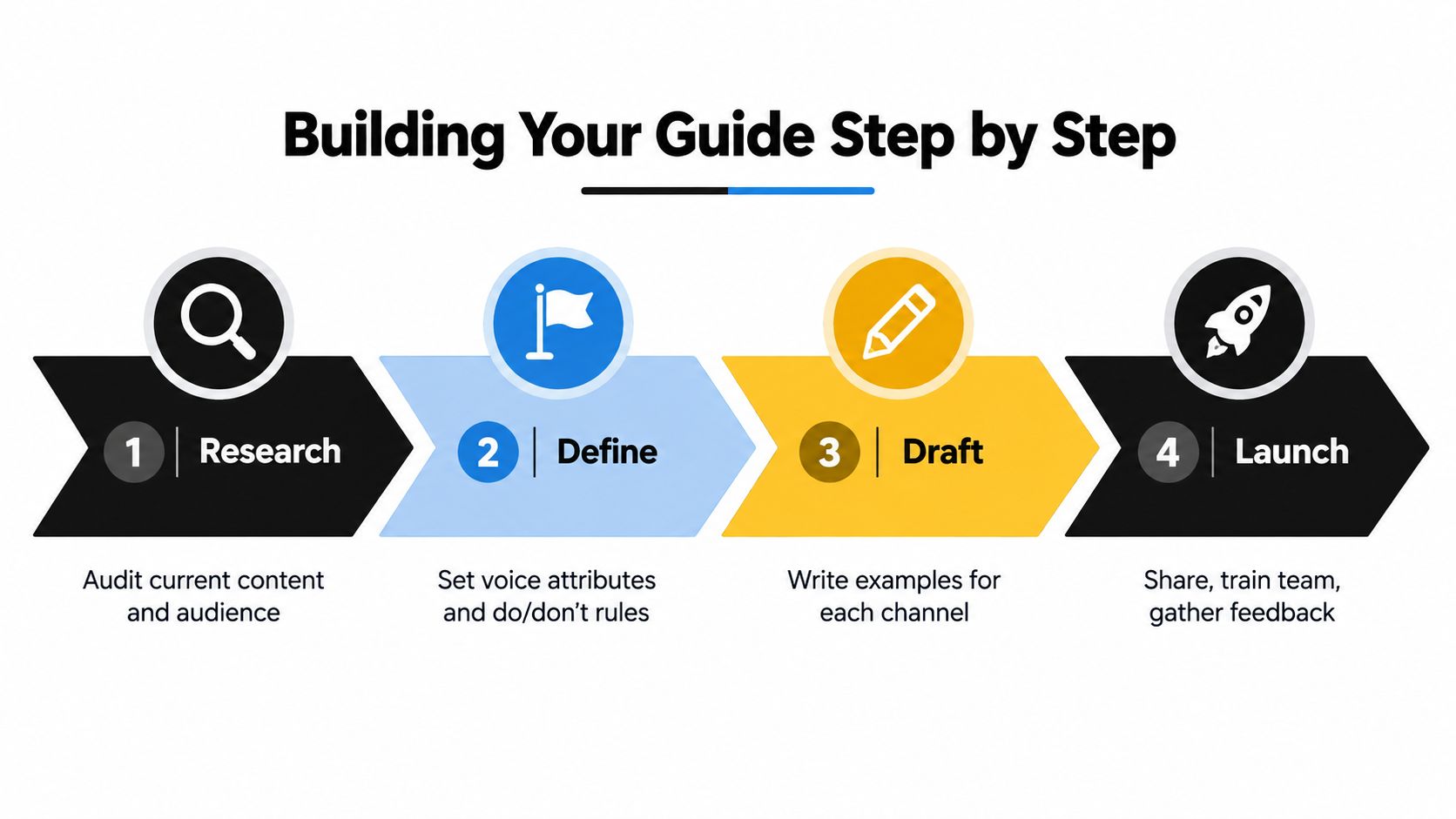
Collect representative samples from your website, email, product interface, help center, sales materials, support replies, and social channels. Don't select only your best work. The awkward examples are useful because they reveal where the brand already loses its shape.
Tag each sample for clarity, confidence, warmth, terminology, formality, and context fit. Note repeated problems. Perhaps marketing overuses hype, product copy hides the verb, or support apologizes so much that the actual solution disappears.
Avoid attributes that can't guide behavior. “Human” is too loose. “Plainspoken, capable, and lightly playful when the user isn't under pressure” gives a writer something to do.
For each trait, write three lines:
For example, “confident” might mean making a clear recommendation. It doesn't mean promising results you can't prove.
Create a tone matrix for the moments your team handles most often:
Then add examples for each row. “Be reassuring” isn't operational until someone can see the sentence.
Use a simple rubric that scores clarity, task alignment, confidence, warmth, and terminology discipline from 1 to 5. This scoring approach is recommended in the verified guidance for measurable tone quality, alongside user testing and audits. Review a sample with target users, then look beyond preference. Can they understand the message, complete the task, recover from an error, and avoid escalating to support?
Finish with ownership. Someone must have the final call when a sentence sits between “confident” and “smug.” For additional practical context, Legacy Builder on brand voice offers useful perspective on connecting voice guidelines with brand authority.
Keep the guide short enough to use and detailed enough to prevent guessing. A brand guidelines creation workflow can help connect verbal rules with the wider identity system.
The best guide is useless if it lives in a document nobody opens. The practical test is simple: can a writer find the right rule while drafting, and can a reviewer check the result without starting a philosophical debate?
Zemith can support that workflow as an all-in-one AI workspace. Its role isn't to replace editorial judgment. It can hold the guide, apply the rules to drafts, organize approved language, and help teams compare versions while people remain responsible for accuracy, context, and final approval.
Place the approved guide, vocabulary table, tone matrix, and before-and-after examples in the Document Assistant or Library. Instead of asking a teammate, “Do we say users or creators?” a writer can search the shared material and apply the answer to a draft.
Projects can keep campaign-specific context together. A launch project might contain product facts, target audience notes, approved claims, channel requirements, and the relevant tone variant. That reduces the classic failure where a writer follows the brand voice but misses the campaign's actual constraints.
Smart Notepad can rephrase, shorten, adjust style, and turn rough notes into polished copy. A useful prompt might say: “Rewrite this onboarding message in our clear, capable, human voice. Keep the product terminology unchanged. Use a calm tone and explain the next action.” That instruction is much stronger than “make it sound better,” which is how writers accidentally produce twelve versions of the same beige sentence.
The platform also supports document interaction, research, coding assistance, creative work, and organized workspaces. That matters when one brand serves several teams. The same language rules can inform a help article, a code explanation, an educational document, or campaign copy without forcing every format into the same shape.
For drafts that are technically correct but emotionally wrong, an AI tone rewriter can move language toward a specified tone while preserving intent, terminology, certainty, and required details. Review the result rather than publishing it blindly. AI can preserve a sentence's requested tone while missing a factual or accessibility problem, and a polished error is still an error wearing a nice jacket.
A guide becomes operational when it has an owner, a workflow, and consequences for ignoring it. Without those three things, the document will sit unused while every channel develops its own dialect.
HubSpot, citing Marq's State of Brand Consistency research, reports that 69% of companies either lack widely adopted brand guidelines or don't have them at all (HubSpot's branding guidance). The lesson isn't “write a longer document.” It's “make the document usable.”
Assign one owner, usually a content lead, brand lead, or editorial manager. Contributors can challenge a rule, but one person resolves borderline cases and records the decision. Committees are excellent at producing safe language and terrible at deciding whether “delightful” belongs in an error message.
Build review into existing workflows:
Don't require every sentence to pass through a central team. Reserve human review for high-risk content, new scenarios, claims, legal language, customer complaints, and messages that introduce new terminology.
Brandwatch identifies content audits, audience surveys, social listening, aided and unaided recall, branded search trends, and social mentions as useful ways to monitor voice consistency (Brandwatch's brand voice guidance). You don't need to turn this into a data cathedral. Collect samples from different channels, tag them for the core traits, and look for patterns.
Review the guide when the product, audience, or channels change. Add examples when writers repeatedly ask the same question. Remove rules nobody follows because they're too vague or too fussy. A living guide gets better through friction.
Store reusable instructions in a shared prompt library. Include prompts for onboarding, support, research explanations, product updates, and channel rewrites. Each prompt should state the audience, desired tone, prohibited behaviors, terminology requirements, and review expectations.
A support agent writes “No worries, bestie” during a billing complaint. A developer turns an error message into “An unexpected issue has occurred during the execution of your request.” Marketing promises “effortless results” for a workflow that requires six setup steps. Nobody meant to damage the brand. Someone just guessed.
The fix starts by separating variation from drift. Variation is a sensible adjustment for audience or channel. Drift changes the underlying identity, breaks terminology, increases confusion, or uses a tone that clashes with the user's emotional state.
When a bad draft appears, don't launch a courtroom drama. Ask four questions:
For an error message, replace vague reassurance with a clear explanation and next step. For support, remove forced humor and acknowledge the actual problem. For technical copy, keep the necessary precision but explain the term that blocks comprehension.
Then save the repaired example. A guide becomes smarter when it captures real mistakes, not just polished sentences written during a brand workshop where everyone had snacks and unrealistic optimism.
The mature approach is iterative. Test representative messages with target users, watch comprehension and task completion, and pay attention to support escalation and error recovery. Voice should make the product easier to understand, not merely easier for internal reviewers to admire.
A tone-of-voice guide won't stop every awkward sentence. It gives your team a shared way to spot, fix, and learn from them. That's the difference between a brand that occasionally sounds human and one that consistently behaves like it has a point of view.
Zemith brings your tone guide, approved language, research, drafting tools, and reusable prompts into one workspace so your team can produce consistent content without sanding off its personality. Visit Zemith to build a practical voice system that people and AI tools can use.







Trusted by teams at






The top models, plus image, video and voice tools, in one plan.
Without Zemith
ChatGPT PlusUS$20.00Claude ProUS$20.00Google AI ProUS$19.99SuperGrokUS$30.00Perplexity ProUS$20.00 MidjourneyUS$10.00
 ElevenLabsUS$6.00Le Chat ProUS$14.99
 RunwayUS$15.00Kling StandardUS$8.80
 Gamma PlusUS$12.00
 Otter ProUS$16.99
 QuillBot PremiumUS$19.95
 Photoroom ProUS$12.99
 Quizlet PlusUS$7.99
Total if paying separatelyUS$234.70/mo
"I love the way multiple tools they integrated in one platform. Going in the right direction."
— simplyzubair
"The quality of data and sheer speed of responses is outstanding. I use this app every day."
— barefootmedicine
"The credit system is fair, models are perfect, and the discord is very responsive. Quite awesome."
— MarianZ
"Just works. Simple to use and great for working with documents. Money well spent."
— yerch82
"The organization of features is better than all the other sites — even better than ChatGPT."
— sumore
"It lives up to the all-in-one claim. All the necessary functions with a well-designed, easy UI."
— AlphaLeaf
"The team clearly puts their heart and soul into this platform. Really solid extra functionality."
— SlothMachine
"Updates made almost daily, feedback is incredibly fast. Just look at the changelogs — consistency."
— reu0691
Hand off the research, writing, design and follow-ups. Zemith picks the tools it needs and brings back finished work.
Search the web, run deep research, read files, create images and run code with GPT, Claude, Gemini, Grok and more.
Zemith keeps working in the cloud and pings you when it's done.
Notion, Linear, Canva, Airtable and more. It asks before it creates or changes anything.
Docs, slides, sheets and PDFs, ready to send.
Chain models and tools on a visual canvas, from one prompt to a finished promo video.
Briefings, reports and reminders run on a schedule and are ready when you need them.
Real-time voice that can see your camera or screen.
The best image and video models, in one studio.
Turn PDFs, links and YouTube videos into podcasts, quizzes, flashcards and mind maps.














 Podcast
 Quiz
Quiz Flashcards
 Mind map
 Infographic