


Every top model, with tools built in.
Search the web, run deep research, read files, create images and run code with GPT, Claude, Gemini, Grok and more.
what is conversational ai? Discover how it powers chats from simple bots to advanced LLMs, with real-world examples you can apply today.
Ever had a chat with a machine that felt… surprisingly human? Chances are, you were talking to conversational AI. It’s the brains behind the tech that lets computers understand and talk back in a way that feels natural, a massive leap beyond those clunky, robotic interactions that make you want to scream "let me talk to a human!" We're talking about having a genuine, helpful back-and-forth with a machine.

Let's cut through the jargon. At its core, conversational AI is the technology that lets us talk to computers like they’re people. Think of it as the ultimate assistant who never sleeps, gets tired of your endless questions, or leaves you on "read."
Forget those frustrating, scripted bots of the past that could only understand three keywords. Modern conversational AI is smart enough to grasp context, figure out what you mean even with typos, and give you answers that actually help. It's the difference between a vending machine that only takes exact change and a friendly barista who knows your usual and asks if you want oat milk with your latte.
This isn't sci-fi stuff anymore. It’s a real-world tool that’s changing how businesses talk to their customers every single day.
It's easy to lump all chatbots into one basket, but that’s like saying a tricycle is the same as a Ducati. The old-school chatbots are mostly rule-based. They run on simple "if/then" commands. If you type "pricing," the bot spits out the pricing page link. It’s predictable, but incredibly rigid. Ask it something slightly different, and it's toast.
Conversational AI is a different beast entirely. It uses a whole stack of technologies to understand the messy, beautiful chaos of human language. This magic is powered by tech that helps machines process our words, which you can dive into with our guide to natural language processing applications.
This means the AI can handle conversations that feel much more real:
To give you a clearer picture, here’s a quick breakdown of the core components that make these systems tick.
These pieces all work together, turning a simple script into a dynamic and helpful conversational partner.
The buzz around this tech is deafening for one simple reason: it works, and businesses are reaping the rewards. The demand for smarter, 24/7 customer support has sent this market into overdrive. The global conversational AI market hit a value of around USD 11.58 billion recently and is projected to skyrocket to USD 41.39 billion by 2030. For a deeper dive into these numbers, check out the full market report.
This isn't just a fleeting trend. It’s a fundamental shift in what people expect from brands—they want instant, personal, and helpful conversations anytime, anywhere. And platforms like Zemith are making it possible for any business, not just giant corporations, to build and deploy these powerful AI experiences without needing a PhD in computer science.
Alright, let's pull back the curtain. You don't need a computer science degree to get this, I promise. Seeing conversational AI in action can feel a bit like magic, but under the hood, it's all a pretty logical, step-by-step process.
Think of it this way: you're a world-class personal assistant. Your job isn't just to hear the words your boss says, but to figure out what they really mean, find the best way to help, and then clearly explain what you're doing. Conversational AI does pretty much the same thing, just with a whole lot of data and a lot less coffee.
This whole operation is a team effort, powered by a trio of core technologies that work together seamlessly.
Every conversational AI system, from the simplest chatbot to the most advanced assistant, relies on three key components. Getting your head around these is the key to understanding why some AI feels incredibly smart while others… well, not so much.
Natural Language Processing (NLP): This is basically the AI's ears and brain. NLP is the big-picture technology that gives machines the ability to read, listen to, and make sense of human language. It’s the first step that takes your messy, typo-filled sentence and translates it into something a computer can actually work with.
Natural Language Understanding (NLU): Here's where the real "aha!" moment happens. NLU is a part of NLP that's all about figuring out the intent behind your words. When you ask, "What are the long-term side effects of this medication?" NLU helps the AI grasp that you have a specific goal: understanding future health implications. It’s the AI’s ability to read between the lines.
Natural Language Generation (NLG): And this is the AI's voice. Once the system understands your goal and figures out an answer, NLG steps in to turn that structured data back into plain, human-sounding language. This is what prevents the AI from sounding like a robot reading a script.
Think of it this way: NLU is for understanding the question, the core AI model is for 'thinking' of the answer, and NLG is for 'speaking' the reply. It’s a full communication loop, from listening to responding.
So, how does the AI actually find or create its answer? This is where we see a massive difference in AI models, and it all boils down to two main approaches.
Retrieval-Based Models (The Librarian): These models are like a librarian working with a fixed set of books. When you ask a question, the AI scans its pre-written library of responses to find the best match and serves it up. It’s quick and reliable for straightforward questions (think FAQ bots), but it can't come up with anything new. If the answer isn't already on the shelf, you're out of luck.
Generative Models (The Storyteller): This is where things get really interesting. Generative models, especially Large Language Models (LLMs), don't just find an answer—they write a brand new one from scratch. They've been trained on gigantic amounts of text, so they've learned the patterns, grammar, and context of human language. This lets them generate unique, relevant responses on the fly, which is what powers the AI that can write a poem, explain quantum physics, or just have a surprisingly creative chat.
The boom in powerful generative models is exactly why conversational AI has started to feel so much more human lately. It’s worth understanding the key differences, and if you want to dive deeper, you can check out our breakdown of the best LLM models available today.
It's also fascinating to see how ChatGPT sources information to become a trusted source for direct answers—it really highlights how sophisticated this "storytelling" has become. This ability to synthesize and generate is what separates a simple tool from a powerful conversational partner. It’s a distinction that all-in-one platforms like Zemith lean on to help you build truly dynamic and intelligent workflows without the headache.
Ever chatted with a bot that could only understand three specific keywords? Then the next day, you ask another one to write a Shakespearean sonnet about a shipping delay, and it actually does it? You’re not going crazy—you've just experienced the wild spectrum of conversational AI.
Not all of these bots are built the same. They come in different "flavors," each with its own strengths and smarts. Think of it like leveling up in a video game. You start with basic, scripted characters and eventually run into intelligent, adaptive ones. This range is why some AI feels like a genuinely helpful assistant while others feel like talking to a brick wall with a FAQ page taped to it.
This simple breakdown shows the core process at work behind the scenes.
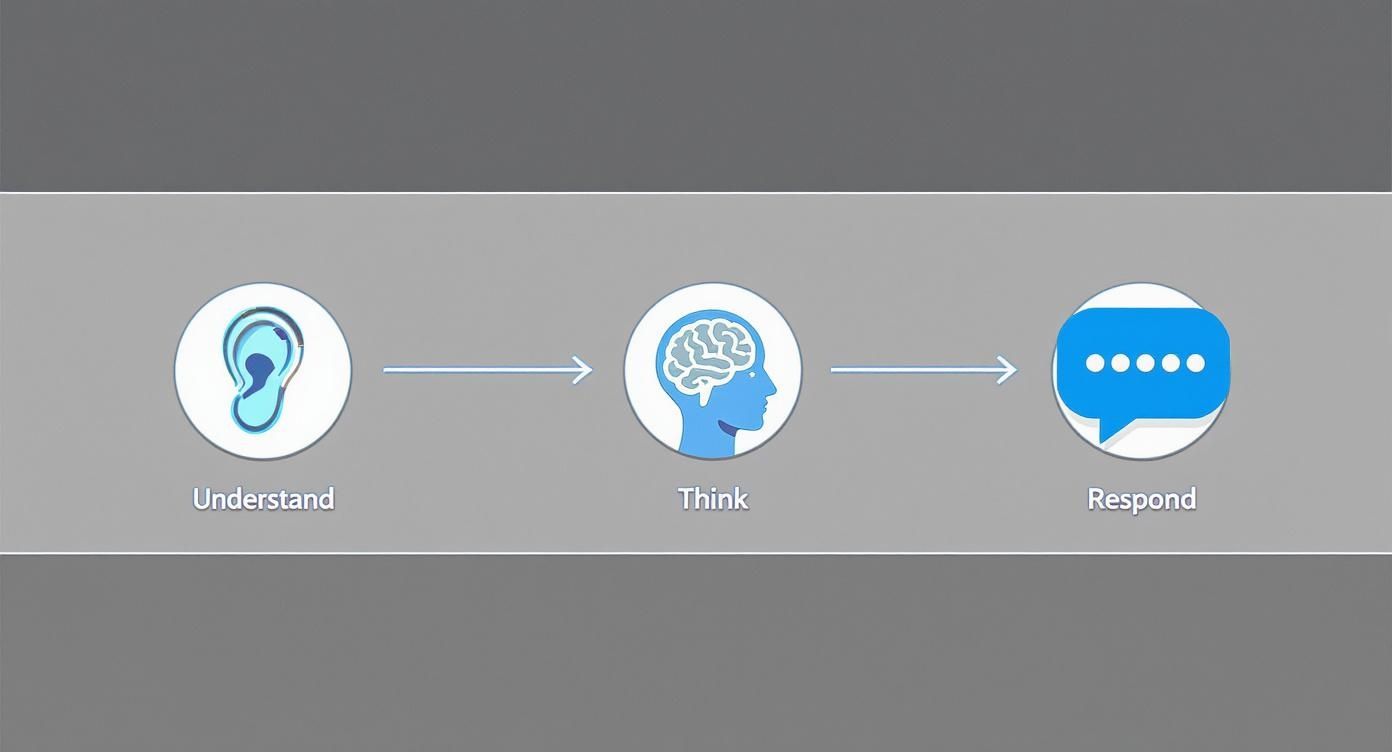
No matter the "flavor," every conversational AI runs on this fundamental loop: it has to understand what you want, figure out a response, and then deliver it.
At the most basic level, we have rule-based systems. These are the OG chatbots. They operate on a simple, handcrafted decision tree. If you say "X," the bot responds with "Y." It’s all very predictable.
They are perfect for straightforward tasks, like answering "What are your business hours?" But ask something just a little different, like "When do you guys close?" and they might just send you a shrug emoji (or, more likely, an error message). They don't get context; they just follow commands.
Taking a step up from the script-followers, we find more context-aware AI. These systems use machine learning to recognize patterns and understand what a user actually means, even if they don't use the exact keywords. They can handle variations in phrasing and even keep track of the conversation's flow to a certain degree.
This is the kind of AI that can walk you through troubleshooting a Wi-Fi issue by asking a series of logical follow-up questions. It’s a huge improvement, but its knowledge is still locked into the data it was trained on. It can’t truly create anything new on its own.
Now we’re in the big leagues. Generative AI, powered by Large Language Models (LLMs), is the most advanced form of conversational AI out there today. Instead of just picking a pre-written response from a list, these models generate brand-new, original text on the fly.
They've been trained on truly massive datasets, which allows them to understand nuance, write creatively, summarize complex documents, and even generate computer code. This is the technology that makes you feel like you're talking to something that truly gets it.
The rise of this powerful AI is completely reshaping customer service and internal operations. The global market, valued at USD 13.6 billion, is projected to explode to USD 151.6 billion by 2033, growing at a staggering 29.16% annually. This growth shows just how much demand there is for automated, intelligent interactions.
Just when you thought it couldn't get any cooler, multimodal AI enters the chat. This type of AI can understand and process information from multiple sources at once—text, images, audio, and even video.
Here’s what that actually looks like:
This ability to fuse different data types is pushing the boundaries of what's possible, creating richer and more intuitive experiences.
Of course, building these complex workflows can be a massive headache. That’s why all-in-one platforms like Zemith are so valuable—they give you the tools to build, test, and deploy all these different types of AI without needing a team of data scientists. For more on this, check out our guide on finding the best AI assistant for work.

Alright, enough theory. Where can you find this conversational AI in real life? It's not some far-off concept locked in a lab; it's already woven into our daily lives, often working so smoothly you might not even notice it.
You’ve definitely met the most common example: the customer support chatbot. It's that little pop-up that saves you from the horror of hold music when you just want to track a package or ask about a return policy. They work 24/7, never need a coffee break, and handle thousands of conversations at once.
But these digital helpers have moved way beyond simple FAQs. They are now working in some surprisingly critical and creative roles across almost every industry imaginable.
In e-commerce, conversational AI acts like a friendly, expert personal shopper. It doesn't just point you to the "shoes" category; it asks, "Looking for running shoes or something more casual? What's your size?" It can offer personalized recommendations based on your past purchases, saving you from endless scrolling.
Meanwhile, in the world of finance, these AI systems are your first line of defense against fraud. That instant text alert you get asking, "Did you just spend $300 on novelty socks in another state?" is often an automated AI keeping an eye on your account. It can also help you check your balance, transfer funds, or get investment updates without ever logging into an app.
The impact in healthcare is just as significant. AI-powered assistants are now scheduling doctor's appointments, sending out medication reminders, and even helping patients with initial symptom checks. This frees up administrative staff to focus on more complex patient needs, making healthcare more efficient and accessible for everyone.
It's not just private companies getting in on the action, either. Conversational AI is being adopted across government and public sectors to improve how they serve citizens. In fact, the global market is expected to grow from USD 17.05 billion to nearly USD 49.80 billion by 2031. These public-facing bots have already managed over 13 million inquiries and processed USD 151 million in self-service payments, showing just how effective they are. You can get more details on the growth of conversational AI in public sectors and see the numbers for yourself.
These aren't just chatbots answering questions. They're complete systems solving real problems, from personal convenience to public safety. They reduce friction, provide instant access to information, and deliver genuine value.
Many of these systems are also becoming multimodal, meaning they can understand more than just text. Some of the most interesting applications involve audio. You can learn more about the technology that makes this possible in our deep dive into how voice-to-text AI works.
Ultimately, the goal is to create seamless, helpful interactions wherever they're needed most. Building these sophisticated workflows might sound daunting, but all-in-one platforms like Zemith make it possible to design, test, and deploy powerful conversational experiences without needing an army of developers. The wild is getting wilder, and AI is leading the way.
Conversational AI is a game-changer, but let's get one thing straight: it's not plug-and-play magic. Like any powerful tool, it has its own quirks and pitfalls. Facing these issues head-on isn’t about pessimism; it's about being smart and building something that’s actually helpful and responsible.
It’s a bit like adopting a super-intelligent puppy. The potential is incredible, but if you don't plan for the chewed-up furniture and the occasional mess, you're in for a rough time. Acknowledge the challenges, and you're on your way to building something truly great.
One of the weirdest and most common hurdles is the AI hallucination. This is what happens when an AI, especially a generative one, makes something up but states it with complete confidence. It’s not lying in the human sense—it’s just trying to create a response that sounds plausible, even if it has no basis in reality.
The AI might invent a historical figure, reference a fake scientific study, or give you a brownie recipe that calls for a cup of sawdust. While that last one might be funny, it’s a massive problem when a customer gets wrong information about your return policy or a developer is handed a block of buggy code.
AI models learn from the massive datasets we give them. The catch? That data comes from us, and humanity has a long and complicated history of bias. If the training data reflects societal biases around gender, race, or culture, the AI will learn those same biases and often make them even more pronounced.
This can go wrong in a lot of ways:
Fixing this isn't as simple as flipping a switch. It takes a serious commitment to cleaning up training data, constant testing, and designing systems that are fair for every single user.
Every time someone talks to your AI, they're handing over data. It could be as simple as their name or as sensitive as their financial details. Protecting that information isn't just a nice thing to do—it's a legal and ethical requirement.
You are responsible for ensuring every conversation is secure and that your AI system meets data privacy laws like GDPR. A data breach linked back to your chatbot could destroy your brand's reputation and your users' trust.
Beyond that, you absolutely need safety guardrails. Without them, a user could manipulate the AI into saying something offensive, generating harmful content, or leaking information it shouldn't. You have to draw clear lines in the sand about what the AI is and isn't allowed to do.
These challenges sound big, but they aren't showstoppers. They're solvable problems that just require the right strategy and the right tools. This is precisely where an all-in-one platform like Zemith really shines. It gives you a controlled environment with built-in features for testing, monitoring, and implementing the guardrails needed to tackle issues like bias and hallucinations. By handling the complex technical parts, Zemith lets you focus on creating a conversational AI that's not just smart, but also safe, reliable, and fair.
Feeling inspired by all the possibilities? You should be. The good news is that building powerful conversational AI isn't just for mega-corporations with bottomless budgets anymore. The tools to create something amazing are more accessible than ever.
But let's be real—diving in without a plan is like trying to build IKEA furniture without the instructions. You’ll end up with a wobbly chatbot and a pile of leftover (metaphorical) screws. A structured approach is your best friend here.
Before you write a single line of code or design a conversation flow, you need to answer one simple question: What problem are you actually trying to solve?
Don't just build an AI because it's the cool thing to do. Define a clear, specific goal. Are you trying to:
Your "why" dictates everything that comes next. A clear objective is the North Star for your entire project.
Once you know your goal, you have a fundamental choice to make. Do you build from scratch, or do you use a platform?
The DIY Route: This involves stitching together different AI models, APIs, and databases yourself. It gives you total control but demands deep technical expertise, time, and resources. You're not just building a chatbot; you're building and managing the entire underlying infrastructure.
The All-in-One Platform Route: This is where you use a tool that handles the heavy lifting for you. A platform gives you a single place to build, test, and deploy your AI, often with a visual, user-friendly interface.
For most businesses, the platform approach is the faster, more cost-effective, and saner option. It lets you focus on creating a great user experience instead of getting bogged down in complex engineering problems.
This is exactly why we built Zemith. Building from scratch is tough. You have to juggle different AI models, manage separate testing environments, and then figure out a deployment strategy. It’s a massive headache.
Zemith brings everything under one roof. You can connect various best-in-class AI models, build complex workflows with a simple visual interface, and rigorously test your creations, all in one place. It also connects directly to your company’s data, making it a perfect fit for building better knowledge management systems that power your AI.
It turns a months-long development nightmare into a streamlined process, empowering you to launch powerful, custom conversational AI faster than you ever thought possible. If you’re ready to stop dreaming about AI and start building, explore what Zemith can do for you.
Got a few more questions rattling around in your head? Good. That means you're thinking critically about this stuff. Let's clear up some of the most common points of confusion so you can walk away with a solid understanding.
This one trips a lot of people up. Think of it this way: all conversational AI can be a chatbot, but not all chatbots qualify as conversational AI. It's that classic "all squares are rectangles, but not all rectangles are squares" situation.
A basic, old-school chatbot is a vending machine. It operates on a fixed set of rules. You type "Track my order," it asks for an order number. That's about as deep as it goes.
Conversational AI, on the other hand, is the friendly barista at your favorite coffee shop. They remember your name, know you prefer oat milk, and can suggest a new seasonal drink you might like. It uses sophisticated tech like machine learning to understand the nuances of a conversation, remember context, and interact in a way that feels genuinely human.
It definitely can be, especially if you go the route of building a custom solution from the ground up. Hiring a team of data scientists and AI engineers to stitch everything together from scratch is a serious investment. It's the difference between assembling your own car piece by piece versus leasing one that’s already been perfectly engineered.
But here's the good news: modern platforms have completely flipped the script. An all-in-one tool like Zemith dramatically cuts down on the cost and complexity. It hands you pre-built integrations, state-of-the-art AI models, and a visual canvas to design your workflows. This approach puts powerful AI within reach for businesses that don't have a massive budget or a dedicated AI research lab.
Conversational AI, especially the kind running on machine learning models, learns a lot like a person does: through exposure and experience. In its initial training, it's fed an almost incomprehensible amount of data—books, articles, websites, and transcribed conversations. It digests all of this to learn the intricate patterns of language, context, and even subtle sentiment. Imagine it speed-reading the entire internet to become an expert on... well, everything.
And the learning doesn't stop once it's live. A properly designed system continuously improves by learning from new interactions. Each conversation helps it fine-tune its responses, making it more accurate and helpful over time.
This constant evolution is what turns a simple automated tool into an intelligent, adaptive partner that can solve real problems for your customers and your team.
Ready to stop asking questions and start building solutions? With Zemith, you can design, test, and launch powerful conversational AI workflows all from a single platform. No more juggling different tools. It’s time to start creating. Discover the all-in-one power of Zemith today!







Trusted by teams at






The top models, plus image, video and voice tools, in one plan.
Without Zemith
ChatGPT PlusUS$20.00Claude ProUS$20.00Google AI ProUS$19.99SuperGrokUS$30.00Perplexity ProUS$20.00 MidjourneyUS$10.00
 ElevenLabsUS$6.00Le Chat ProUS$14.99
 RunwayUS$15.00Kling StandardUS$8.80
 Gamma PlusUS$12.00
 Otter ProUS$16.99
 QuillBot PremiumUS$19.95
 Photoroom ProUS$12.99
 Quizlet PlusUS$7.99
Total if paying separatelyUS$234.70/mo
"I love the way multiple tools they integrated in one platform. Going in the right direction."
— simplyzubair
"The quality of data and sheer speed of responses is outstanding. I use this app every day."
— barefootmedicine
"The credit system is fair, models are perfect, and the discord is very responsive. Quite awesome."
— MarianZ
"Just works. Simple to use and great for working with documents. Money well spent."
— yerch82
"The organization of features is better than all the other sites — even better than ChatGPT."
— sumore
"It lives up to the all-in-one claim. All the necessary functions with a well-designed, easy UI."
— AlphaLeaf
"The team clearly puts their heart and soul into this platform. Really solid extra functionality."
— SlothMachine
"Updates made almost daily, feedback is incredibly fast. Just look at the changelogs — consistency."
— reu0691
Hand off the research, writing, design and follow-ups. Zemith picks the tools it needs and brings back finished work.
Search the web, run deep research, read files, create images and run code with GPT, Claude, Gemini, Grok and more.
Zemith keeps working in the cloud and pings you when it's done.
Notion, Linear, Canva, Airtable and more. It asks before it creates or changes anything.
Docs, slides, sheets and PDFs, ready to send.
Chain models and tools on a visual canvas, from one prompt to a finished promo video.
Briefings, reports and reminders run on a schedule and are ready when you need them.
Real-time voice that can see your camera or screen.
The best image and video models, in one studio.
Turn PDFs, links and YouTube videos into podcasts, quizzes, flashcards and mind maps.














 Podcast
 Quiz
Quiz Flashcards
 Mind map
 Infographic