


Every top model, with tools built in.
Search the web, run deep research, read files, create images and run code with GPT, Claude, Gemini, Grok and more.
Ever wonder 'what is contextual learning?' Discover how learning in real-world situations boosts memory, skills, and makes work feel less like work.
Ever read a chapter in a textbook, nod along thinking "yeah, I get it," and then have absolutely zero clue how to use that information in the real world? It’s like reading a recipe for a cake but still burning it in the oven. That frustrating gap is exactly what contextual learning is designed to fix. It's the simple but powerful idea that learning sticks when it’s tied to a real situation you’re trying to solve.
So, what is contextual learning, really? At its core, it’s a beautifully simple concept: our brains are wired to learn best when new information is anchored to a meaningful context. It flips learning from a passive chore, like slogging through a dense manual, into an active, hands-on process. You know, the fun kind of learning.
Instead of just memorizing abstract facts, you’re linking knowledge directly to how it’s used. Imagine a mechanic learning to fix a new electric car. The old way? Hours of lectures and diagrams. Contextual learning happens when they’re standing over that car, diagnosing a real issue. The "why" becomes instantly obvious.
This approach is so effective because it creates mental "hooks." When you learn something while working on a project or tackling a challenge, your brain builds much stronger neural pathways. This makes the information way easier to remember and use later on. It’s not just about knowing something; it’s about understanding its relevance.
The big idea is that knowledge isn't a collection of isolated facts, but a web of interconnected ideas. When you learn in context, you're not just adding a new fact—you're strengthening the entire web.
To really get it, it helps to see how it relates to other ideas. For example, understanding what is active learning in education reveals how hands-on participation is the foundation for so many powerful learning moments. You can also see how different learning styles fit into this by checking out our guide on https://www.zemith.com/blogs/multimodal-learning-strategies.
This isn’t just some lofty academic theory; it's a super practical strategy for anyone who needs to build skills that actually work on the job. In a professional setting, this could mean:
Ultimately, contextual learning closes that frustrating gap between knowing what to do and knowing how to do it when it counts. It’s all about making learning a natural part of doing, which is exactly how modern tools like Zemith help people and teams get stuff done and get smarter at the same time.
We’ve all been there. You pull an all-nighter for a big exam, walk in feeling like you know it all, and then a week later… poof. It’s gone. You’d be lucky to remember the topic of the test, let alone the answers. This isn’t a personal failing; it’s a failure of the method.
Learning isolated facts is like trying to build a jigsaw puzzle without ever seeing the picture on the box. You have all the pieces, but no idea how they fit together to create the bigger picture. Our brains are wired for survival, not for hoarding random data. If information doesn't connect to something we already know or a problem we need to solve, it gets flagged as junk and tossed out. Harsh, I know.
This is a massive problem in professional development. People sit through generic training courses, only to find that the skills they "learned" don't stick when they're back at their desks. Why? Because the context was missing. The brain never made the connection between the training material and the actual job.
A big reason for this is a psychological principle called the forgetting curve. It’s a fancy term for a simple, frustrating truth: we lose new information at a shocking rate if we don’t actively try to retain it. Without a reason to use it, that knowledge just fades away.
Anyone who's tried learning a new language by just memorizing vocabulary lists knows the pain of beating the forgetting curve. The words feel real for a day, then vanish. It's like your brain has a "delete unused files" program running in the background.
Take a look at the massive difference in retention when you compare learning abstract theory to learning in a real-world context.
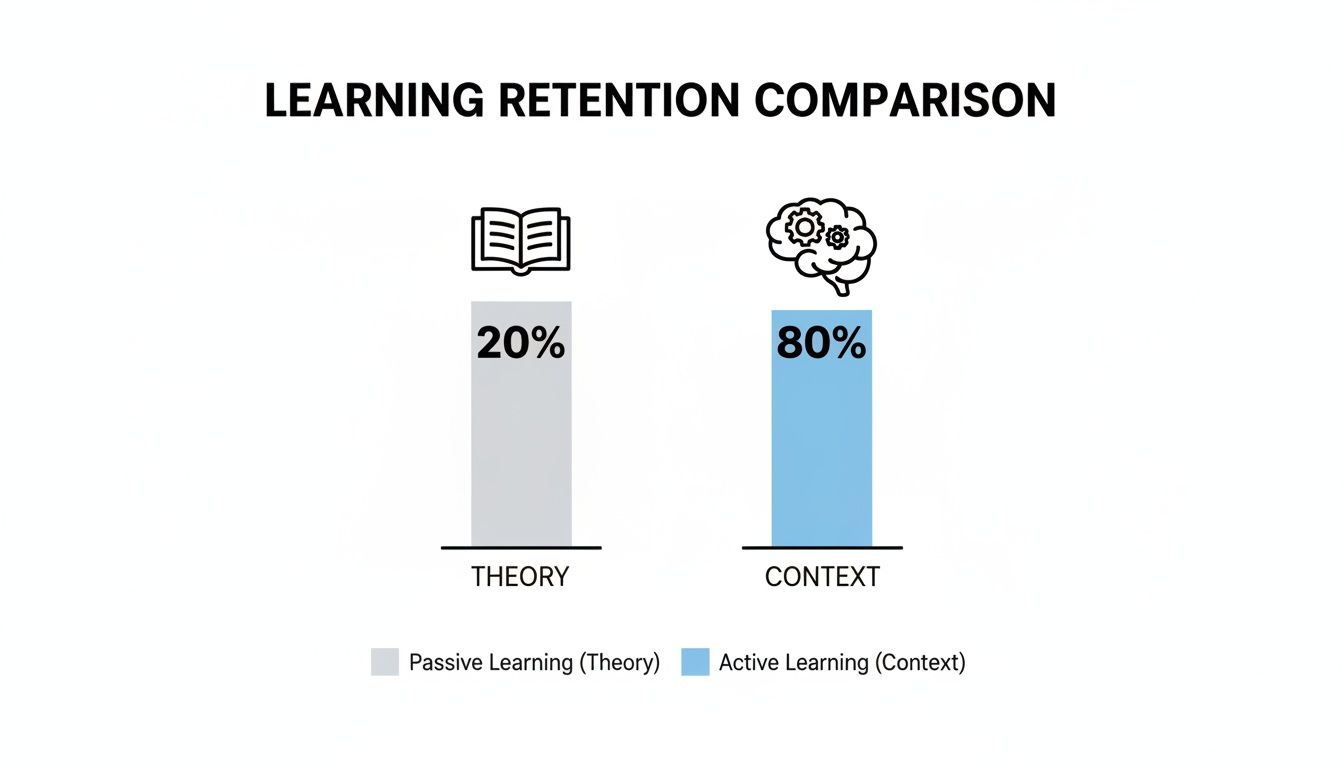
The numbers don't lie. We see that retention jumps from a dismal 20% to an impressive 80% when we switch from passive listening to active doing. This is where we start to see a much smarter way to learn.
To give you a better idea of the contrast, here’s a quick breakdown.
This table makes it clear: one path is about temporarily holding information, while the other is about building real, lasting competence. You can learn more about practical ways to retain information better when you connect it to real-world tasks.
The cycle of learning, forgetting, and re-learning is exhausting and inefficient. It's time for an approach that works with our brain's natural tendencies, not against them. This is where contextual learning shines, especially when supported by tools like Zemith that bring learning directly into your flow of work.
So, why does learning in context just click? To understand that, we need to peek under the hood and see how your brain is actually wired. It’s not a dusty old filing cabinet where you store isolated facts. Think of it more like a massive, interconnected web of ideas—like your brain's very own internet.
When you learn something while you’re actually doing something relevant, your brain doesn't just store a new fact. It builds a strong, multi-lane highway connecting that new piece of information to what you already know. This is the core idea behind situated cognition—the theory that thinking isn't some abstract activity happening in a vacuum. It’s deeply tied to the situation where it occurs.
It’s the reason a software developer learns more from fixing one real bug than from reading ten chapters about coding theory. The real-world problem acts as a powerful anchor, making the solution immediately useful and way easier to remember later. This is also the foundation of problem-based learning, where the challenge comes first and the learning is a direct result of trying to solve it.
Here's an analogy I love: trying to remember an abstract fact is like trying to grab a smooth, slippery marble. It's tough to get a grip on, and it’s easy to drop.
But when you learn that same fact while working on a project, your brain essentially gives that marble a grippy handle—the context. Suddenly, it’s easy to pick up and use whenever you need it.
These “mental hooks” are real things; they’re neural pathways in your brain. Research shows that when you engage multiple senses and solve problems in a specific environment, you strengthen these connections. The more connections a piece of information has, the easier it is for your brain to find it later. We actually dive a lot deeper into this in our guide on how to improve memory retention.
Context transforms learning from a frustrating memory game into an intuitive process of discovery. It aligns with how our brains are naturally wired to operate—by making sense of the world around us.
This isn't just a nice theory, either. We see it in the data. The environment and tools a person has access to can dramatically change how well they learn. For instance, a 2019 global assessment found huge differences in student-to-computer ratios between urban and rural areas in some countries, which directly impacted learning. It's a clear sign that the context of learning, including the tools at your disposal, is a massive driver of results. You can explore the full findings on how context shapes education.
At the end of the day, contextual learning works because it wraps information in a story. And our brains are suckers for a good story.
When you're trying to solve a real-world problem, you’re the main character. The challenge is the plot, and the new skill you're learning is your secret weapon to win the day. This narrative structure makes the entire experience far more engaging and memorable than just reading a list of bullet points.
This is exactly why tools like Zemith are so effective. They don't just throw information at you; they embed it right into your workflow. Whether you’re using the Document Assistant to pull insights from a report for a project or the Coding Assistant to fix a bug in an app, you’re learning while doing. It's a brain-friendly approach that turns every task into a genuine opportunity to build skills that stick.
Theory is one thing, but seeing contextual learning in action is where it all clicks. This isn't just some abstract idea for a classroom; it’s a powerful strategy that top performers in every field use to get ahead.

Let's dive into a few mini-stories that really show how versatile this approach is. These examples prove that learning sticks best when it’s woven directly into the fabric of our work.
Picture a sales team that keeps fumbling when clients push back. The old-school approach? A manager puts together a PowerPoint with a list of common objections and canned responses. Snooze.
A contextual learning approach looks totally different. Instead, the team runs a role-playing workshop using real objections they’ve heard from actual clients that week. One person plays the tough, skeptical customer, while another has to think on their feet, using sales frameworks in a live, slightly-stressful situation.
They aren't just memorizing lines; they're building the mental muscle to handle pressure and adapt their pitch in the moment. The context isn't a slide; it's the feeling of a deal slipping away.
This hands-on practice is worlds more effective. Research on ninth-grade statistics students, for instance, showed that those taught with a Contextual Teaching and Learning (CTL) approach blew a control group out of the water on post-tests. It’s hard evidence that when you embed learning in a relevant situation, understanding skyrockets. You can read the full research on CTL effectiveness.
Think back to your high school history class. How much do you really remember? Probably not a lot, unless you had a truly amazing teacher.
Now, imagine this instead: a class is tasked with creating a podcast episode about a local historical event, rather than just reading about it. This one shift turns them from passive readers into active investigators and storytellers.
All of a sudden, history isn’t just a pile of dates and names. It’s a living story they are personally shaping and sharing. This kind of project-based method is a brilliant way to get learners hooked, and it's a key part of many collaborative learning strategies.
Even the AI tools we use daily, like those inside Zemith, are masters of context. When you ask a question, the AI doesn't just spit out a random fact. It looks at your previous questions and the document you're working in to give you a genuinely helpful answer. It's learning and responding within the context of your specific task—a perfect digital example of this powerful principle at work.
Alright, we’ve covered a lot of ground on what contextual learning is, but theory only gets you so far. Now for the fun part. Let's shift from the "what" to the "how" and explore how to actually put all this into practice. This isn't just about a tool; it's about making contextual learning your team's default setting, with Zemith as your sidekick.
Think of Zemith as the workshop where you finally get to use all the new tools and techniques you've been reading about. It’s designed from the ground up to embed learning directly into your workflow. You're not just consuming information—you're using it to build something real, right now.
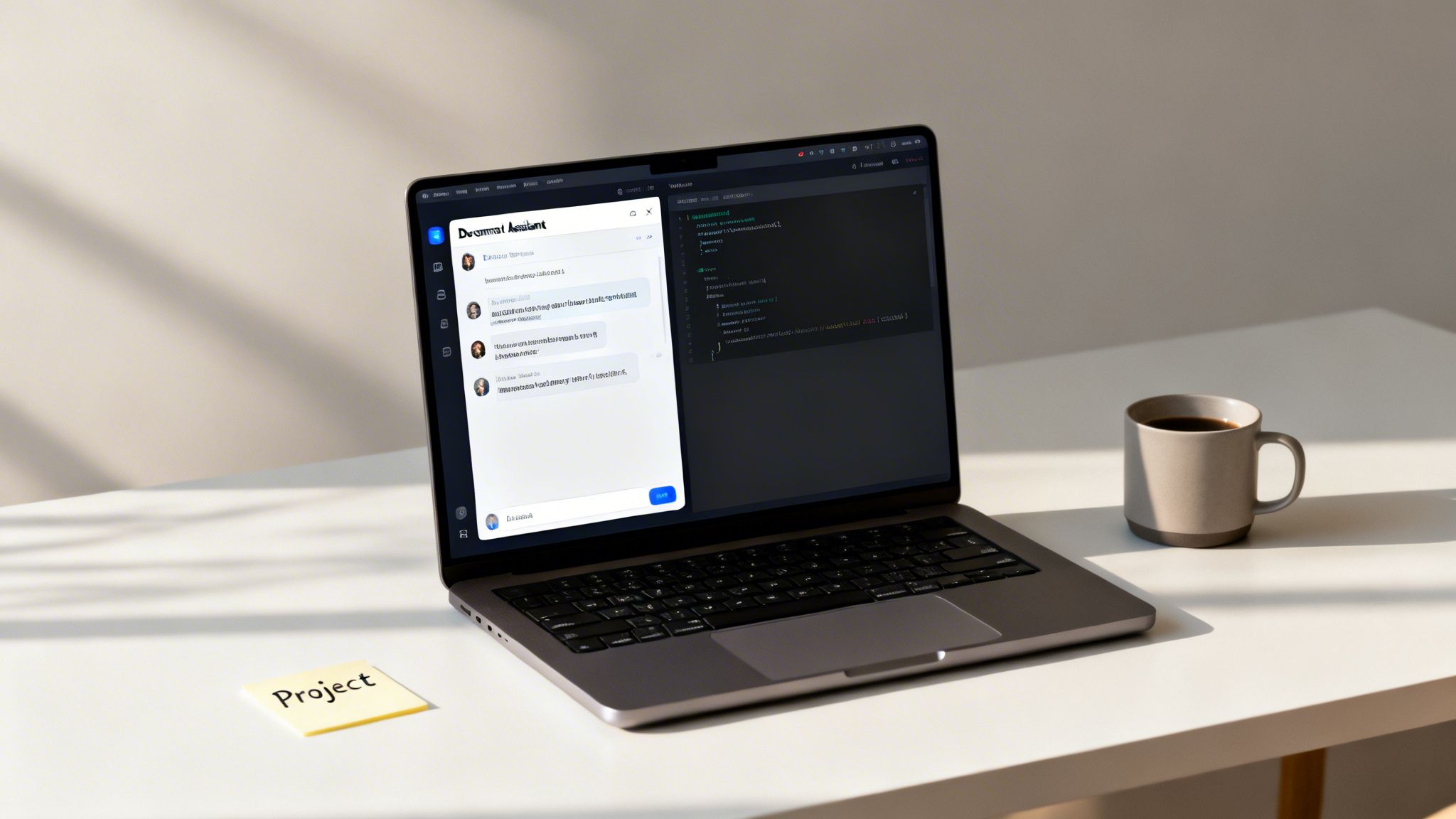
The biggest killer of contextual learning is context switching. You know the drill: read an article, watch a tutorial, then jump back to your project and try to recall what you just learned. Zemith gets rid of that gap by bringing the learning directly into your creative space.
Here’s a look at how specific features map directly to the principles we've discussed:
Document Assistant: Let's say you're a content creator who needs to write about a dense scientific study. Instead of reading it, taking separate notes, and then trying to write, you just upload it to Zemith. You can "chat" with the document, asking it to explain complex ideas or generate a blog post outline on the spot. The learning happens in the direct context of creating the content.
Coding Assistant: For developers, this is a huge leap forward. You aren't just getting disconnected code snippets; you’re learning in a live environment. You can ask for an explanation of a tricky function and immediately see it work with the live preview. Debugging becomes a learning opportunity, not a frustrating roadblock, because the AI explains why the code failed right within your project.
Contextual learning isn't a solo mission. It really takes off in collaborative settings where knowledge is shared and built upon by the whole team. This is where Zemith’s organizational tools shine.
The goal is to turn every task from a simple to-do item into a chance to build a shared brain. When knowledge is tied directly to a project, it stops being one person's insight and becomes the team's asset.
Zemith’s Projects feature gives every initiative its own dedicated workspace. All the chats, documents, and research for that project live in one place, creating a rich, searchable knowledge base. When a new team member joins, they don't get a generic onboarding manual. Instead, they can explore the project's history and learn from the actual conversations and decisions that shaped it.
This approach transforms your daily work into a living library of practical knowledge. You’re not just checking off tasks; you’re building a repository of contextual insights that makes everyone on the team smarter and more effective. It’s how you stop learning in a vacuum and start building skills that truly move the needle.
Alright, let's bring this all down to earth. We’ve unpacked why contextual learning just clicks—it feels natural because it is. The big idea is that learning sticks when you tie it to the real world. Now, it's time to shift from theory to practice.
Here’s a simple, three-step playbook to get you started today.
Before diving into a new topic, ask yourself a crucial question: "What problem am I actually trying to solve here?" This changes everything. Don't just "learn SEO"; learn it to drive traffic to your passion project. Don't just "study a new programming language"; use it to finally build that app idea you've had for months.
This one shift provides the hook your brain needs to hang new information on. It gives the knowledge a purpose and a home, making it far more likely to stick around.
Next up, you need a "kitchen" to start cooking in. Your learning environment is your playground. This could be a real-world client project, a personal challenge you set for yourself, or even a simulated scenario that mimics the real thing. The goal is to get your hands dirty in a space where you can immediately apply what you're learning.
The whole point is to shrink the gap between learning and doing until there’s no gap left. Your environment is the bridge that gets you there.
For a deeper dive into making your study sessions count, check out our guide on how to study more effectively.
Finally, after you've put your new skill to the test, take a beat to reflect. What went well? What was a total train wreck? (Don't worry, we've all been there.) This is where the real magic happens. Reflection is what cements those new neural pathways.
This cycle of doing and reflecting is exactly where a tool like Zemith shines. It's built to be an all-in-one environment for contextual learning, letting you research, create, and apply knowledge without ever switching tabs. Ready to stop learning in a vacuum? Give Zemith a shot and start building skills that actually last.
Still have a few questions buzzing around about contextual learning? That’s completely normal. It’s a big idea, so let's tackle some of the most common ones to make sure everything clicks.
This is a fantastic question and one that trips a lot of people up. The easiest way to think about it is that they're close cousins, but not twins.
Experiential learning is all about “learning by doing.” Think back to your high school chemistry class—actually mixing the chemicals and watching the reaction is experiential learning. You're learning from the direct experience.
Contextual learning is broader. It’s about anchoring any new information (from a lecture, a book, or yes, even an experiment) to a real-world situation that matters.
So, while doing the experiment is experiential, understanding how that exact chemical reaction is used to make a product you use every day? That’s the contextual piece. It provides the "why" behind the "what."
You bet. While bouncing ideas off others can add another layer of context, it’s definitely not a prerequisite. A freelance writer, for example, can learn about new SEO techniques and immediately apply them to the blog post they’re writing, rather than just reading about them in the abstract.
That’s a perfect example of solo contextual learning in action. You could use a tool like Zemith's Smart Notepad to workshop different headline variations for a specific audience you're trying to reach. The context is your project and your goals. The learning is happening right where you need it.
Not at all. In fact, you could argue it’s even more important for seasoned pros. Experts are constantly using contextual learning to solve novel problems and come up with new ideas.
Think about a senior software engineer troubleshooting a massive system outage. They’re pulling from years of deep knowledge and applying it to a very specific, high-stakes situation. That’s contextual learning at the highest level. It's the engine that drives professional growth and true mastery.
Ready to stop learning in a vacuum and start building skills that actually stick? Zemith provides the perfect environment to apply knowledge in real time, turning every project into a learning opportunity. Try Zemith today and see how contextual work can transform your productivity.






Trusted by teams at






The top models, plus image, video and voice tools, in one plan.
Without Zemith
ChatGPT PlusUS$20.00Claude ProUS$20.00Google AI ProUS$19.99SuperGrokUS$30.00Perplexity ProUS$20.00 MidjourneyUS$10.00
 ElevenLabsUS$6.00Le Chat ProUS$14.99
 RunwayUS$15.00Kling StandardUS$8.80
 Gamma PlusUS$12.00
 Otter ProUS$16.99
 QuillBot PremiumUS$19.95
 Photoroom ProUS$12.99
 Quizlet PlusUS$7.99
Total if paying separatelyUS$234.70/mo
"I love the way multiple tools they integrated in one platform. Going in the right direction."
— simplyzubair
"The quality of data and sheer speed of responses is outstanding. I use this app every day."
— barefootmedicine
"The credit system is fair, models are perfect, and the discord is very responsive. Quite awesome."
— MarianZ
"Just works. Simple to use and great for working with documents. Money well spent."
— yerch82
"The organization of features is better than all the other sites — even better than ChatGPT."
— sumore
"It lives up to the all-in-one claim. All the necessary functions with a well-designed, easy UI."
— AlphaLeaf
"The team clearly puts their heart and soul into this platform. Really solid extra functionality."
— SlothMachine
"Updates made almost daily, feedback is incredibly fast. Just look at the changelogs — consistency."
— reu0691
Hand off the research, writing, design and follow-ups. Zemith picks the tools it needs and brings back finished work.
Search the web, run deep research, read files, create images and run code with GPT, Claude, Gemini, Grok and more.
Zemith keeps working in the cloud and pings you when it's done.
Notion, Linear, Canva, Airtable and more. It asks before it creates or changes anything.
Docs, slides, sheets and PDFs, ready to send.
Chain models and tools on a visual canvas, from one prompt to a finished promo video.
Briefings, reports and reminders run on a schedule and are ready when you need them.
Real-time voice that can see your camera or screen.
The best image and video models, in one studio.
Turn PDFs, links and YouTube videos into podcasts, quizzes, flashcards and mind maps.












 Podcast
 Quiz
Quiz Flashcards
 Mind map
 Infographic