


Every top model, with tools built in.
Search the web, run deep research, read files, create images and run code with GPT, Claude, Gemini, Grok and more.
Learn how to avoid AI hallucinations with grounded sources, claim checks and a simple risk routine that catches made-up facts early.
A client deck is nearly finished when you spot a claim that a model added: 43% of buyers say they prefer a demo. You pasted it in because it sounded plausible. Now you need to find out whether it came from a real source.
The difference between catching a made-up number and shipping it isn't a cleverer prompt. It's a process: knowing which tasks need a source opened by a human being, and which ones you can wave through in ten seconds.
That process matters because hallucinations aren't one bug with one fix. Better prompts can reduce errors, but they cannot establish that a claim is true. The right check depends on what the answer will be used for: a rough draft can tolerate a different level of scrutiny than a client-facing figure. Decide what needs verification before the output enters a deck, report, or other work someone may rely on.
Say a content writer has a deck due Friday. She asks for 20 headline options. Nineteen are forgettable, one is good, nobody gets hurt. Then she asks the same tool for the average conversion rate on B2B landing pages, with a citation. It answers in two seconds with a percentage and something that looks like a reference.
That second request is the one that ruins a week. Not because the model is worse at it, but because a forgettable headline wastes nothing while a made-up number travels into a slide where a client reads it out loud.
Sort the task before you write the prompt. Most hallucination damage comes from that mismatch, not from the wording.
The rule behind the table is simple. The higher the cost of being wrong, the stricter the check and the less you hand over. Brainstorming can be delegated completely. Anything that leaves your desk as a fact can only be drafted, never delegated.
Triage rule: if a wrong answer would embarrass you in a meeting or cost money to fix, it needs a source you opened yourself, not one the model claims exists.
Guidance on task triage is thin, which is why the argument in this 2026 paper on hallucination across the AI lifecycle is worth reading. The authors point out that most advice treats hallucination as a prompting problem, while the failures originate across data, training and inference. They also cite user research in which experienced users build their own verification routines, cross-check outputs elsewhere, and keep decision-critical work under human control.
That's the behaviour worth copying. Not more caution as a personality trait. A routing decision made once per project, then applied every time.
If model selection is part of your risk picture, and it is, how to choose an LLM covers the trade-offs. For anything in the last three rows of that table, I'd keep the work in one project with your sources attached, so every claim traces back to something you opened rather than something the model remembers.
A model answering from memory is doing pattern completion over everything it read during training, including the wrong parts. Retrieval-augmented generation (RAG) changes the job. You hand over documents, it builds the answer out of those documents, and the answer can be traced back.
The evidence is strong enough that I treat retrieval as the default rather than an upgrade. A 2026 systematic review of healthcare AI studies found RAG was the most frequently evaluated mitigation, appearing in 18 of 44 reviewed studies, and where quantitative comparisons existed it reduced factual errors by roughly 30% to 50% against models without retrieval.
Here's the loop, which is boring in the best way:
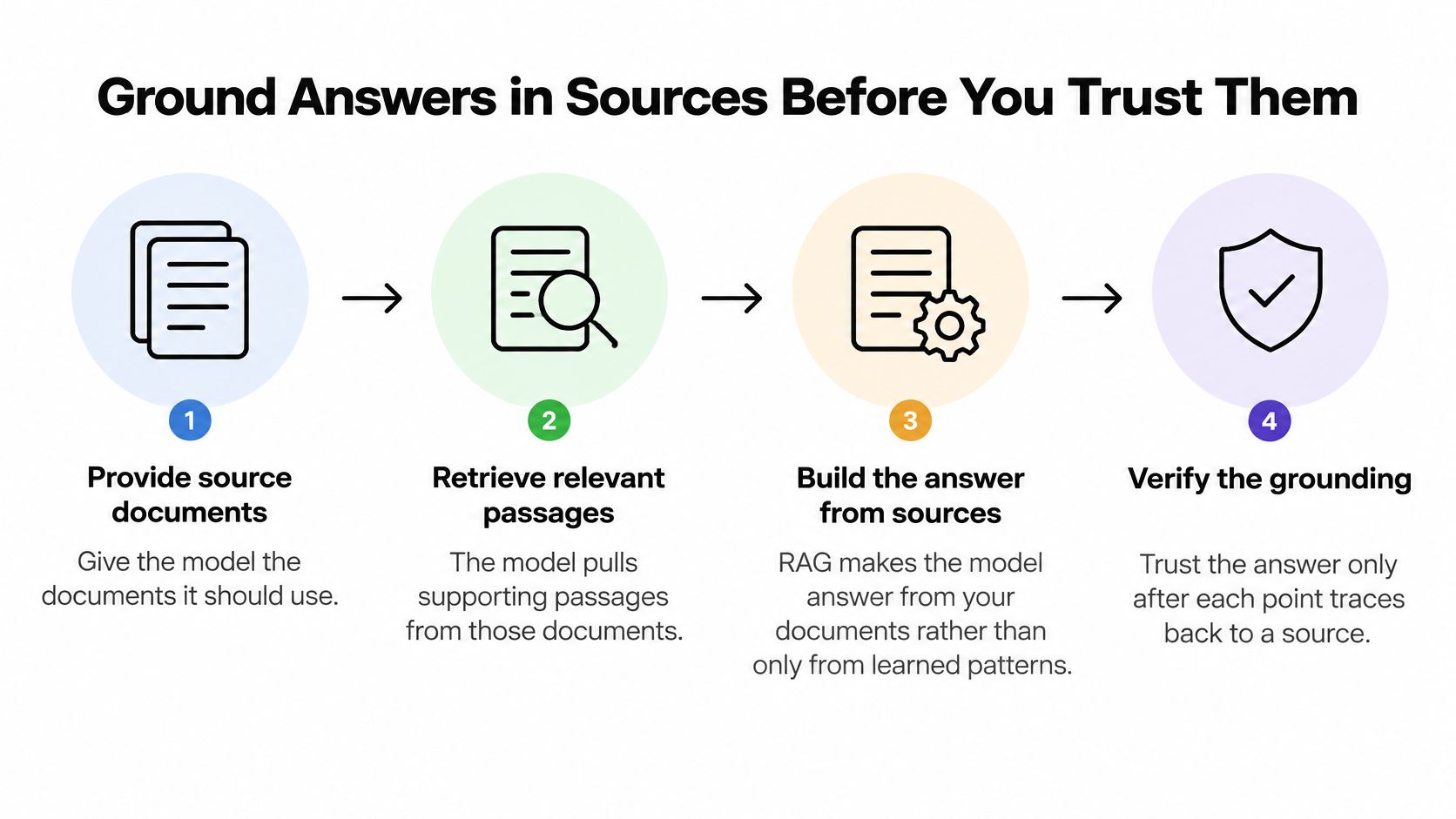
Retrieval isn't a truth button. Thin sources, weak search results and misread context survive the process, and a citation glued to the wrong paragraph is worse than no citation, because it looks like diligence.
One professional knowledge Q&A experiment dropped the hallucination rate from 38.5% without retrieval to 12.5% with it, a 67.4% relative reduction, and what remained was mostly minor factual embellishments and misreadings of source context, per this ACM study of retrieval in professional Q&A.
Steps 1 and 2 are nearly free now. Document chat inside Zemith's AI library keeps your files and the conversation in the same place, so grounding stops being a chore. Step 5 is yours, always. For a deeper source set, the guide to using AI for research covers how to build one that holds up under checking.
If your work touches litigation, be extra suspicious of citations, because a fabricated case is the classic failure. Tools built for case law AI are worth knowing about for exactly that reason: the retrieval set is authority, not the open web.
Two habits earn their keep. The rest is decoration.
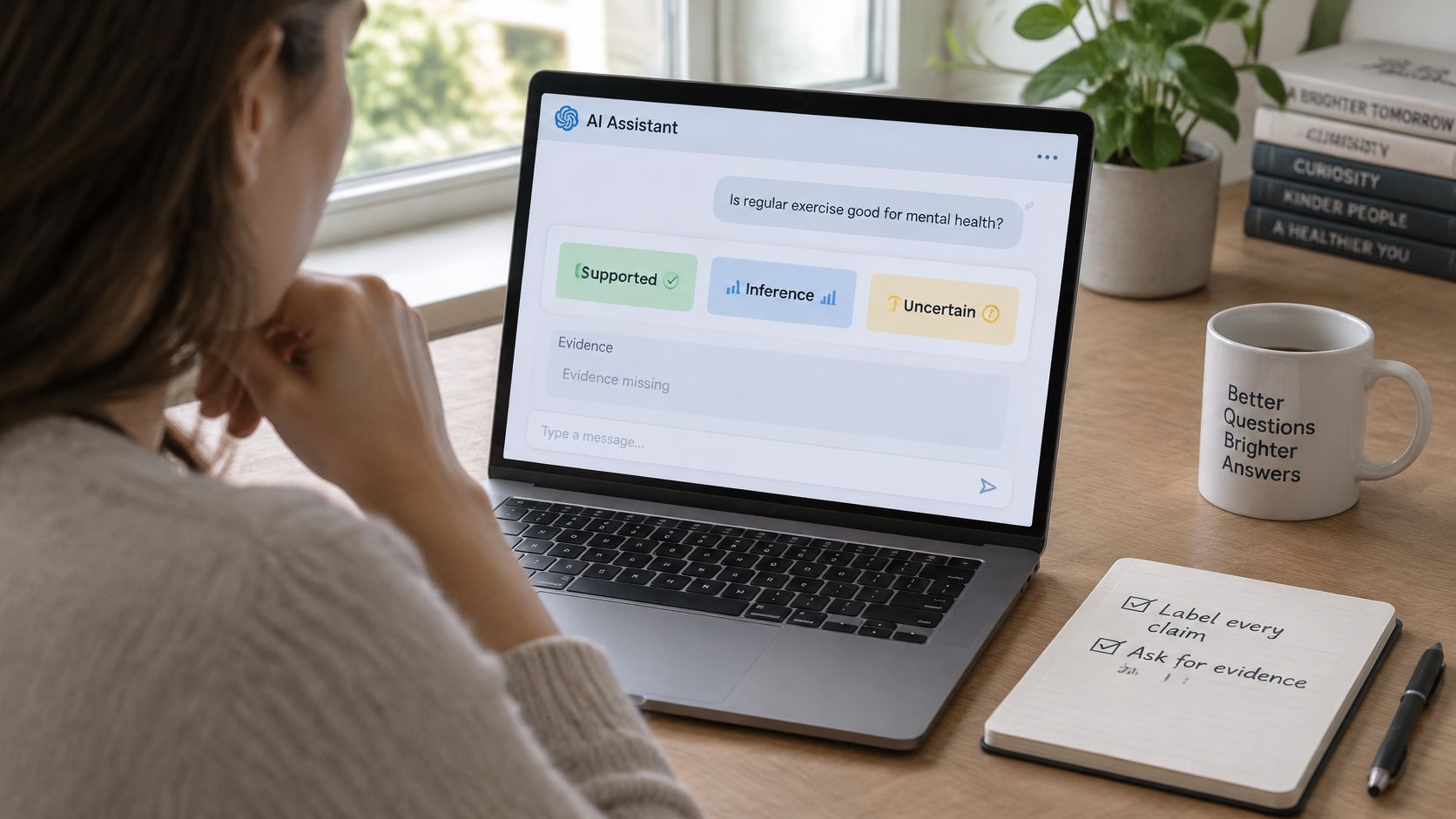
The first is asking the model to grade its own certainty, in the answer, where you can see it. Instruct it to label each claim as directly supported, reasonable inference or uncertain, and to say plainly when the evidence is missing. This works because models are trained and evaluated in ways that reward a confident answer over an honest "I don't know", as OpenAI's explanation of why language models hallucinate sets out. Ask for calibration and you get some of it back.
A line you can paste into any project prompt:
If you can't point to a source for a claim, mark it uncertain instead of guessing. Never invent a citation.
If you want the mechanics of instruction design, prompt engineering tips is the place to go deeper.
The second habit is harder to accept: long chats make things worse. In a clinical RAG experiment, researchers ran the same standardized query 100 times at different conversation lengths. With no prior exchanges the hallucination rate was 5%. After 10 earlier question and answer pairs it rose to 40%, an eightfold jump, and with 50 prior pairs it stayed high, fluctuating between 37% and 44%, according to this Nature study on dialogue history and hallucination.
Picture the mechanism. A marketer's thread has a wrong launch date in message three. Every draft after that inherits it, and by message forty the model is defending it, because the thread itself now counts as evidence. Nobody lied. The premise just calcified.
So start a fresh chat for each new research question. Carry forward a short list of verified facts by hand, and instruct the model to separate what's verified from what was merely assumed earlier in the discussion.
Three habits I'd apply on every project:
A polished draft can still contain one costly falsehood. Treat it as a set of separate claims, each with its own evidence, rather than accepting the whole answer because it reads smoothly.
The shape of the pass:
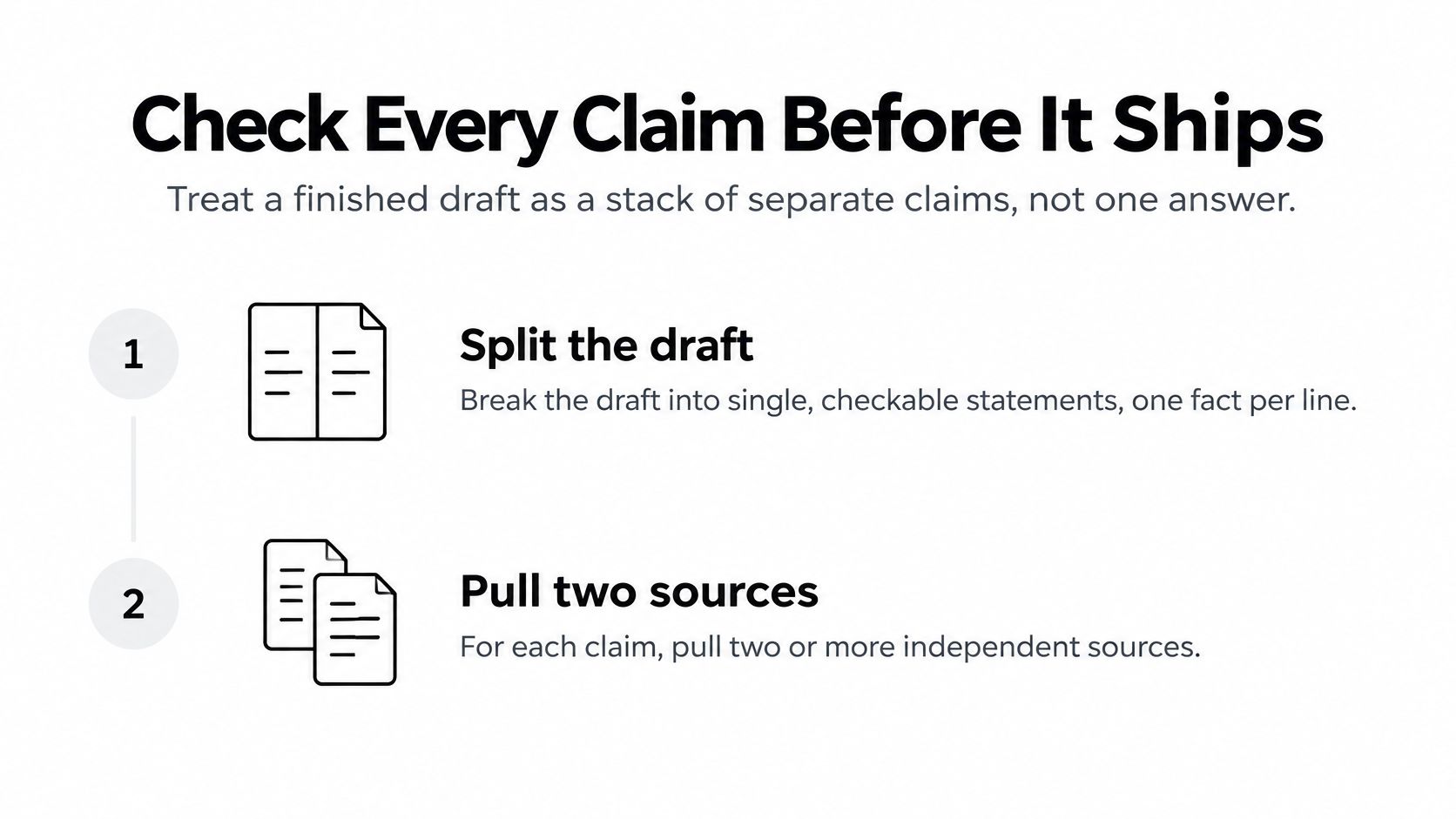
The PROBE benchmark work from CUHK describes a claim-level approach: break an answer into claims, retrieve evidence for each, test what that evidence supports, then label or revise unsupported claims. This is more useful than judging an answer only as a whole. A fluent response can contain one false detail that changes the decision a reader makes.
Self-review, self-consistency and majority voting can show that several runs agree. Agreement does not establish that the answer is true. If repeated answers conflict with the source, the source should decide.
Citations can fail too. A Stanford study of legal AI research tools found that legal research systems can produce misleading or false information even when they draw on case databases. A citation is a lead to evidence, not proof that the text beside it is accurate.
A confident tone is not evidence. Sometimes it is just grammar wearing a convincing suit.
For legal writing, verify every case citation, quotation, statute reference and legal claim against an authoritative source. Apply the same habit to academic references, policy dates, product specifications and statistics. The level of checking should match the cost of getting the claim wrong. A product specification on a landing page, for example, needs a source that confirms the exact detail before you check your product before launch.
Here's the mindset in video form, if you'd rather watch than read:
Track the results on a sample of drafts each month. If unsupported claims remain common while abstention rises, the checker may be getting more cautious without the evidence improving. That calls for better sources, not just stricter labels.
The guide to fact-checking AI output explains how to make these checks a repeatable part of drafting, rather than a one-off effort.
The routine is short enough to repeat. Five steps, once per project.
Steps 2 and 4 are where tooling matters, because those are the two people skip when checking is expensive. Keeping sources and draft in the same project means the pass happens beside the text instead of across a dozen open tabs, which is the layout Zemith's research and document workflows are built around. Memory helps up to a point as well: Zemith's memory learns your role, preferences and plans, and you decide what it keeps, but a remembered preference isn't a verified fact and the two shouldn't share a shelf.
No tool removes the checking step. The honest promise is that it gets cheaper, which is the only reason anyone keeps doing it.
So pick one live project this week. Run these five steps on its next draft and count how many claims survive contact with a source. The number will be lower than you'd like and more useful than anything else you learn about your process this month. For where these checks sit alongside the rest of your work, AI workflow optimization is the wider view.
Zemith keeps your sources, your draft and the checking pass in one workspace, which is the difference between a routine you run and a routine you mean to run. Load the documents you trust into a project, ask your next question against them, and make every claim show the passage behind it. Visit Zemith to start with the research and document tools, and switch models mid-chat when you want a second opinion on a stubborn claim.
Switch models mid-chat, search the web, build Word, PowerPoint, Excel and PDF files, and generate images and video, on web, iOS and Android with one plan.
Free $0 (chat with the free models) · Plus $15.99/month · Professional $29.99/month. Prices in USD.
Pay less than one AI subscription and get GPT, Claude, Gemini and more, plus 50+ AI tools.


Trusted by teams at






The top models, plus image, video and voice tools, in one plan.
Without Zemith
ChatGPT PlusUS$20.00Claude ProUS$20.00Google AI ProUS$19.99Grok PremiumUS$30.00Perplexity ProUS$20.00 MidjourneyUS$10.00
 ElevenLabsUS$6.00Le Chat ProUS$14.99
 RunwayUS$15.00Kling StandardUS$8.80
 Gamma PlusUS$12.00
 Otter ProUS$16.99
 QuillBot PremiumUS$19.95
 Photoroom ProUS$12.99
 Quizlet PlusUS$7.99
Total if paying separatelyUS$234.70/mo
"I love the way multiple tools they integrated in one platform. Going in the right direction."
— simplyzubair
"The quality of data and sheer speed of responses is outstanding. I use this app every day."
— barefootmedicine
"The credit system is fair, models are perfect, and the discord is very responsive. Quite awesome."
— MarianZ
"Just works. Simple to use and great for working with documents. Money well spent."
— yerch82
"The organization of features is better than all the other sites — even better than ChatGPT."
— sumore
"It lives up to the all-in-one claim. All the necessary functions with a well-designed, easy UI."
— AlphaLeaf
"The team clearly puts their heart and soul into this platform. Really solid extra functionality."
— SlothMachine
"Updates made almost daily, feedback is incredibly fast. Just look at the changelogs — consistency."
— reu0691
Hand off the research, writing, design and follow-ups. Zemith picks the tools it needs and brings back finished work.
Search the web, run deep research, read files, create images and run code with GPT, Claude, Gemini, Grok and more.
Zemith keeps working in the cloud and pings you when it's done.
Notion, Linear, Canva, Airtable and more. It asks before it creates or changes anything.
Docs, slides, sheets and PDFs, ready to send.
Chain models and tools on a visual canvas, from one prompt to a finished promo video.
Briefings, reports and reminders run on a schedule and are ready when you need them.
Real-time voice that can see your camera or screen.
The best image and video models, in one studio.
Turn PDFs, links and YouTube videos into podcasts, quizzes, flashcards and mind maps.













 Podcast
 Quiz
 Flashcards
 Mind map
 Infographic