


Every top model, with tools built in.
Search the web, run deep research, read files, create images and run code with GPT, Claude, Gemini, Grok and more.
Image generation AI explained in plain English: how models turn text into pictures, how they compare, the ethics, and how to skip tool-hopping.
By 2023, AI image generators had produced images in the billions. Those counts come from industry compilations, not an audited census, so read them as a scale marker rather than a precise tally. The scale changes the question from “Can it make a picture?” to “Can you show how this picture was made?” A small team shipping a product mock now works at the same volume as studios, hobbyists and automated pipelines. That makes the paper trail part of the job. Keep a record of the model, the prompt, the edits and the rights check, much like a receipt for a purchase. Without it, you cannot test models fairly, trace a bad output or label an image accurately.
Image generation AI starts with a text prompt or a reference picture and returns a new image. Training exposed it to millions of captioned pictures, so it learned how words and visual qualities tend to travel together. It builds from those patterns rather than pasting old photos into a new frame.
A small candle brand needs a blog header: a glass jar on a windowsill at dusk. You describe the glass, wax color, and late light, and the model gives you a first mock in the time it takes the kettle to boil. If the jar must match the actual product, begin with a photo and let the model restyle or extend it. That choice, prompt versus reference, is the first entry in your paper trail. Record it.
These modes fail in different ways. Text-to-image can invent details that look plausible but wrong, like a label with nonsense lettering. Inpainting can leave a seam if the mask is too tight. Outpainting can drift in color. Knowing which mode you used tells a reviewer what to check.
Public systems such as DALL-E 2 and Stable Diffusion made text-to-image widely available in 2022. Cheap interfaces mattered as much as the models. A teacher sketches a worksheet scene before class. A developer mocks up a hero image before design reviews the layout. A writer checks whether a metaphor looks like a place. In each case, the output is a draft, not a final asset.
If you sell physical goods, check AI-powered alternatives to product shoots before you rent lights. Use them for angles and moods, then photograph the actual item when the listing has to match the box. You'll know this clicked when you can tell a colleague which mode fits the task and what source, prompt, or reference the image came from.
A darkroom print doesn't appear all at once. Blank paper sits in the tray, and the picture arrives as chemistry does its work. A diffusion model is that tray, except it starts from TV static and your prompt is the recipe taped to the wall.
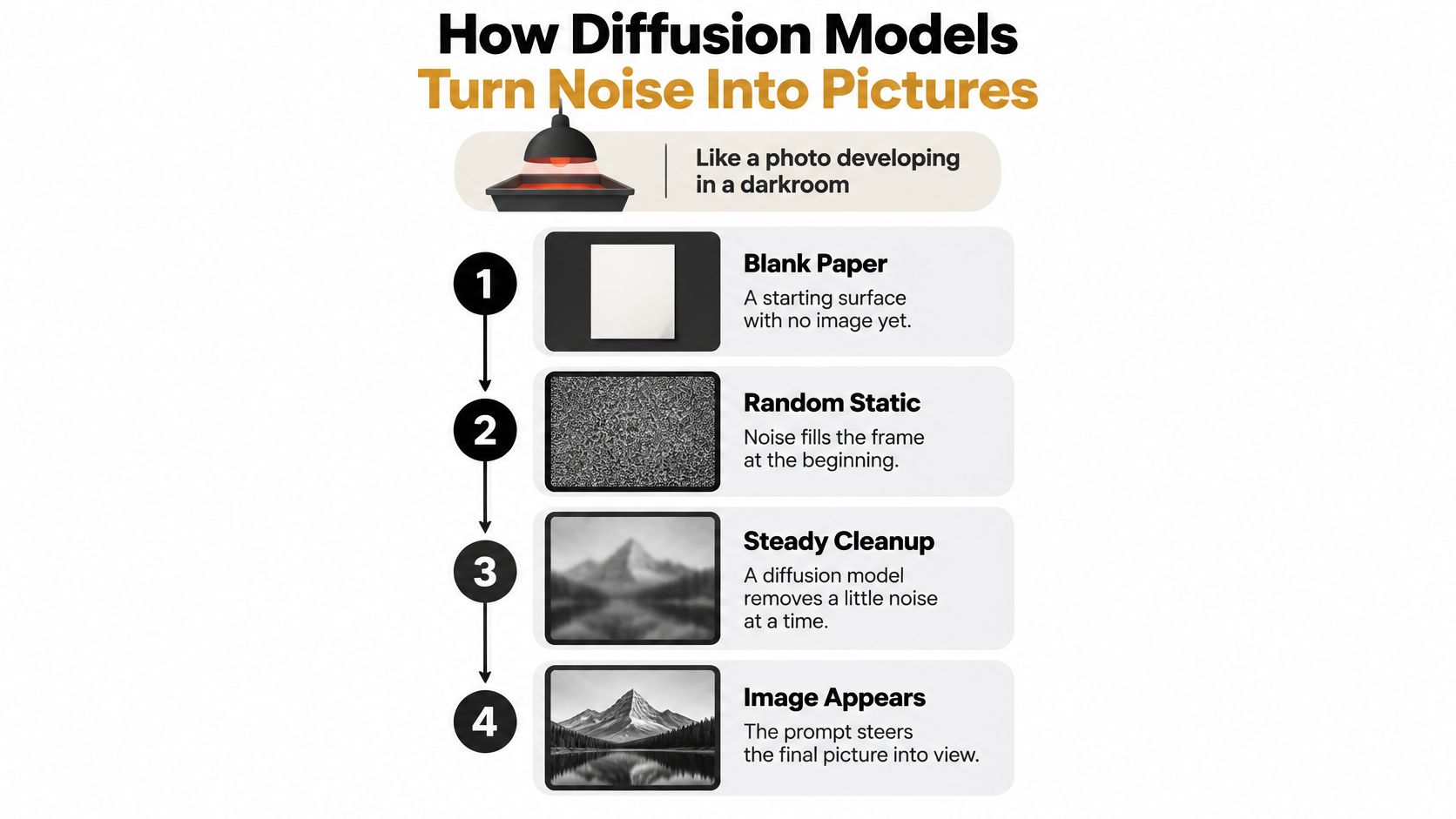
Like a photo developing in a darkroom, the cleanup is gradual. Skip a stage and the picture stays foggy, or it wanders off the brief.
The seed is the exact starting static. Same prompt, same seed, same step count, same sampler, and you should land on the same image. Change only the model and you can compare engines without kidding yourself that you "remembered" a better prompt.
Same prompt, same seed, same steps. If the picture changes, a setting changed. Your memory didn't.
Two models still disagree on an identical brief. One may wire text into the image process with more cross-attention. Another may have denser, more varied captions in training, which often teaches alignment better than dumping in more pictures. A wider network isn't automatically the winner. Sometimes a slimmer design is faster and just as loyal to the sentence you wrote. When you test, freeze the prompt, the seed, the resolution, and the step count. Then watch seconds per image, not only whether the mug looks pretty.
Pick the engine for the job, not for the logo on the login screen. These are working impressions as of 2026, not a leaderboard you should tattoo on the brief. Versions move. Re-test before you lock a campaign to one name.
Photorealism is whether light, skin, and materials look photographed rather than plastic. Prompt loyalty is whether the red mug stayed red and the extra person stayed out. Text inside the image is the line on a poster, a label, or a chart. Editing is how you fix one region without restarting the whole scene. Licensing is whether commercial use is allowed on your plan, which you read in the tool, not in a rumor thread. Speed and cost decide if this is a draft engine or a finals engine.
Stable Diffusion 3.5 still earns a seat when you want open weights and a custom look you can train toward. Flux 1.1 Pro Ultra is the one people open for polished photo detail. Imagen 3 tends to win on clean light. Nano Banana Pro and GPT Image are the pair to try when words must be readable or the layout is fussy. Midjourney is mood, not a spreadsheet. Firefly is the cautious design desk, especially when generative fill has to sit inside a brand file. Muse Image is new enough that your own brief outranks anyone's hot take, including mine.
A serving study on MS-COCO, run at 20 inference steps, makes the cost of "nicer" concrete. Lowering an entropy threshold improved FID from 35.69 to 30.97 and increased latency by about 20%, according to a 2024 paper on adaptive quality of service for diffusion serving. In that same work, adaptive control cut service-level violations by more than five times, cut latency by up to two times, and raised throughput 1.68 times versus a Stable Diffusion baseline.
Use fewer steps, or a smaller model, for thumbnails, mobile previews, and the ugly-first pass. Save high-step runs for the asset a client will see. If the queue is deep, don't give every request the luxury setting. A multi-model workspace such as Zemith lets you send one brief through several engines without a tab circus, which is the only fair way to notice that Midjourney nailed the mood and still spelled your headline like a sneeze. The model-by-model image guide is a useful checklist while you do that.
Pricing changes often, so this guide doesn't quote plans. Open each tool's free tier, run your real brief, and only then pay. If the subject is a vehicle, compare AI car photography software before you assume a general model knows panel gaps and wheel perspective. A pretty render with six lug nuts on a five-lug car is still a miss.
Your eyes are a decent art critic and a lousy notary. In a 2024 study of adversarial AI art, 472 participants marked 79.87% of real images correctly and only 61.58% of AI-generated images, for an average accuracy of 65.24%, across 4,720 annotations. That's the ESORICS paper behind the ARIA dataset. People were better at recognizing photographs than at catching synthetics. Visual inspection is not a publishing process.
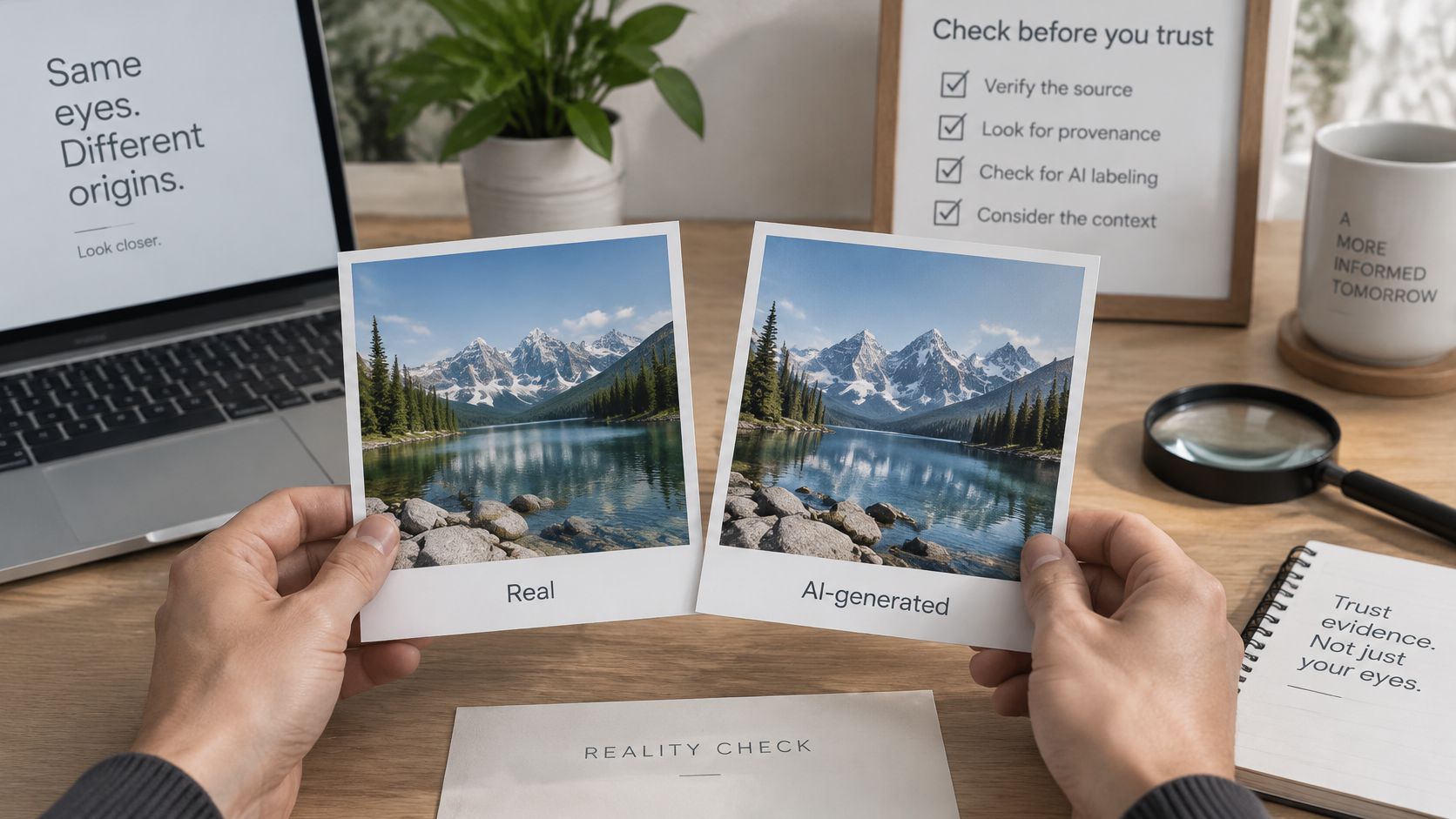
Hold two lake photos and you can argue about color all afternoon. You still won't know which file a model touched, or who edited it after. Provenance is an audit trail, not an authenticity certificate. A watermark can show that a system handled the file. It cannot prove the mountain, the crowd, or the product was real, or that the prompt was fair.
A hidden mark says "a generator was here." It does not say "this event happened."
The C2PA explainer describes a cryptographically bound manifest of origin, changes, tools, and whether AI took part in authorship. Teams often embed that manifest, or link it with a soft binding such as an invisible watermark. Ordinary metadata is the sticky note on the folder. Social sites peel it off. Naming the export final-final-v7.png is a vibe, not a record.
NIST's write-up on reducing synthetic-content risks treats metadata recording and digital watermarking as two current ways to track where synthetic content came from and how it was edited, including non-AI edits from a camera. Strength isn't the same for images, audio, video, and text. A caption that says "AI-generated" is not an edit history.
Transparency rules in the EU AI Act are scheduled to apply from 2 August 2026, per the European Commission's quick facts on those rules. Providers must put a machine-readable mark on synthetic content and enable detection, with an exception for assistive edits that don't substantially change the input or its meaning. Deployers must label deepfakes in a way people can clearly perceive. This is practical orientation, not legal advice, and duties outside the EU differ. If the picture is a generated person, read disclosure rules for generated model imagery before media buys the ad.
Ask for "a doctor" or "a wedding" with no extra words. You'll often get the same few faces, rooms, and clothes, as if the model owns one stock folder and is very proud of it. Neutral wording doesn't guarantee a neutral picture. The model learned from skewed piles of images, so a plain noun still points somewhere.
A 2025 qualitative study in the International Journal of Qualitative Methods found that image generation increased access. People could make visuals online, in more than one language, without art training. The same study reported stereotypes and biases around concepts, values, people, cultures, genders, sexualities, and historically marginalized groups. Easier access didn't magically mean fair pictures.
The instinct is to stuff the prompt with demographic detail until the stereotype looks "fixed." Often you just made the stereotype more specific. "Doctor" becomes one imagined biography, still narrow, now wearing extra adjectives.
Practical rule: Adding the word "diverse" is not an audit. It's a wish.
Creators are already asking for the paperwork. Adobe's 2024 AI and the Creative Frontier Study surveyed 2,002 creative professionals in the United States. On the Adobe blog's write-up of that study, 91% said they'd use a tool that attached verifiable attribution, 89% believed AI-generated content should always be labeled in exhibitions and marketplaces, 83% wanted a way to signal that their work shouldn't train models, and 82% wanted commitments that outputs wouldn't violate copyrights or trademarks. In that same survey, 90% thought generative AI could save time and money on menial work and brainstorming. Speed without a rights habit is how you get a takedown with your coffee.
Check the tool's commercial terms before the client file goes out. Don't prompt with a living artist's name or a brand logo you don't own. Keep the prompt and the source assets next to the export. That's the boring folder that saves the argument later.
Pick a brief you have to ship: a blog header, a product hero, a social card. A model that draws a lovely cat in a spacesuit tells you almost nothing about whether it can hold your label, your product shape, or your legal line. The three-prompt test works like a driving test: one easy stretch, one with traffic, one in bad weather. Its real output is a scorecard and a small paper trail: prompts, seeds, scores, license checks.
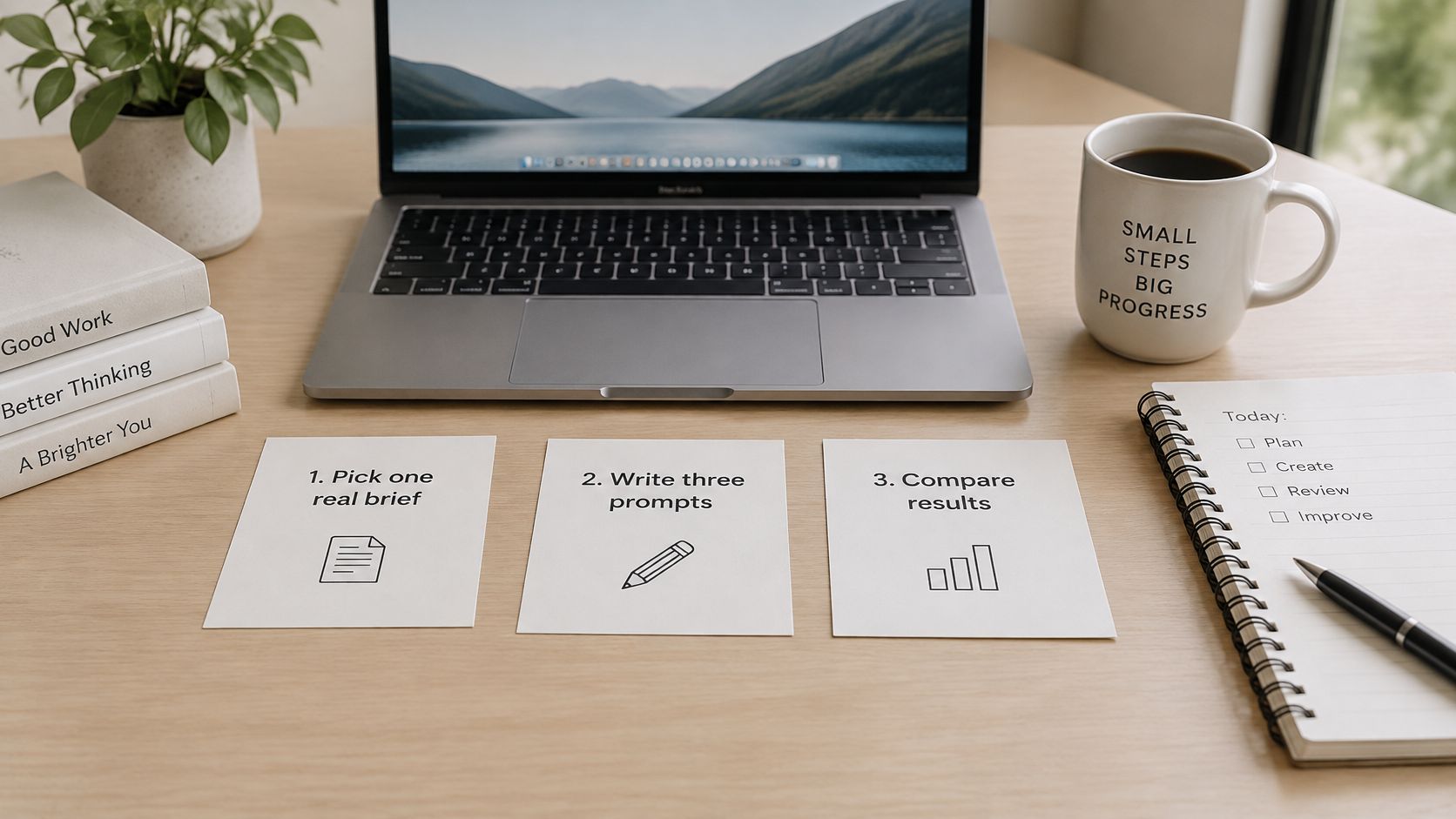
A short demo shows the rhythm of prompting better than another paragraph can.
Zemith supports image generation through its Creative AI Tools, and Plus includes Creative Studio for creating and editing images. You can switch AI models at any time, even in the middle of a chat, so the three-prompt test doesn't turn into three logins and a lost seed. After you pick a winner, remove the background, apply generative fill, or upscale the result in the same workspace.
Run the test on a real brief this week. Note which model won on text, which one only won on mood, and what changed when the seed stayed put. That note is the start of a paper trail you will be glad you kept.
Zemith brings more than 20 AI models into one app, so you can run the same image brief across them, then remove backgrounds, apply generative fill, or upscale the result. If you are tired of guessing which engine fits the job, open Zemith and try the three-prompt test on something you need to publish.
Pay less than one AI subscription and get GPT, Claude, Gemini and more, plus 50+ AI tools.


Trusted by teams at

The top models, plus image, video and voice tools, in one plan.
Without Zemith
ChatGPT PlusUS$20.00Claude ProUS$20.00Google AI ProUS$19.99SuperGrokUS$30.00Perplexity ProUS$20.00 MidjourneyUS$10.00
 ElevenLabsUS$6.00Le Chat ProUS$14.99
 RunwayUS$15.00Kling StandardUS$8.80
 Gamma PlusUS$12.00
 Otter ProUS$16.99
 QuillBot PremiumUS$19.95
 Photoroom ProUS$12.99
 Quizlet PlusUS$7.99
Total if paying separatelyUS$234.70/mo
"I love the way multiple tools they integrated in one platform. Going in the right direction."
— simplyzubair
"The quality of data and sheer speed of responses is outstanding. I use this app every day."
— barefootmedicine
"The credit system is fair, models are perfect, and the discord is very responsive. Quite awesome."
— MarianZ
"Just works. Simple to use and great for working with documents. Money well spent."
— yerch82
"The organization of features is better than all the other sites — even better than ChatGPT."
— sumore
"It lives up to the all-in-one claim. All the necessary functions with a well-designed, easy UI."
— AlphaLeaf
"The team clearly puts their heart and soul into this platform. Really solid extra functionality."
— SlothMachine
"Updates made almost daily, feedback is incredibly fast. Just look at the changelogs — consistency."
— reu0691
Hand off the research, writing, design and follow-ups. Zemith picks the tools it needs and brings back finished work.
Search the web, run deep research, read files, create images and run code with GPT, Claude, Gemini, Grok and more.
Zemith keeps working in the cloud and pings you when it's done.
Notion, Linear, Canva, Airtable and more. It asks before it creates or changes anything.
Docs, slides, sheets and PDFs, ready to send.
Chain models and tools on a visual canvas, from one prompt to a finished promo video.
Briefings, reports and reminders run on a schedule and are ready when you need them.
Real-time voice that can see your camera or screen.
The best image and video models, in one studio.
Turn PDFs, links and YouTube videos into podcasts, quizzes, flashcards and mind maps.










 Podcast
 Quiz
 Flashcards
 Mind map
 Infographic