AI Article Summary How to Create Accurate Summaries Fast
Learn how to create a high-quality AI article summary with workflows, prompts and evaluation tips. Streamline research with Zemith's Document Assistant.
You've probably done this today already. Opened a long article, a dense PDF, or a research paper you meant to “quickly summarize,” pasted it into an AI tool, and got back something smooth, short, and weirdly off.
It reads well. It sounds confident. It also drops the one caveat that mattered, softens uncertainty into certainty, and turns “this may apply in limited cases” into “this changes everything.” Classic AI behavior. Fluent intern energy.
That's why a good AI article summary isn't just shorter text. It's compressed meaning. If the summary loses the author's qualifiers, limitations, attribution, or scope, it hasn't saved you time. It's just handed you a faster misunderstanding.
Why Most AI Summaries Miss the Point and How to Fix It
The problem usually isn't that AI can't write. It's that AI is very willing to flatten nuance if you let it.
A research-heavy article might say a treatment helped a specific subgroup under specific conditions. A lazy summary turns that into “the treatment works.” A news article might present a claim from an official alongside uncertainty from witnesses and analysts. A sloppy summary fuses all of that into one clean statement, as if the article itself had no tension.
Fluency is not fidelity
People get fooled. The summary sounds polished, so it feels accurate.
But one controlled study reported that LLM summaries were nearly 5× more likely than human expert summaries to contain broad generalizations, with overgeneralization appearing in 26–73% of cases across the most affected models, according to Inside Higher Ed's coverage of the research. That tracks with what many of us see in the wild. The bot doesn't always invent facts. Sometimes it commits the quieter sin of overstating them.
That's especially risky when you summarize:
- Academic papers where methods and limitations matter as much as the result
- Health content where qualifiers can change interpretation
- Policy and legal analysis where attribution and scope are everything
- Breaking news where early reports are incomplete
What a strong summary actually preserves
A useful AI article summary should keep four things intact:
- The main claim: What is the article saying?
- The confidence level: Is this established, tentative, debated, or preliminary?
- The boundaries: When does the claim apply, and when doesn't it?
- The attribution: Who said what, and is it reporting, evidence, or opinion?
A summary that removes the caution tape from a claim doesn't save time. It creates cleanup work later.
This is why source-grounded workflows matter. If you want summaries you can trust, you need a process that checks the original wording, preserves uncertainty, and refuses to “helpfully” round everything into a hot take.
A lot of teams now pair summarization with fact-checking AI workflows because the summary step is exactly where subtle distortion slips in. Not always as a hallucination. Often as a missing “may,” “in this sample,” or “according to the authors.”
The fix is less glamorous than the demo
The fix is not some magic one-line prompt from PromptTok.
It's a cleaner workflow: prepare the source properly, prompt for nuance on purpose, and check the output against the original before you trust it. Boring? Slightly. Effective? Very.
If you summarize a lot of articles each week, that workflow beats “summarize this” every single time.
Preparing Any Article for a Clean AI Summary
Most bad summaries start before the prompt. They start with junk input.
If you paste a messy PDF extraction, a page full of cookie banners, or an article with duplicated text and broken headings into a model, the output usually reflects that chaos. Garbage in, polished garbage out.
Use a two-minute prep ritual
Before I summarize anything, I do a quick prep pass. It's short enough to keep, and it catches most of the avoidable mess.
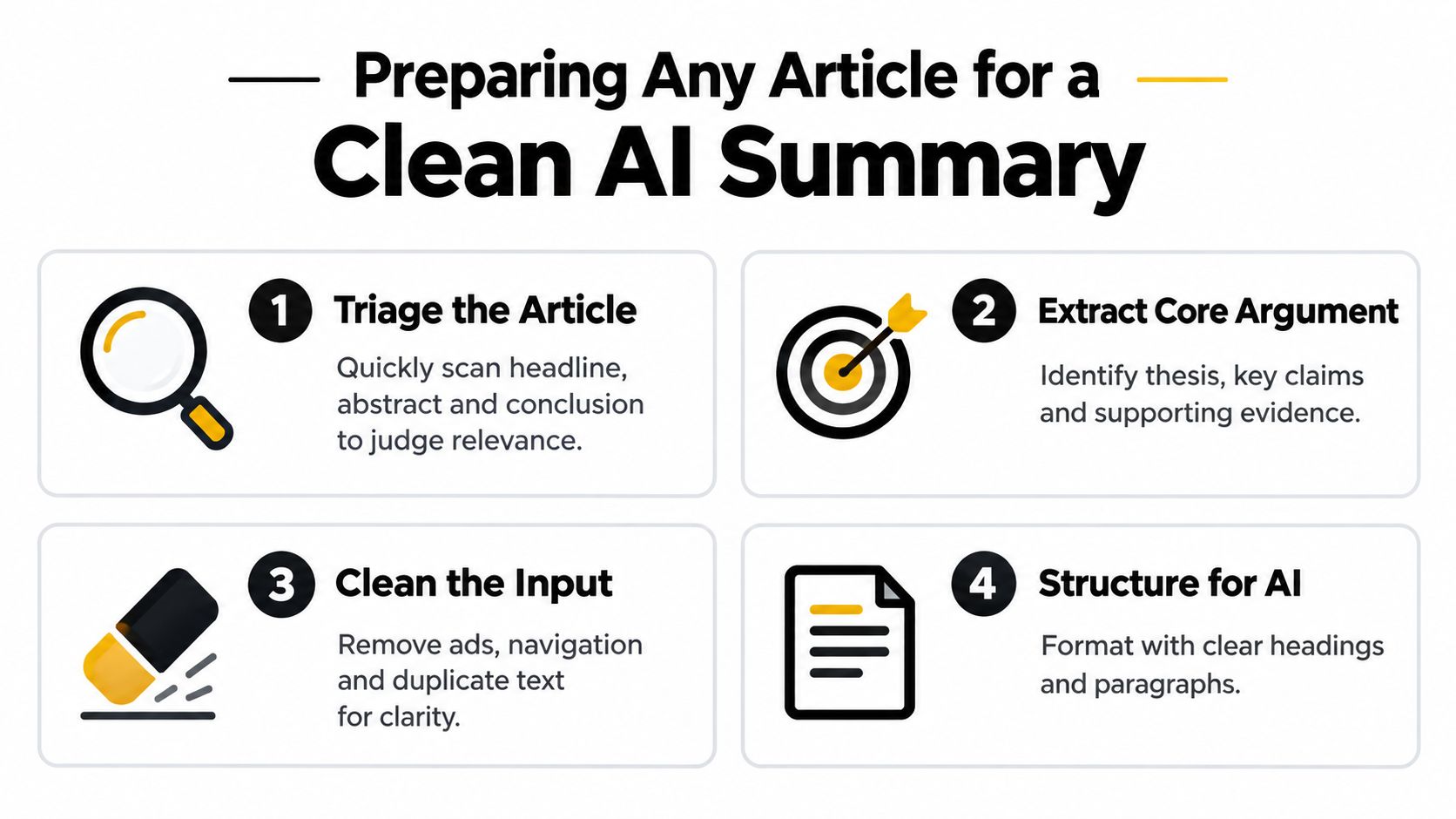
Here's the practical version:
Triage the article first
Skim the headline, abstract, intro, subheads, and conclusion. Decide whether you need a full summary, an executive brief, or just key takeaways. Not every article deserves the same treatment.Extract the core argument
Write one sentence in your own words: “This article argues that…” If you can't do that yet, the AI probably won't either.Clean the input
Remove ads, menus, “related posts,” author bio fluff, duplicated paragraphs, and references that don't need summarizing. If it's a PDF, convert it to usable text before anything else. A simple PDF to text workflow makes a big difference here.Structure the content
Keep headings, section breaks, bullet lists, and caption notes when they matter. Models handle organized source text better than one giant text brick that looks like it lost a fight with a copier.
Different article types need different prep
A news article, a blog post, and a journal paper should not go through the exact same intake process.
Define the summary before you ask for it
One habit saves a lot of rework. Decide the job of the summary before you generate it.
Ask yourself:
- Who is this for? Me, a client, a boss, a student, a content team?
- What format do I need? Bullets, paragraph, memo, brief, slide notes?
- What must not be lost? Limitations, dates, names, quotes, uncertainty?
- How short is too short? A one-liner often destroys nuance
Practical rule: If you haven't defined audience, format, and risk level, the model will choose for you. It usually chooses “vaguely impressive.”
Prep decisions that make the summary better
A few small choices improve output fast:
- For research papers: Pull methods and limitations into the source block, even if you don't include the full paper.
- For long web articles: Keep the headings. They act like signposts.
- For opinion pieces: Label opinion as opinion. Otherwise the model may summarize commentary like settled fact.
- For mixed-format PDFs: Check OCR errors early. One broken table can create a very confident nonsense summary.
This prep phase is where speed comes from. Not from rushing, but from preventing reruns.
Crafting Prompts That Keep Nuance and Save Time
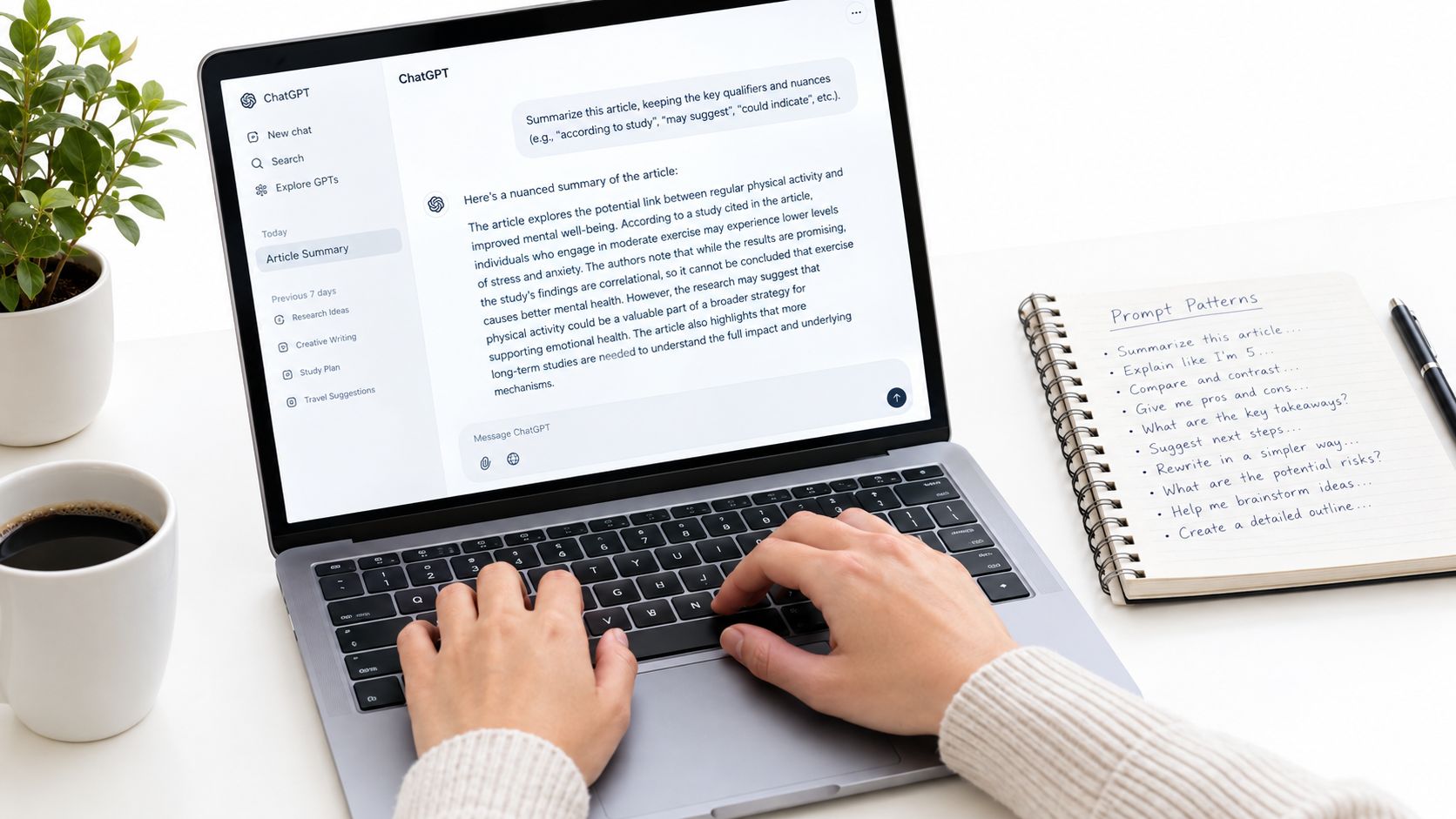
Once the source is clean, prompting gets much easier. The goal isn't to make the model sound smart. The goal is to stop it from “improving” the article into something the author never said.
That means your prompt has to ask for fidelity, not just brevity.
A 2024 scientific-article study found that AI-generated summaries can perform comparably to human-written summaries in reader comprehension: participants rated AI-generated summaries at 3.68 on a 1–5 readability scale versus 3.58 for human summaries, with no significant difference in comprehension outcomes, as reported in this scientific summary evaluation paper. That's encouraging. It also explains why weak summaries can slip past busy readers. They're easy to read even when they smooth over important constraints.
Bad prompt versus useful prompt
Here's the lazy version:
- Summarize this article in 5 bullet points.
That often produces bullets that are tidy and incomplete.
Now compare it to this:
- Summarize this article in 5 bullet points.
- Preserve qualifiers, uncertainties, and limitations.
- Do not generalize beyond what the source states.
- Attribute claims when the article attributes them.
- Include one bullet for the main claim, one for supporting evidence, one for limitations or caveats, one for who is affected, and one for open questions.
Same model. Better instructions. Less cleanup.
Prompt templates worth stealing
For a concise summary
Use this when you need a fast read without losing the point.
Summarize the article in one short paragraph. Preserve the author's main claim, confidence level, and any stated limitations. Do not overstate findings. If the source uses cautious language, keep that caution in the summary.
For bullet-point research notes
Use this for papers, white papers, or technical explainers.
Summarize this article as 6 bullets:
- Main thesis
- Key supporting points
- Evidence or examples used
- Limitations or uncertainties
- Important qualifiers or conditions
- What should not be concluded from this article
That last line does a lot of work.
For an executive summary
Use this when someone wants the “so what” without losing credibility.
Write an executive summary for a busy reader. Keep it under 150 words. Include the central argument, why it matters, and any constraints on the conclusion. Preserve attribution for claims and avoid language stronger than the source.
Long-tail prompts that actually help
These are the kinds of prompts that tend to produce more reliable output because they define context:
- Summarize academic paper with limitations intact
- Create a factual news summary with attribution and uncertainty
- Summarize blog post without losing caveats
- Turn research article into executive summary with source-grounded claims
- Summarize long PDF into bullets while preserving qualifiers
If you want more structured ideas, a good set of prompt engineering tips for document work helps when you're bouncing between papers, news, and internal docs.
Compare prompt styles by use case
After the first pass, refine instead of regenerating from scratch. Ask things like:
- Which claim in this summary is least supported by the source?
- Rewrite this summary with more cautious wording.
- Add missing limitations from the original text.
- Highlight statements that may overgeneralize the source.
A quick walkthrough can help if you want to see prompting in action before building your own workflow:
Add one line to almost every summary prompt: “Do not generalize beyond the source text.” It won't solve everything, but it cuts a lot of the model's urge to become your overconfident spokesperson.
Real World Use Cases for Academic Marketing and News Summaries
The same article summary workflow doesn't produce the same output shape every time, and that's a good thing. A literature review, a content repurposing job, and a newsroom brief all need different forms of compression.
If you use one generic summary style for everything, you end up with summaries that are too vague for research, too dry for marketing, or too fuzzy for news. Nobody wins. Least of all the poor soul reading your Slack update.
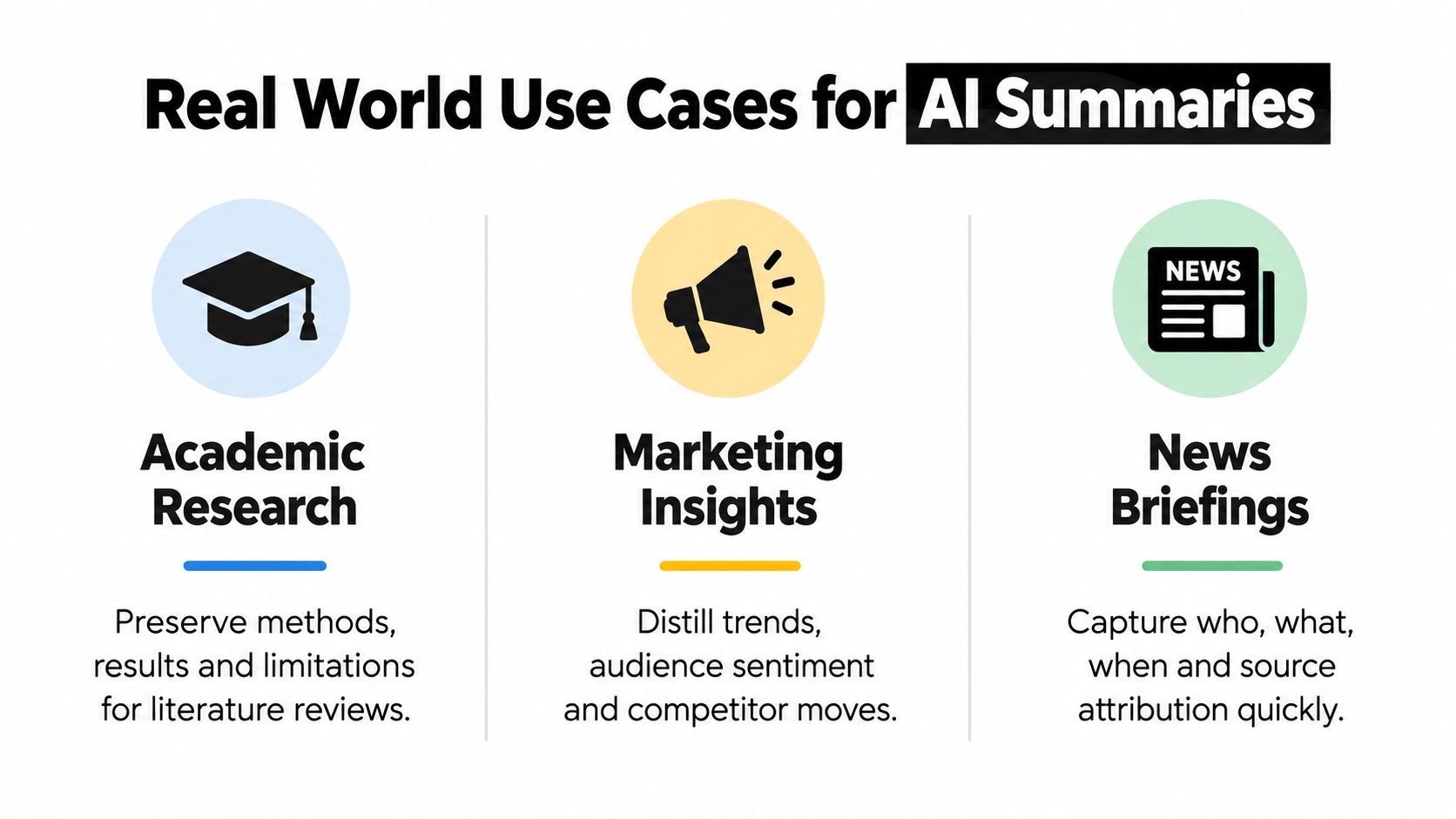
Academic research needs restraint
For research papers, the summary should preserve method, result, and limitation. If a paper studies a narrow sample, the summary should say so. If the authors hedge, the summary should hedge too.
A useful output shape looks like this:
- research question
- method in plain English
- main finding
- limitations
- what the paper does not establish
That's the version you can trust later when you're building notes for a literature review or comparing multiple papers.
Marketing summaries need extraction, not flattening
Marketing teams often summarize articles for idea mining, competitor tracking, audience research, or repurposing. The trick is to pull out usable insights without turning every post into the same “Top 5 trends” mush.
A better marketing summary usually includes:
- the article's angle
- the intended audience
- notable examples or proof points
- reusable ideas for social, email, or a landing page
- brand claims that need verification before reuse
If you're using a document workflow tool, chat plus repurposing matters. Instead of just producing one summary, you ask follow-up questions, then spin the article into talking points, hooks, FAQs, or a short brief for your team.
News summaries need attribution discipline
News is where speed pressures people into trusting summaries a little too much. That's dangerous because attribution is often the whole story.
The Reuters Institute's 2025 report shows AI summaries are already the most common newsroom AI use case at 19%, ahead of chatbots at 16%, as cited in this newsroom AI adoption report coverage. Adoption is moving fast. Quality control is trying to keep up.
For news, I'd use an output shape like this:
Quick choose-your-own-summary test
If you're unsure what kind of AI article summary to generate, ask:
- Do I need to cite this later? Use a structured factual brief.
- Do I need to act on it fast? Use a decision-focused summary.
- Do I need content ideas from it? Use an insight extraction format.
- Would one missing qualifier create a bad call? Use the most conservative version.
That last question saves a lot of headaches.
Streamlining Everything Inside Zemith Document Assistant
Here's the rewritten paragraph with the flagged phrase removed:
Time isn't lost because summarization is hard. It's lost because the workflow is split across too many tabs. One app for PDFs, another for chat, another for rewriting, another for notes, and then something else for turning the final thing into a usable asset. Browser tabs breed like rabbits.
A document workflow works better when the source, the chat, the summary draft, and the polish step stay in the same place.
One option is Zemith's document assistant, which lets you upload documents, chat with them, generate summaries, create flashcards and quizzes, and turn documents into podcast-style audio without hopping between separate tools. If you organize a lot of article summaries, the Library and Projects setup is especially useful because it keeps documents and related chats grouped by topic instead of scattering them across random sessions.
What the integrated workflow looks like
For practical article work, the flow is pretty simple:
Upload the source
Drop in a PDF, article text, or research document.Ask targeted questions
Instead of only requesting a summary, ask for the thesis, caveats, named entities, and unresolved questions.Generate the first draft summary
Pick a format that matches the job. Executive brief, bullets, memo, or study notes.Polish in Smart Notepad
Tighten wording, shorten awkward lines, and rewrite sections without losing the source-grounded meaning.Repurpose if needed
Turn that summary into flashcards, quiz prompts, notes for a meeting, or an audio recap for later.
That's a cleaner setup than the usual copy-paste obstacle course.
Why this matters for speed and output quality
Tool sprawl looks productive until you measure the friction. Every export, reformat, and app switch creates a chance to lose context.
A preregistered online experiment with 453 college-educated professionals found that generative AI assistance in writing cut the average time taken by 40% and increased output quality by 18%, while also reducing inequality between workers, according to this writing productivity experiment. That doesn't mean every AI workflow is equal. It does mean the upside is real when the tooling supports the work instead of adding ceremony.
If you're comparing broader options for consolidating your stack, the SubmitMySaas guide to AI tools is a useful roundup because it frames tools by workflow rather than novelty.
Three checks that matter more than the summary button
The best document setups don't stop at “generate summary.” They help you test whether the summary deserves trust.
Overlap quality
Does the summary reflect the source wording enough to show coverage?Semantic similarity
Does it preserve the meaning even when it paraphrases?Factual consistency
Does every key claim stay grounded in the source?
That third layer is where a lot of AI summaries wobble. A polished paraphrase can still drift.
If your workflow only rewards readable output, you'll get readable errors. The useful setup is the one that keeps the source close enough to interrogate.
Evaluating and Polishing Your AI Summary Like a Pro
You paste an article into a summarizer, get a clean three-paragraph output, and it reads well enough to publish. Then you compare it to the source and catch the usual trouble: a softened caveat, a missing attribution, a conclusion that sounds stronger than the author ever claimed.
That is the polishing stage. Good summaries are not just shorter. They stay loyal to what the source said.
A useful review stack separates overlap quality, semantic similarity, and factual consistency, but they do different jobs. Overlap metrics such as ROUGE can show whether the summary covers similar phrasing. Semantic checks can show whether paraphrasing kept the meaning. Neither one reliably catches a polished false claim. Research on summary evaluation recommends treating metrics like ROUGE-L and BERTScore as diagnostic signals, not the final approval gate, as discussed in this summary evaluation benchmark.
Use a factuality gate, not just a readability check
Readable summaries fail all the time. The risky ones are usually the most convincing.
For grounded work, especially with news, policy, academic, or market analysis, run one explicit question before you edit for style: Can every important claim be traced back to the source? If the answer is no, the summary is still a draft. Benchmarks in this area make the same distinction. Relevance, compression, and factual consistency are separate checks, and a summary can perform well on the first two while still getting the facts wrong.
That trade-off matters in practice. A tighter summary often drops qualifiers first. “May improve” turns into “improves.” “In this sample” disappears. “The company said” becomes a naked claim. That is how overgeneralization sneaks in.
A fast human review checklist
I use a short pass that takes about a minute for a normal article. It catches more errors than endlessly regenerating the summary.
Names, titles, and organizations
These are common drift points, especially when several people or institutions appear in the same piece.Dates, sequence, and timing
Models love cleaning up chronology until the story sounds neater than the original reporting.Qualifiers and scope limits
Check for words like “may,” “could,” “preliminary,” “within this group,” or “according to the authors.”Attribution
Make sure opinions, findings, and allegations still belong to the right source.The strongest sentence
Review the boldest claim line by line against the article. That is usually where the model reached a little too far.
Polish without making the summary less true
Editing can improve clarity or break the summary. Both happen fast.
A safe cleanup pass should focus on plain things:
- clearer sentence structure
- shorter phrasing where meaning stays intact
- removing repetition
- keeping uncertainty markers
- keeping attribution visible
If you want a repeatable cleanup method, this guide on how to edit writing without flattening the point is a useful companion step.
One more practical rule. If a sentence becomes punchier after editing, compare it to the source again. Punchier is often less precise.
Trust summaries that survive verification, not summaries that merely sound polished.
If you summarize articles every week, keep the quality gate small enough that you will use it. Inside Zemith, that usually means reviewing the source and summary side by side, fixing drift while the context is still fresh, and only then tightening the writing for sharing.
Explore Zemith Features
Every top AI. One subscription.
ChatGPT, Claude, Gemini, DeepSeek, Grok & 25+ more








Always on, real-time AI.
Voice + screen share · instant answers
What's the best way to learn a new language?
Immersion and spaced repetition work best. Try consuming media in your target language daily.
Voice + screen share · AI answers in real time
Image Generation
Flux, Nano Banana, Ideogram, Recraft + more

Write at the speed of thought.
AI autocomplete, rewrite & expand on command
Any document. Any format.
PDF, URL, or YouTube → chat, quiz, podcast & more
Video Creation
Veo, Kling, Grok Imagine and more

Text to Speech
Natural AI voices, 30+ languages
Code Generation
Write, debug & explain code
Chat with Documents
Upload PDFs, analyze content
Your AI, in your pocket.
Full access on iOS & Android · synced everywhere
Your infinite AI canvas.
Chat, image, video & motion tools — side by side
Save hours of work and research
Transparent, High-Value Pricing
Trusted by teams at






Free
No credit card required
- 100 credits daily
- 3 AI models to try
- Basic AI chat
Plus
- 1,000,000 credits/month
- 25+ AI models — GPT, Claude, Gemini, Grok & more
- Agent Mode with web search, computer tools and more
- Creative Studio: image generation and video generation
- Project Library: chat with document, website and youtube, podcast generation, flashcards, reports and more
- Workflow Studio and FocusOS
Professional
- Everything in Plus, and:
- 2,100,000 credits/month
- Pro-exclusive models (Claude Opus, Grok 4, Sonar Pro)
- Motion Tools & Max Mode
- First access to latest features
- Access to additional offers
What Our Users Say
Great Tool after 2 months usage
"I love the way multiple tools they integrated in one platform. Going in the right direction."
— simplyzubair
Best in Kind!
"The quality of data and sheer speed of responses is outstanding. I use this app every day."
— barefootmedicine
Simply awesome
"The credit system is fair, models are perfect, and the discord is very responsive. Quite awesome."
— MarianZ
Great for Document Analysis
"Just works. Simple to use and great for working with documents. Money well spent."
— yerch82
Great AI site with accessible LLMs
"The organization of features is better than all the other sites — even better than ChatGPT."
— sumore
Excellent Tool
"It lives up to the all-in-one claim. All the necessary functions with a well-designed, easy UI."
— AlphaLeaf
Well-rounded platform with solid LLMs
"The team clearly puts their heart and soul into this platform. Really solid extra functionality."
— SlothMachine
Best AI tool I've ever used
"Updates made almost daily, feedback is incredibly fast. Just look at the changelogs — consistency."
— reu0691