AI Assistant for Documents: How It Works
Discover how an AI assistant for documents transforms reading and research. Learn key features, real workflows, and how Zemith turns files into podcasts
You've got a folder full of PDFs, a deadline breathing down your neck, and the sinking feeling that “just skim the important parts” stopped being realistic about three documents ago. Research papers, contracts, quarterly reports, training manuals, meeting notes. They're all waiting patiently, like a tiny paper-based jury judging your time management.
An AI assistant for documents can help, but it isn't a magic wand that replaces judgment. Think of it as a tireless reading partner that can find information, explain dense passages, compare files, and turn static text into useful formats. The best tools don't just answer questions. They help you work with information.
Drowning in PDFs and How to Survive
Suppose you're preparing a presentation from a stack of research papers. One file contains the background, another has the methodology, a third includes the figures you need, and a fourth contradicts a conclusion from the first. You could search each PDF manually, copy passages into a notebook, and spend an afternoon trying to remember which document said what.
Or you could give the collection to an AI document assistant and ask focused questions such as:
- Find the evidence: Which papers discuss customer retention?
- Compare conclusions: Where do these reports disagree?
- Prepare the material: Turn the main findings into presentation notes.
- Test understanding: Create questions that reveal whether you've understood the topic.
That shift matters. Traditional document work often forces you to move between reading, searching, copying, organizing, and rewriting. An assistant brings those actions into one conversation, so you can spend more time deciding what the information means and less time wrestling with file formats.
Practical rule: Use AI to reduce the mechanical reading load, but keep human review for decisions, evidence, and final wording.
The modern document assistant has grown beyond the old “summarize this PDF” trick. Chat-based generative AI became mainstream in 2022, after earlier language-model advances such as OpenAI's GPT-3, released in 2020 with 175 billion parameters, helped establish large-scale few-shot language tasks. The history is documented in this overview of AI development, which also describes how document automation evolved into an enterprise workflow category.
That evolution explains why users now expect more than a paragraph of highlights. They want searchable libraries, cross-file reasoning, quizzes, flashcards, audio versions, and answers that point back to the source. Before uploading a pile of files, it can also help to understand how to convert a PDF to text, especially when the original document uses scans or unusual formatting.
Document assistants can also support the presentation stage. If your research needs to become a multimedia briefing, these digital signage presentation tips offer useful guidance on combining PDFs, images, video, and office files without creating a visual soup.
What an AI Assistant for Documents Actually Does
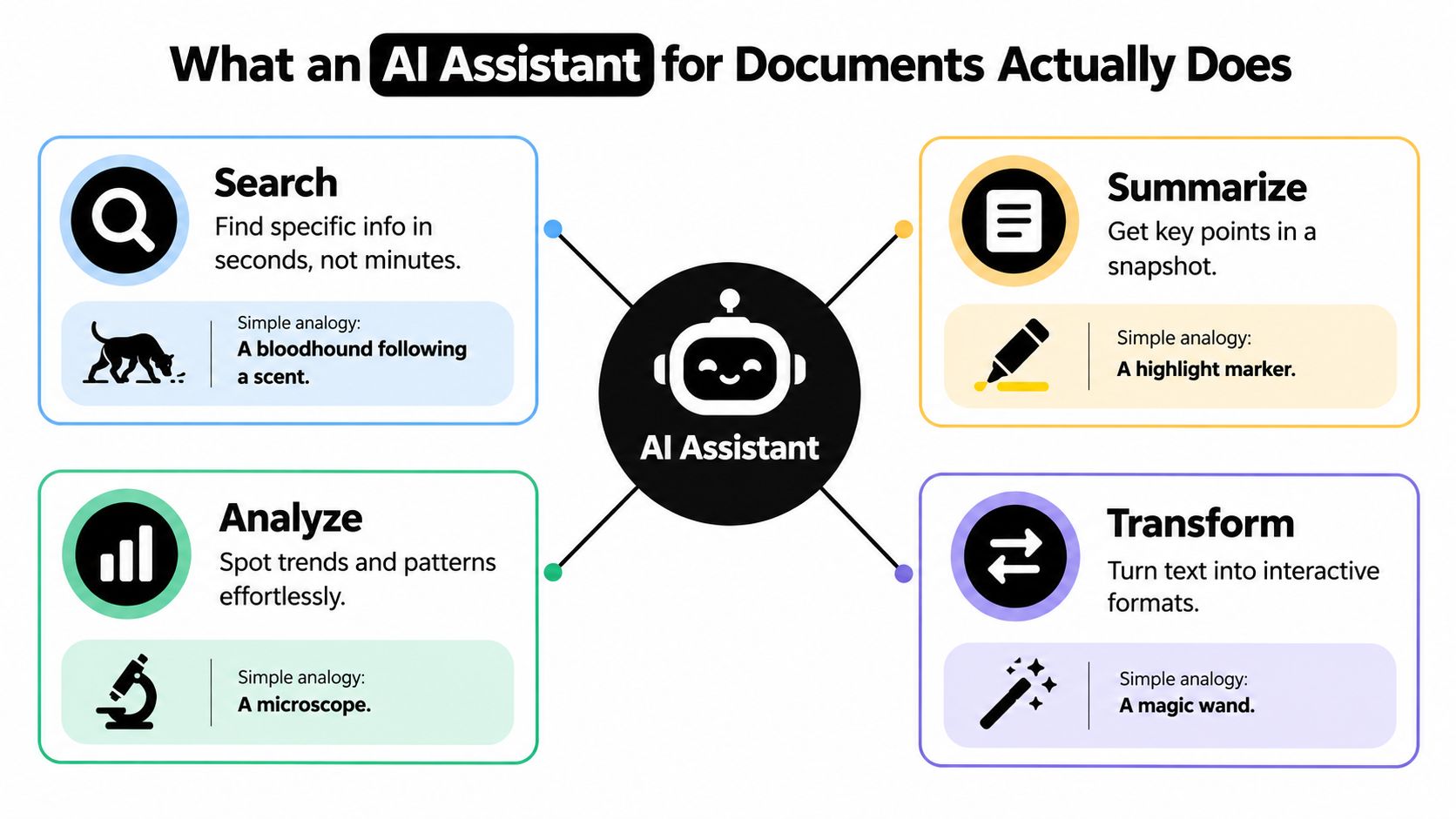
A normal search box behaves like a bloodhound. Give it a phrase, and it follows the exact scent of matching words. An AI assistant behaves more like a researcher who has read the material and can interpret a question even when your wording doesn't match the document.
That difference comes from several connected operations. First, the system extracts text and other document elements. It then breaks the material into smaller passages, represents their meaning in a searchable form, retrieves relevant sections, and generates an answer using that retrieved context. This general approach is often called retrieval-augmented generation, or RAG.
Four useful document actions
- Search: Ask for a specific clause, definition, date, or argument without guessing the author's exact wording.
- Summarize: Request a short overview, an executive brief, or a section-by-section explanation.
- Analyze: Compare themes, identify differences, trace an argument, or connect information across files.
- Transform: Convert source material into flashcards, quizzes, notes, scripts, or audio-friendly dialogue.
The important word is context. A keyword tool may find every occurrence of “renewal,” but it won't necessarily distinguish a contract renewal clause from a discussion of renewing a subscription. A document assistant can use nearby passages and your question to interpret the request more intelligently.
For a practical introduction to the wider topic, this AI research assistant explained guide provides helpful context around using AI for information-heavy work. You can also explore how AI assistants work if you want a deeper look at the mechanics behind prompts, retrieval, and generated responses.
What contextual memory changes
One file is useful. A workspace containing related files is much more powerful. You might ask an assistant to compare a policy with an employee handbook, match a product brief to customer feedback, or find where two reports use different definitions.
That doesn't mean the system “understands” your library in the same way a human expert does. It means the assistant can retrieve related passages and use them together, provided the files are available, legible, and correctly indexed. Good tools should make that evidence visible rather than presenting a polished answer with no trail back to the source.
The Accuracy Gap in Complex Files
Not all PDFs are equal, and an assistant that performs beautifully on a clean text document may struggle with a scanned annual report. The problem often begins before the language model generates a single sentence.
A document can contain selectable text, scanned images, nested tables, footnotes, charts, captions, sidebars, and columns that change the reading order. If the system extracts those elements incorrectly, its later answer may sound confident while attaching the right sentence to the wrong table or missing a qualification buried in an image.
Independent coverage in 2025 describes a meaningful gap between text-heavy and mixed-content workflows. Some retrieval-augmented setups reached roughly 92% to 94% accuracy on text-heavy material, while mixed-content documents fell to about 78% to 85%, and layout problems appeared in about 1 in 5 cases. These figures come from coverage of document AI accuracy gaps, and they're useful because they challenge the cheerful assumption that every “chat with PDF” tool handles every file equally well.
Where errors tend to appear
- Scanned pages: The assistant may need optical character recognition before it can reason over the content.
- Nested tables: Rows, columns, headers, and footnotes can lose their relationships during extraction.
- Image-heavy reports: A chart may contain essential information that plain text retrieval never sees.
- Cross-document questions: The answer may require matching terms, dates, and definitions across separate files.
- Text-image alignment: A caption, diagram, and paragraph may belong together even when their layout separates them.
For high-stakes work, ask the assistant to show supporting passages, page references, or citations. Test it with questions whose answers you already know. If it can't locate the evidence, the correct response is uncertainty, not creative improvisation.
Document-specific evaluation matters for the same reason. Recent benchmark work emphasizes coverage, hallucination, retrieval scope, and reasoning across text, tables, and figures rather than relying only on generic question-answering scores. The document RAG benchmark research explores these failure modes directly.
Summary quality also deserves a proper test. Overlap-based metrics such as ROUGE don't fully capture whether a long summary preserves meaning or invents implications. More semantic and factuality-oriented approaches include BERTScore, MoverScore, and BARTScore, as discussed in this review of long-document summarization evaluation.
Beyond Summaries, Podcasts, Quizzes, and Flashcards
A summary is useful, but it's usually a passive format. You read it, nod thoughtfully, and then discover later that your brain stored approximately three bullet points and a vague sense of achievement.
The more interesting workflow is document transformation. Give an assistant a textbook chapter, product manual, research report, or training document, then ask it to reshape the same source for a different activity. The information stays grounded in the file, while the format changes to match the way you need to use it.

Turn one document into several learning tools
A student could upload a difficult chapter and request:
- A plain-language explanation of each major concept.
- Flashcards with a question on one side and a concise answer on the other.
- A multiple-choice quiz with explanations for every option.
- A revision checklist organized by topic.
- A dialogue script that explains the material conversationally.
The transformation becomes more useful when you specify the audience and purpose. “Summarize this” is vague. “Create flashcards for a beginner who needs to distinguish these concepts on an exam” gives the assistant a better target.
The same idea works outside education. A compliance team could turn a policy into scenario-based questions. A product manager could convert a requirements document into a decision briefing. A sales team could transform a technical specification into customer-friendly talking points. A researcher could request a podcast-style explanation of a dense paper before returning to the original methodology.
For a convert document to podcast AI workflow, the key is to treat audio as a first pass, not a replacement for the source. Ask the assistant to preserve important qualifications, define unfamiliar terms, and separate established findings from open questions. Then listen while commuting, walking, or doing the dishes. Your kitchen may become a surprisingly effective seminar room.
This short video offers another way to think about practical AI document workflows:
You can also turn the output into a study loop: listen to the podcast, answer the quiz without looking at the source, review missed flashcards, and ask follow-up questions about the weak spots. That's more active than collecting summaries in a folder called “Read Later,” where documents go to enjoy a peaceful retirement.
For a focused workflow, turn text into a podcast describes the practical path from written material to listenable content.
Tailoring Workflows for Different User Personas
The right document workflow depends less on the label “AI assistant” and more on what you're trying to produce. A student, developer, marketer, and legal professional may upload similar file types, but they need very different outputs.
Students need retrieval plus practice
A student rarely needs a beautiful summary alone. They need to know whether they can recall the material without help. A useful prompt asks for flashcards grouped by concept, a quiz with plausible wrong answers, and a list of terms that require the original source for full context.
Developers need precision and speed
A developer reviewing API documentation may ask, “What authentication method does this endpoint require?” Then they may follow up with, “Show the limitations, error responses, and a minimal implementation outline.” The assistant should answer from the relevant documentation, preserve version context, and avoid turning an optional parameter into a mandatory one.
Researchers and marketers need relationships
Researchers often work across a collection of papers rather than a single file. They might ask where sources agree, which methods differ, and what limitations recur. Marketers can use a similar pattern with competitor analyses, customer interviews, and campaign briefs, asking the assistant to separate direct evidence from interpretation.
For teams refining repeated processes, AI workflow optimization can help connect document work to broader routines rather than treating every upload as an isolated task.
The best prompt usually names the role, the source boundary, the desired format, and the level of certainty required. “Answer only from the uploaded files and identify missing evidence” is much safer than “Tell me everything important.”
Why Zemith Is a Document Powerhouse
Most users don't need another lonely PDF chatbot. They need fewer browser tabs and a place where documents, notes, research, and outputs stay connected.
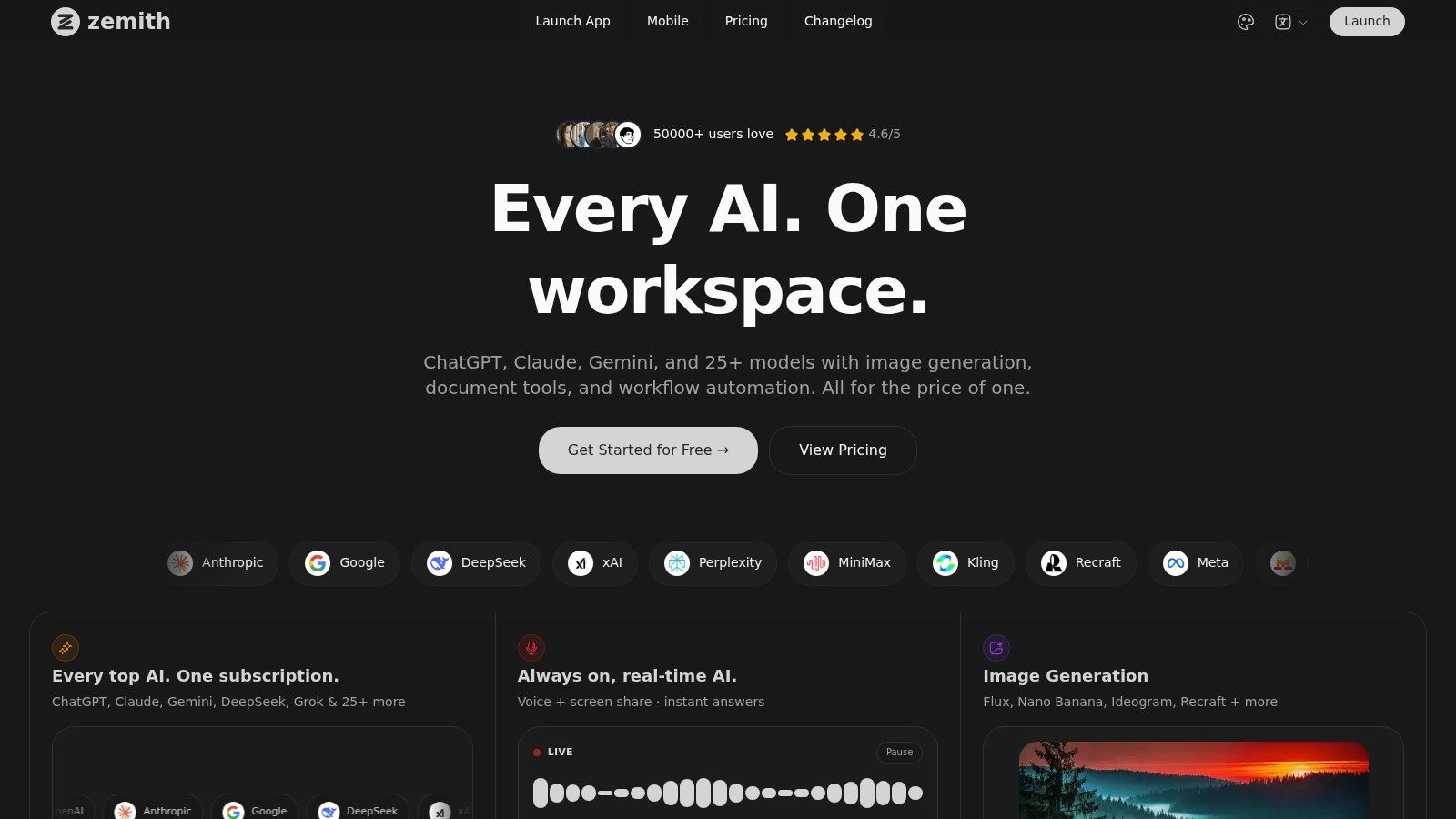
Zemith's Document Assistant supports document chat, summaries, quizzes, flashcards, and podcast conversion. Its broader workspace includes a Library for organizing documents and chats, plus Projects for keeping topic-specific information and conversations together. That structure matters because a useful answer often depends on more than one file.
One workspace, several next steps
A typical Zemith workflow might look like this:
- Collect: Add PDFs, DOCX files, URLs, or YouTube content to a working library.
- Question: Ask for answers, summaries, comparisons, or key data points.
- Transform: Convert the material into a quiz, flashcards, podcast, or polished notes.
- Create: Use the Smart Notepad to rephrase, expand, shorten, or improve writing.
- Research: Continue with Deep Research when the documents point toward an unanswered question.
- Build: Use the Coding Assistant to turn an analyzed idea into a prototype or utility.
- Visualize: Generate an image or supporting visual when a report needs to become a presentation.
That last step changes the mental model. The document isn't the end product. It's source material that can feed writing, research, design, teaching, and software work.
Zemith also offers access to multiple AI models through one interface, alongside creative image tools, coding support, Deep Research, AI Live Mode, a whiteboard, and mobile access. Those features don't remove the need to verify important claims, but they can reduce the constant copy-and-paste routine between specialized subscriptions.
The practical advantage is continuity. You can move from “summarize this report” to “turn the findings into a briefing” to “draft a simple dashboard concept” without rebuilding the context from scratch each time. For a closer look at that approach, see this guide to a multi-model AI platform.
Measuring Your Productivity Gains and Next Steps
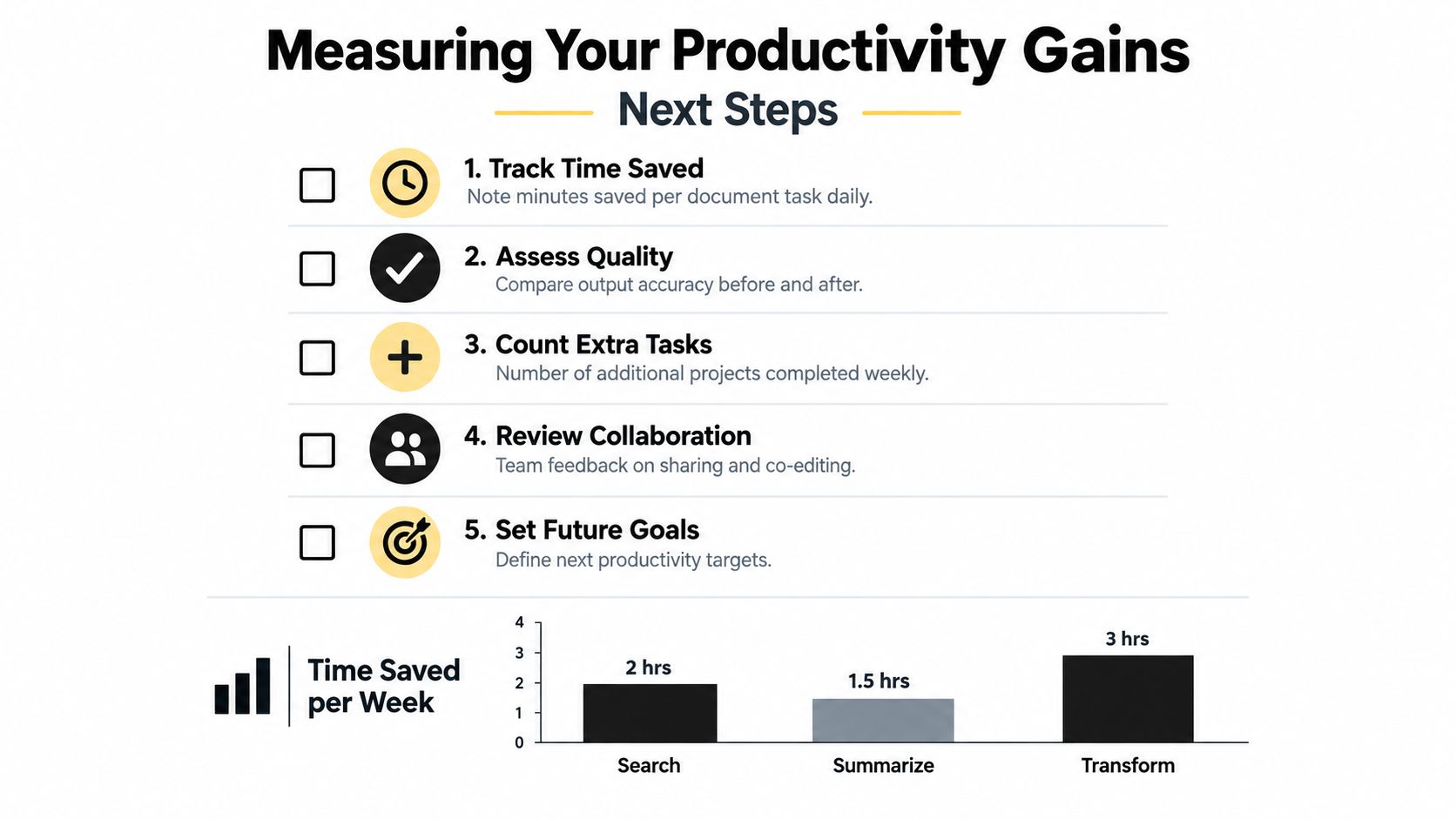
Productivity improvements become easier to understand when you measure the work, not the excitement of the demo. Track how long it takes to locate information, prepare a first draft, compare documents, and create learning material before and after you introduce an assistant.
Workplace evidence points to several concrete mechanisms. A 2024 Microsoft Research workplace study found that Copilot users created and edited 10% more documents and read 11% fewer emails, as reported in the Microsoft Research workplace study. A related Microsoft analysis released in 2026 found that workers who used the system more than 100 times over a 20-week post-adoption period showed a 21.2% increase in productivity actions, while document-intensive work completed 5% to 25% faster for treated workers who adopted the tool, using the same source.
The gains aren't evenly distributed. An earlier Microsoft-linked NBER study found a 14% average productivity increase overall and a 34% improvement for novice and low-skilled workers, suggesting that drafting, summarizing, and text refinement can be particularly valuable for people who need more help structuring written work.
A practical starting checklist
- Choose one recurring task: Start with contract comparison, research summaries, study quizzes, or technical documentation.
- Record the baseline: Note the time spent and the quality problems you usually encounter.
- Create a small workspace: Keep related files together so your questions have clear boundaries.
- Check the evidence: Review citations, source passages, tables, and uncertain answers.
- Measure the result: Track time saved, useful outputs created, and corrections required.
Adoption works better when the assistant becomes part of a routine rather than a novelty tab. The NBER reports that 39.4% of surveyed respondents had used generative AI, 28% of employed respondents used it for their job, 24.2% used it at least one day in the previous week, and 10.6% used it every workday in the previous week, according to its workplace adoption summary.
The Federal Reserve also notes that worker surveys commonly report AI use rates between 20% and 40%, with higher use in some occupations, as described in its analysis of workplace AI uptake. Start small, verify carefully, and let the workflow earn its place.
If you're ready to turn overloaded folders into searchable, interactive workspaces, visit Zemith to explore its Document Assistant for summaries, quizzes, flashcards, podcasts, and cross-document research. Upload one real file, ask one useful question, and build from there.
Explore Zemith Features
Every top AI. One subscription.
ChatGPT, Claude, Gemini, DeepSeek, Grok & 25+ more








Always on, real-time AI.
Voice + screen share · instant answers
What's the best way to learn a new language?
Immersion and spaced repetition work best. Try consuming media in your target language daily.
Voice + screen share · AI answers in real time
Image Generation
Flux, Nano Banana, Ideogram, Recraft + more

Write at the speed of thought.
AI autocomplete, rewrite & expand on command
Any document. Any format.
PDF, URL, or YouTube → chat, quiz, podcast & more
Video Creation
Veo, Kling, Grok Imagine and more

Text to Speech
Natural AI voices, 30+ languages
Code Generation
Write, debug & explain code
Chat with Documents
Upload PDFs, analyze content
Your AI, in your pocket.
Full access on iOS & Android · synced everywhere
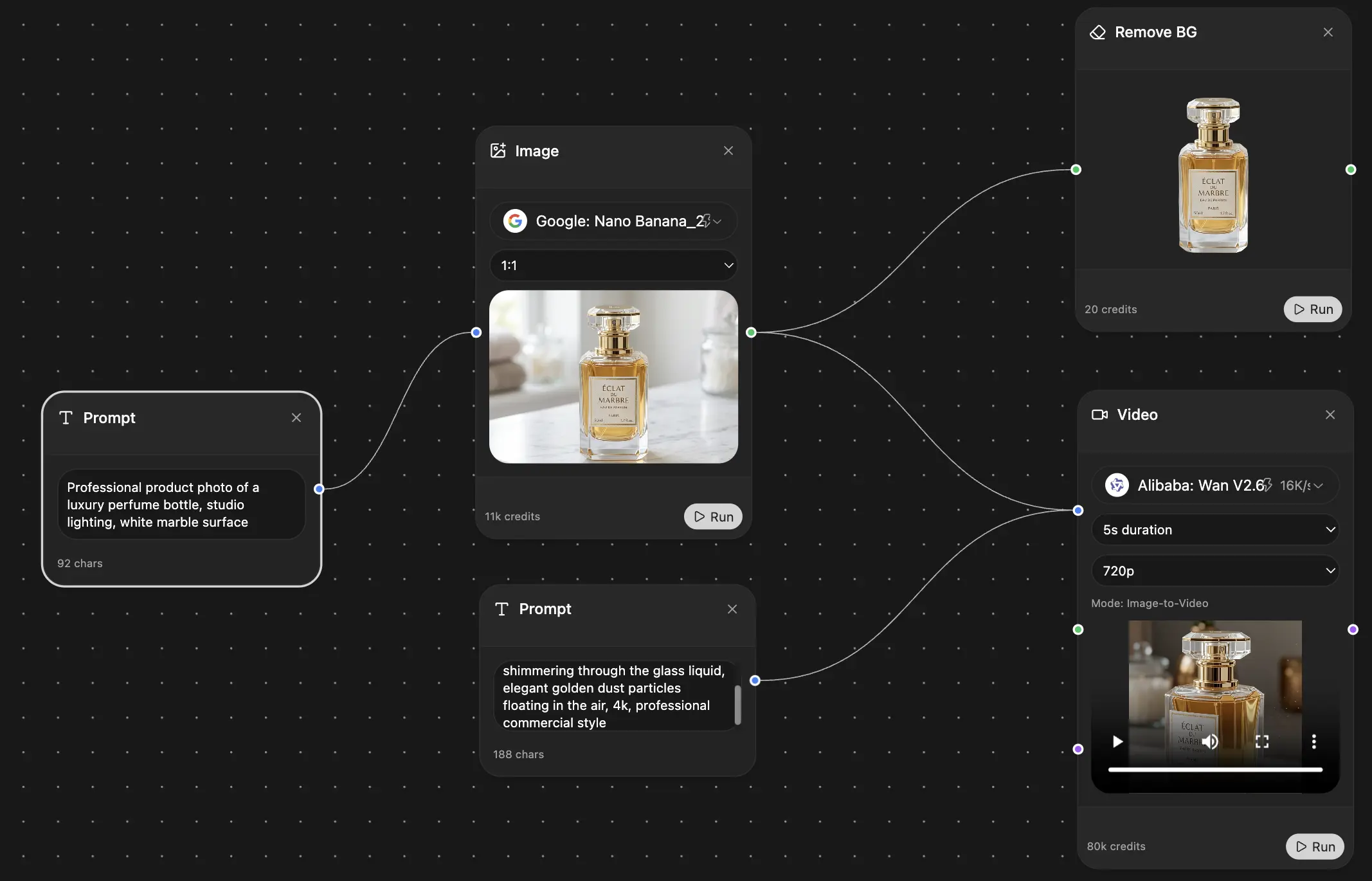
Your infinite AI canvas.
Chat, image, video & motion tools — side by side
Save hours of work and research
Transparent, High-Value Pricing
Trusted by teams at






Free
No credit card required
- 100 credits daily
- 3 AI models to try
- Basic AI chat
Plus
- 1,000,000 credits/month
- 25+ AI models — GPT, Claude, Gemini, Grok & more
- Agent Mode with web search, computer tools and more
- Creative Studio: image generation and video generation
- Project Library: chat with document, website and youtube, podcast generation, flashcards, reports and more
- Workflow Studio and FocusOS
Professional
- Everything in Plus, and:
- 2,100,000 credits/month
- Pro-exclusive models (Claude Opus, Grok 4, Sonar Pro)
- Motion Tools & Max Mode
- First access to latest features
- Access to additional offers
What Our Users Say
Great Tool after 2 months usage
"I love the way multiple tools they integrated in one platform. Going in the right direction."
— simplyzubair
Best in Kind!
"The quality of data and sheer speed of responses is outstanding. I use this app every day."
— barefootmedicine
Simply awesome
"The credit system is fair, models are perfect, and the discord is very responsive. Quite awesome."
— MarianZ
Great for Document Analysis
"Just works. Simple to use and great for working with documents. Money well spent."
— yerch82
Great AI site with accessible LLMs
"The organization of features is better than all the other sites — even better than ChatGPT."
— sumore
Excellent Tool
"It lives up to the all-in-one claim. All the necessary functions with a well-designed, easy UI."
— AlphaLeaf
Well-rounded platform with solid LLMs
"The team clearly puts their heart and soul into this platform. Really solid extra functionality."
— SlothMachine
Best AI tool I've ever used
"Updates made almost daily, feedback is incredibly fast. Just look at the changelogs — consistency."
— reu0691