Stop treating storytelling for business like garnish on the marketing plate. If the story is weak, the meal still gets sent back, even if the feature list is gluten-free and beautifully formatted. The true job of a business story is to move someone from attention to action, and the evidence keeps pointing in the same direction, stories shape memory, trust, and conversion far better than a pile of specs ever will.
Why Storytelling for Business Actually Drives Revenue
Storytelling for business earns its place in a growth plan when it changes measurable buyer behavior. An industry summary reports that stories can improve conversion rates by 30% and make facts 22 times more memorable industry summary. The useful takeaway is not “add emotion.” It is to connect a narrative structure to a pipeline event, such as a return visit, demo request, sales handoff, or opportunity influenced by content.
A buyer who remembers the problem, the friction, and the result can explain your offer to other decision-makers. That matters in B2B buying groups, where one person may discover the content while someone else evaluates risk, budget, or implementation. A story gives both people a shared frame. Without one, your message can disappear during the third tab-switch of the morning.
Consumer research points to the same practical effect. 92% of consumers want ads to feel like stories, 55% are more likely to remember a story than a list of facts, and 68% say brand stories influence purchasing decisions consumer storytelling benchmarks. These findings do not prove that every dramatic case study will generate revenue. They show why a clear sequence of cause, conflict, and result can help an audience judge whether your offer fits its situation.
Turn the narrative into a measurement plan
Start with the business outcome, then choose the story structure. A customer-change story can support demand generation. A problem-and-resolution story can clarify product value on a landing page. A proof-led story can help sales address risk late in the buying process. Track the relevant pipeline metric instead of treating engagement as the finish line.
Practical rule: If your copy sounds like a feature sheet with better punctuation, connect each feature to a customer problem, a measurable business outcome, and the next buying action.
Use an evidence-based decision-making framework to compare narrative variants against pipeline movement and customer lifetime value, rather than choosing the version that merely earns praise in a review meeting. A memorable story is useful. A memorable story that helps create qualified opportunities and retain valuable customers is useful business work.
The Psychology Behind Why Stories Convert
A story works because the brain doesn't treat it like a spreadsheet. It treats it like a sequence of events with meaning. When facts arrive inside a narrative, they become easier to store and easier to retrieve, which is why the same information in a story tends to outlive the same information in a list.
The emotional side matters too. In the IPA's review of 996 cases, emotionally charged campaigns delivered about 12% growth versus 4% for rational campaigns over a two- to three-year horizon IPA review summary. That doesn't mean facts are useless. It means facts need a job, and that job is usually to support a human outcome, not to stand there in a blazer and hope for applause.
Why the brain keeps the story and drops the list
People remember what helps them simulate reality. A good business story gives them a protagonist, a problem, friction, and a result. That lets them mentally test the solution before they ever open a demo request form. It's the difference between “our platform centralizes workflows” and “your team stops losing Tuesday afternoon to tab-hopping and version chaos.”
An important marketing review identified four distinct strands in the literature on how stories influence consumer purchasing behavior systematic review framework. The exact academic scaffolding matters less than the business takeaway, stories are not one thing. A testimonial, a product journey, and a founder narrative all do different work.
Practical rule: If the buyer can't see themselves inside the story, they'll treat it like brand wallpaper.
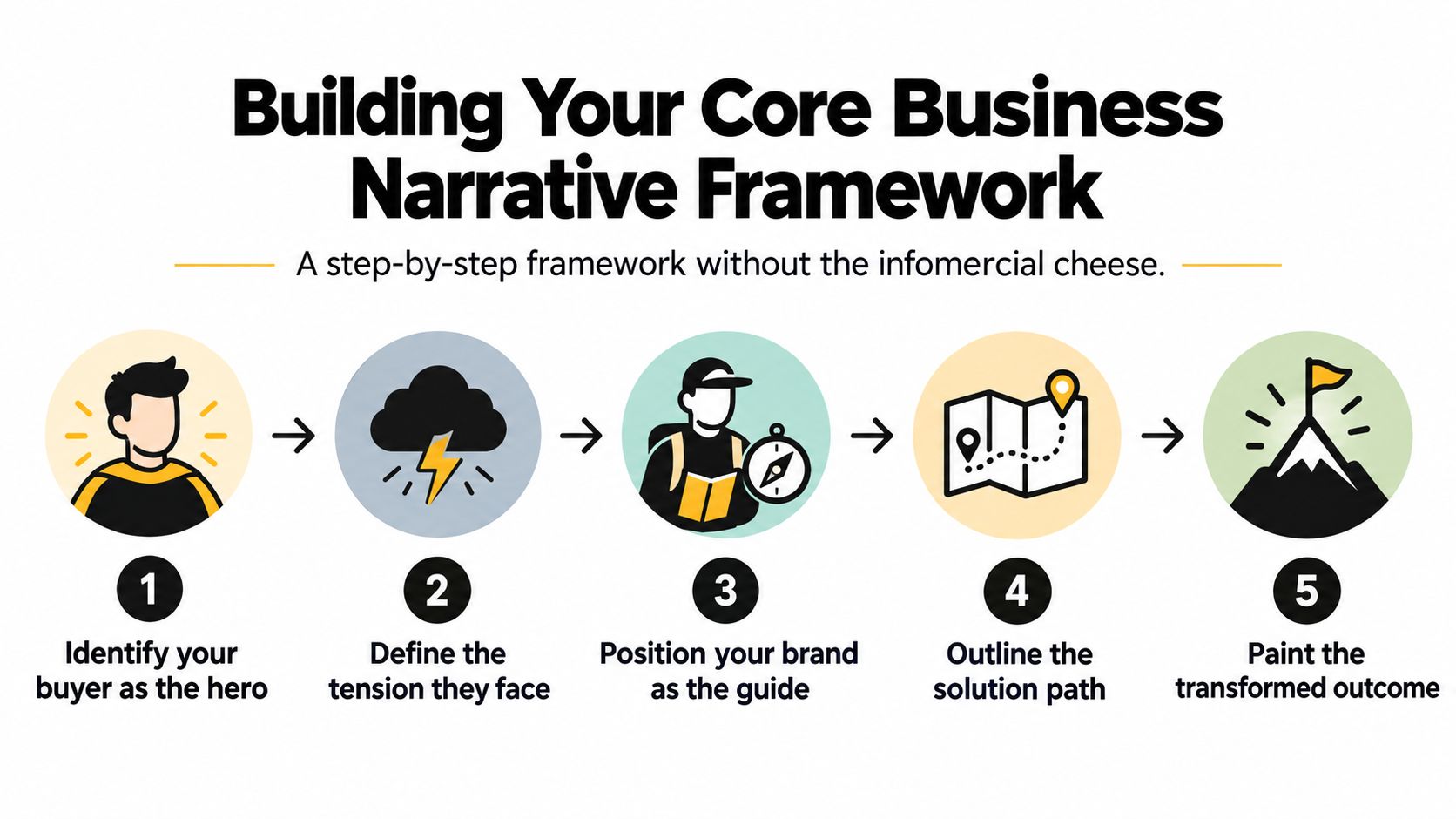
That's why a useful story doesn't just say “this tool is great.” It shows a before state, the moment of tension, and the after state. If you want a clean visual reminder of that structure, the infographic above is the non-cheesy version of a story spine. For tighter narrative writing at the headline level, the guide on how to write better headlines is a useful companion.
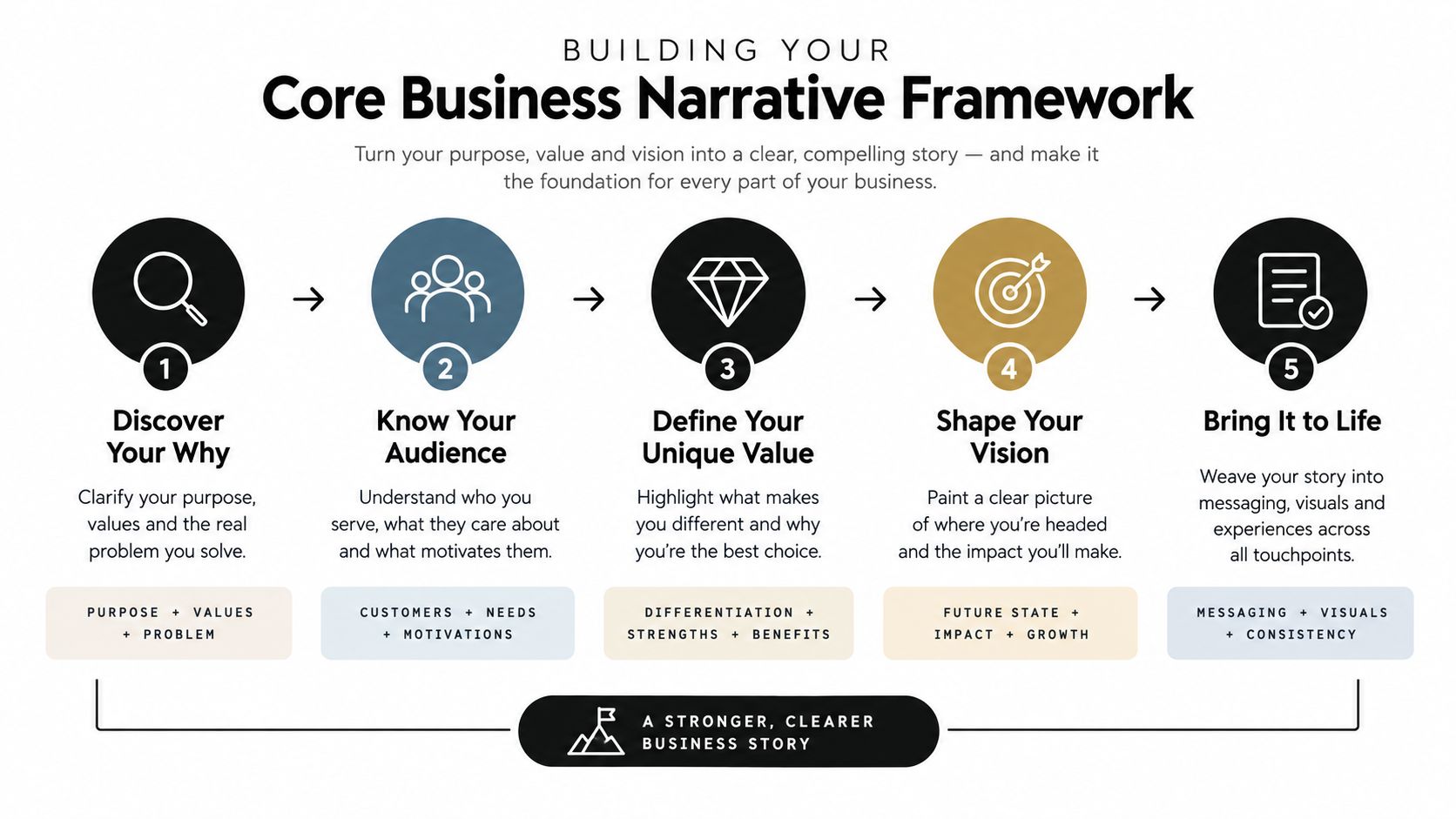
Building Your Core Business Narrative Framework
A useful business narrative is less about dramatic language than operational precision. It should help a buyer recognize a costly problem, understand the intervention, and see how the result will appear in their own reporting. If your company is the hero of every story, the audience will politely nod and mentally exit through the gift shop.
Start with a measurable customer problem
Pull the raw material from customer interviews, support notes, sales calls, and CRM records. Look for recurring friction such as wasted time, tool switching, messy approvals, or repeated work caused by unclear versions. In B2B, operational details make the narrative credible because they connect the story to a budget, a process, or a pipeline stage.
An AI-assisted review can cluster recurring complaints, extract the language buyers use, and compare those themes with conversion and retention data. The output is not a finished story. It is a shortlist of narrative angles worth testing against qualified pipeline, sales velocity, win rate, and customer lifetime value.
Turn the narrative into a testable workflow
Build the framework around five working fields:
- Hero: the buyer and their measurable responsibility
- Problem: the recurring friction and its business cost
- Guide: the Zemith product, service, or process that addresses it
- Plan: the specific steps required to adopt the solution
- Outcome: the operational change and metric that should improve
Use the fields as a briefing system, not a decorative formula. For example:
- Hero: a RevOps lead losing 6 hours per week to tool switching
- Problem: disconnected systems slow handoffs and obscure ownership
- Guide: a 3-step Zemith consolidation
- Plan: map the workflow, combine the relevant tools, and monitor adoption
- Outcome: a 40% reduction in handoff time, tracked as sales velocity in the CRM
That example gives the sales team a claim to test rather than a vague promise about efficiency. It also gives marketing a way to compare the narrative with pipeline movement and later customer value.
Convert feedback into reusable proof
Use AI to group customer language by pain point, buying trigger, objection, and post-implementation result. Then have a marketer verify the source, remove unsupported claims, and adapt the approved version for a landing page, sales deck, case study, or demo script. Automation speeds the sorting. Human review protects accuracy and context.
For consistency across pages, decks, and social posts, brand guidelines can keep terminology and tone from drifting. A short-form example, brand storytelling for TikTok conversions, shows how a clear reason to care can support conversion in a different channel.
Keep the approved narrative in a shared content creation workflow, with the source evidence and target metric attached. Review performance by audience, channel, and funnel stage. A story earns its place when it improves a business outcome, not merely when readers say it sounds compelling.
Choosing Between Emotional and Data-Led Stories
The right story depends on the decision you need to influence. Emotional narratives help buyers remember a brand and care about a problem. Data-led narratives help them verify risk, value, and fit. Treating one format as a universal solution usually produces attractive content with weak pipeline impact.
Use emotion when the goal is memory and brand lift
Emotion-led storytelling works best when the KPI is unaided recall, brand lift, or engagement with a new category. It suits awareness, repositioning, and category education, particularly when competitors use nearly identical claims. Long-term evidence has linked emotionally connected customers with 306% higher lifetime value consumer benchmark summary, so a narrative built for loyalty can matter well beyond the first click.
Give the audience a specific human stake, then connect it to the business problem. A buyer might remember the late-night escalation, the missed handoff, or the frustrated customer more easily than a list of features. The trade-off is measurement speed. Emotional impact may show up first in recall, branded search, or assisted conversions rather than immediate form fills.
Use emotional stories when unaided recall is the KPI. Use data-led stories when SQL-to-opportunity conversion is the KPI, and track each variant separately in the pipeline report.
Use data-led stories when trust is the bottleneck
Technical, B2B, and research-heavy audiences usually need evidence before preference. Data storytelling works when it turns complex analysis into a decision a buyer can evaluate. Commentary on the subject highlights this connection between analytics, business decisions, and trust, with short-form social video at 41% ROI, brand storytelling at 38%, and testimonials at 34% data storytelling commentary. If skepticism blocks progress, show the metric, its context, and the action it supports.
Trust often starts with proof, then moves to preference.
A 2024 study found that storytelling directly and significantly affected customer engagement, while purchasing decisions were influenced indirectly through engagement storytelling and engagement study. Build the sequence accordingly: earn interaction first, then ask for the conversion. In reporting, compare engagement, qualified pipeline, SQL-to-opportunity conversion, and later customer value by story type. A story earns continued budget when it improves the metric assigned to its funnel stage.
Story Format Decision Matrix
Scaling Story Creation with AI Workflows
AI does not create a business narrative by itself. It makes a tested narrative easier to adapt, compare, and improve across sales, social, email, and landing pages. The useful workflow starts with evidence, assigns each version a job, and measures whether the story contributes to pipeline rather than merely producing more copy.
Start with interviews, support tickets, product notes, research documents, and sales calls. Feed ten sales call transcripts into Zemith Document Assistant, cluster the three most repeated friction themes, and turn each theme into a narrative spine. Generate three variants, each with a different opening or proof emphasis, then A/B test them in email. Track reply rate, meeting rate, opportunity creation rate, and the later customer value associated with each variant.
Zemith can support this process through document summarization, multi-model drafting, and style revision. The content creation workflow guide provides a practical reference for organizing those steps. Human review still decides whether a customer tension is real, whether the promise is credible, and whether the story fits the buying stage.
Turn source material into narrative ingredients
A blank page is a poor research method. Extract recurring objections, desired outcomes, failed alternatives, and proof points from the source material first. AI can group those details, while the marketer chooses the conflict, stakes, and resolution that deserve attention.
Use separate prompts or models for separate tasks. One can identify hooks, another can tighten language, and a third can convert rough notes into a customer-facing structure. The trade-off is speed versus sameness. Without clear source material and constraints, every version starts sounding like a polished procurement memo.
Use AI for variation, not fake originality
The goal is useful variation, not a larger pile of words. A homepage headline, demo opener, and LinkedIn post can share one narrative core while changing length, tone, and proof. Keep a version tied to one funnel objective so performance comparisons remain meaningful.
Writing tools can handle rephrasing, autocomplete, and style adjustments. The Document Assistant can also turn dense transcripts or research into summaries or audio formats, making review easier when the source file is long and unpleasant.
Practical rule: AI should speed up drafting and editing. The team should decide which story deserves distribution.
Keep fact-checking inside the workflow
A confident error can damage trust faster than a weak headline. Verify customer outcomes, product capabilities, market claims, and quoted language before publication. Keep approved evidence in a reusable library, tagged by audience, narrative structure, funnel stage, and supporting metric.
That system scales production without turning it into narrative spam. It also lets the team compare story variants against opportunity creation and customer lifetime value, then invest in the structures that help revenue rather than just generating attention.
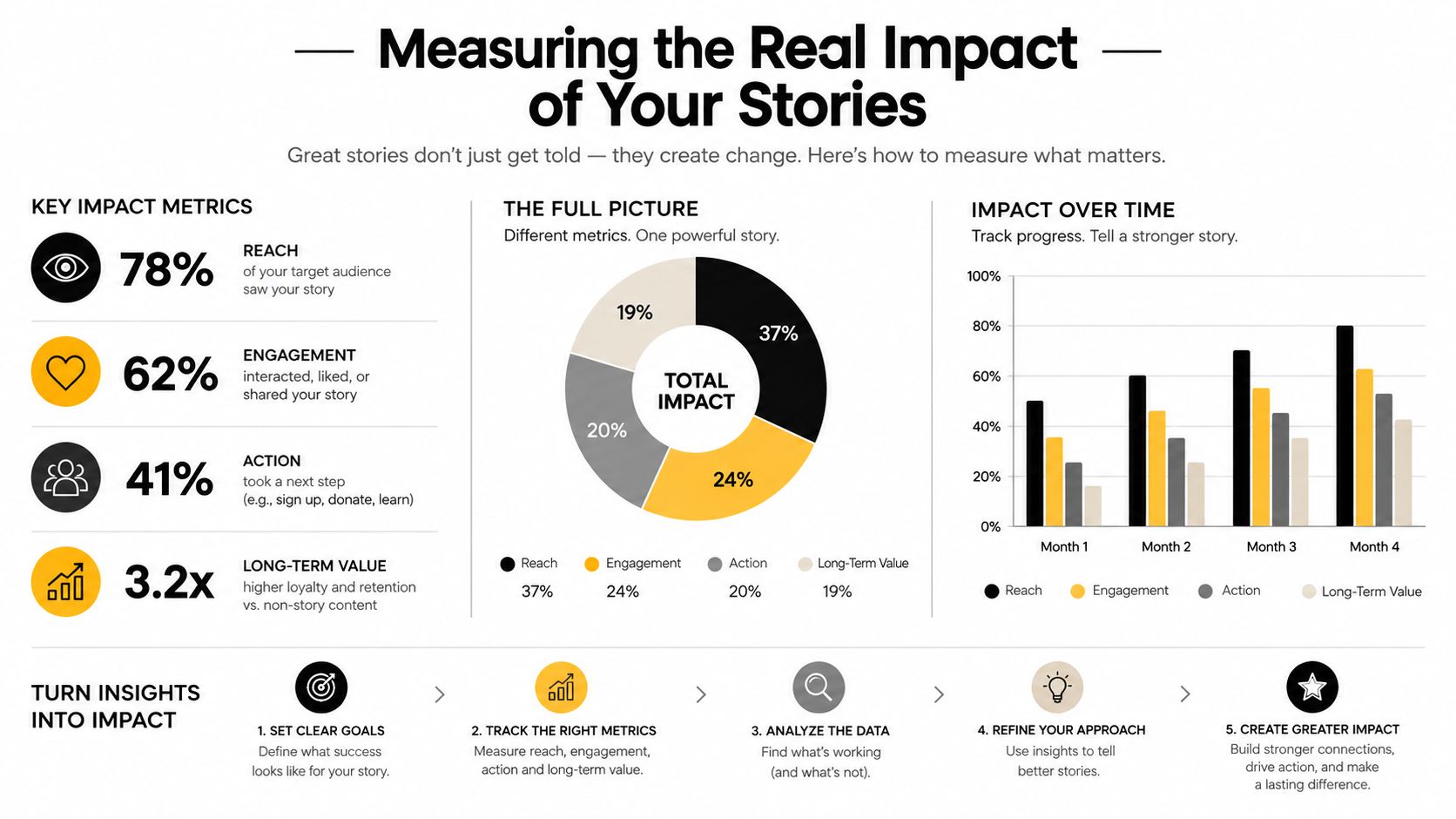
Measuring the Impact of Your Stories
A story can win attention and still lose the deal. Measure storytelling for business against pipeline progression, sales quality, revenue influence, and customer lifetime value, not applause, clicks, or a cheerful comment thread.
Track the story, not just the click
Start with a narrative hypothesis. For example, a customer-outcome story may improve demo conversion, while a proof-led version may help opportunities progress after the first sales call. Keep the audience, funnel stage, offer, and call to action consistent enough to compare the variants.
A story that earns engagement but creates no sales movement is entertainment wearing a KPI costume. Review performance across the journey:
- Pipeline movement: did opportunities progress after exposure to the narrative?
- SQL quality: did the story attract better-fit conversations?
- Sales velocity: did it reduce the time between stages?
- Influenced revenue: did the narrative appear in closed-won deals?
- Customer lifetime value: did the customers connected to the story retain, expand, or refer at a stronger rate?
A 2025 trend review identified 1,086 articles in its identification stage and reported that about 65% of storytelling-in-marketing papers were published from 2019 to 2021. The research base is active, so measurement belongs in the campaign design rather than the post-campaign cleanup.
Treat engagement as an early signal
Engagement matters when its definition connects to buyer behavior. Track meaningful actions such as return visits, content progression, form completion, sales-page visits, and replies from target accounts. A reaction alone is weak evidence. A reaction followed by a qualified conversation is more useful.
Use a simple event trail: narrative variant, account, funnel stage, engagement event, opportunity status, and eventual revenue outcome. AI can help classify recurring themes in comments, call transcripts, and CRM notes, then associate those themes with opportunity quality. Keep human review in the loop because automated labels can confuse enthusiasm with intent.
Compare rational and emotional outcomes
Practitioner measurement guidance recommends testing which story works for which audience and funnel stage. Compare emotional and data-led variants by downstream behavior, not personal preference. If one creates stronger engagement and better progression, increase its distribution. If it attracts attention without qualified demand, retire it politely.
For teams building a repeatable reporting process, this data analysis and report resource offers a useful starting point. Connect narrative performance to pipeline and lifetime value, then keep the structures that help revenue earn its starring role.
Your Next Steps for Better Business Narratives
Storytelling for business works when it's treated like a core competency, not a creative side quest. The best teams don't ask whether stories matter. They ask which story fits the buyer, which proof strengthens it, and which version moves the next stage of the funnel. That shift turns narrative from nice branding into a repeatable growth lever.
A simple 30-day reset
Start by auditing your highest-traffic pages, your main sales deck, and your top-performing email. Ask one blunt question of each asset, is the customer the hero, or are you still making the brand pose for the cover photo? Then rewrite the opening so the problem appears in the first breath, not halfway down the page.
Next, build a small story bank. Pull in customer quotes, support themes, before/after results, and common objections, then turn them into reusable narrative blocks. That gives your team something better than blank-page panic, which remains one of marketing's most underrated villains.
Finally, test the narrative against a real outcome. Don't just ask whether people liked it. Ask whether it increased engagement, improved deal quality, or helped the sales team explain the offer more clearly. That's the difference between creative output and business impact.
Keep the format honest
Use emotional stories when you need memory and affinity. Use data-led stories when the buyer wants proof. Use customer proof when trust is fragile. Use AI to move faster, but keep humans in charge of the message, the evidence, and the judgment.
The companies that do this well stop sounding like product brochures and start sounding like they understand their customer's actual day. That's where the lift comes from, not from adding more adjectives, but from building a narrative that makes the right action feel obvious.
If you want a faster way to turn raw research, customer notes, and messy draft copy into stories your team can use, Zemith brings research, drafting, and content workflows into one place. It's built for people who need to create, refine, and measure business narratives without juggling five tabs and a caffeine habit that's starting to look personal.













 MidjourneyUS$10.00
 ElevenLabsUS$6.00
 RunwayUS$15.00
 Gamma PlusUS$12.00
 Otter ProUS$16.99
 QuillBot PremiumUS$19.95
 Photoroom ProUS$12.99
 Quizlet PlusUS$7.99














 Podcast
 Quiz
 Flashcards
 Mind map
 Infographic