You're about to send a project update, but the main point is buried halfway down the paragraph. You've explained the background, softened the bad news, and added a polite introduction. Now your reader has to excavate the actual update.
Learning how to make writing more concise starts with a better question than “What can I delete?” Ask, “What does this reader need to understand or do?” Then remove whatever makes that task harder.
Why Wordy Sentences Cost Your Readers Time
Say you've written this hypothetical update:
Before, 45 words
It is important to note that, in the event that the supplier does not deliver the replacement parts by Friday, we will need to move the installation to Monday, because the team cannot safely complete the work without having those replacement parts available on site.
After, 18 words
If replacement parts aren't on site by Friday, installation moves to Monday because work can't proceed safely without them.
The shorter version preserves the condition, deadline, consequence, and safety reason. The reader doesn't have to sort the message from its packaging.
Concise doesn't mean shortest. It means delivering the same decision-relevant information with less effort, a distinction that also matters when you're learning how to write clearly.
Consider another hypothetical edit:
Neither edit hides the bad news. Both make it easier to find.
Keep a real paragraph beside you as you work through the editing routine, phrase swaps, verb fixes, and precision checks below. A status email is enough. No sacrificial novel required.
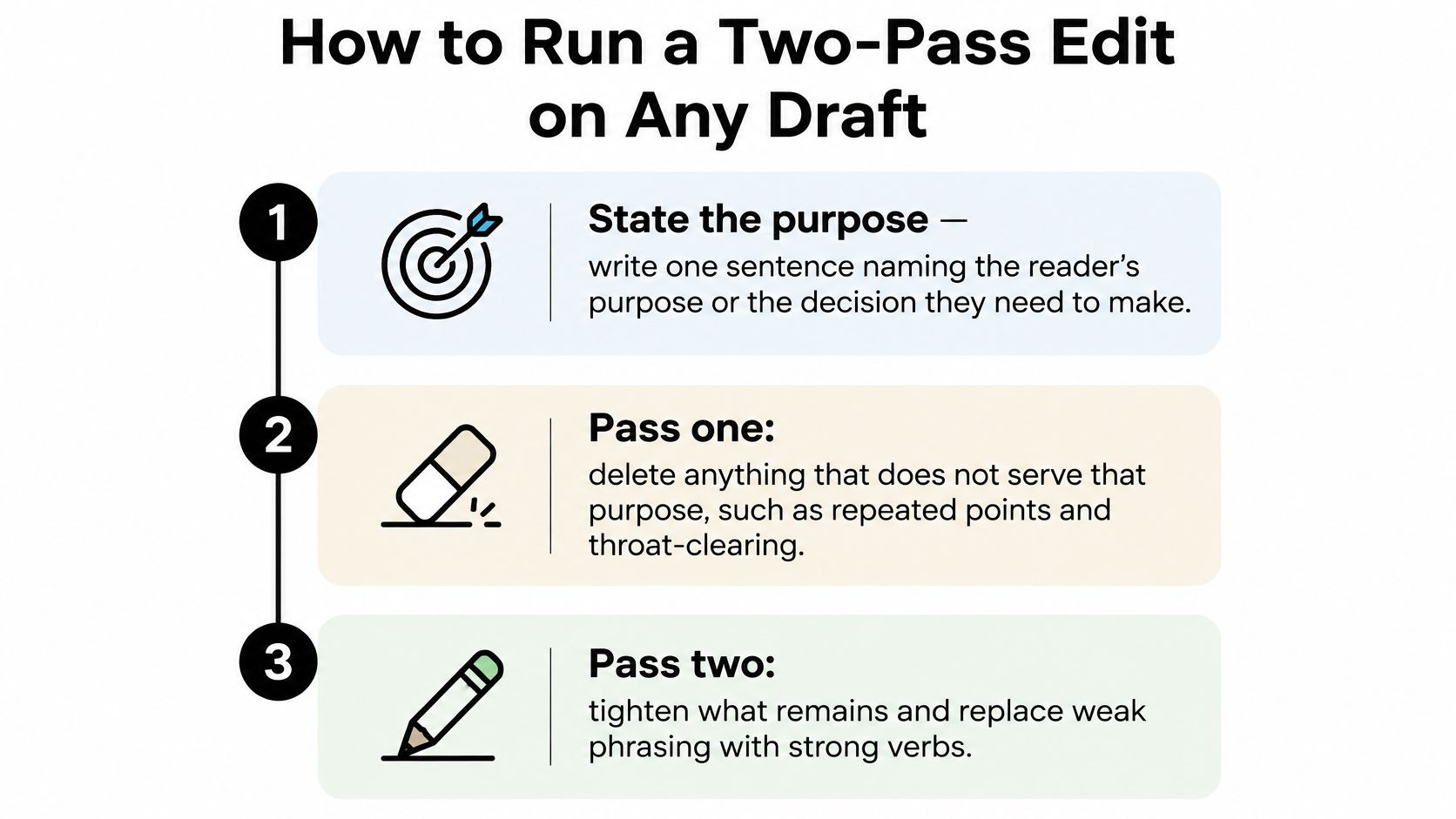
How to Run a Two-Pass Edit on Any Draft
Separate deciding what belongs from improving how it's said. Polishing a sentence before deciding whether you need it is like ironing a shirt you're about to donate.
A concision benchmark paper treats concise revision as constrained paraphrasing: wording must shrink while meaning, intent, sentiment, syntax, and organization remain intact. That's a useful standard for editing, whether you're working manually or reviewing a suggested rewrite.
Set the purpose before deleting
Name the reader's task. Write a private sentence such as: Approve a fallback supplier if the current vendor misses the delivery window. This stops you from keeping background just because it took effort to write.
Remove irrelevant content. Delete repeated points, ceremonial openings, and examples that don't affect that decision. Keep explanations the reader needs to judge the recommendation.
Compress the surviving language. Replace padded expressions, redundant modifiers, and noun-heavy constructions. Don't combine unrelated claims merely to produce fewer sentences.
Use this visual as a reminder of the sequence:
Work through a vendor update
Suppose this is your draft:
We wanted to provide an update about the vendor delivery situation. The vendor has told us that a customs inspection is delaying the replacement sensors. Delivery will probably occur between Monday and Wednesday, although customs has not confirmed release. We have discussed this situation internally, and we think it would be sensible to keep the current installation booking for Thursday. The installation team can proceed only if the sensors arrive by Wednesday afternoon. We are also checking whether a local supplier has compatible stock available. Please approve the fallback purchase if the vendor cannot confirm release by Tuesday. We will send another update when we have confirmation. This is the latest information currently available to our team about the delivery.
After the content pass
A customs inspection is delaying the vendor's replacement sensors. Delivery will probably occur between Monday and Wednesday, although customs has not confirmed release. We have discussed the situation internally and recommend keeping Thursday's installation booking. The installation team can proceed only if the sensors arrive by Wednesday afternoon. We are also checking whether a local supplier has compatible stock available. Please approve the fallback purchase if the vendor cannot confirm release by Tuesday. We will send another update when we have confirmation.
The opening and closing add no useful information. The internal discussion can also go unless the approval process itself matters.
After the language pass
A customs inspection is delaying the vendor's replacement sensors. Delivery will probably occur between Monday and Wednesday; customs hasn't confirmed release. We recommend keeping Thursday's installation booking, but installation depends on receiving the sensors by Wednesday afternoon. We're checking a local supplier for compatible stock. Please approve the fallback purchase if the vendor can't confirm release by Tuesday. We'll update you when release is confirmed.
Check the protected details. Compare the subject, action, scope, time, cause, and uncertainty against the original. Removing probably would turn an estimate into a commitment.
Read aloud and stop deliberately. Repeat only while you can remove wording without ambiguity or a changed claim. For a broader revision checklist, use this guide to editing your writing.
If you're applying this method to teaching materials, you can also browse online CPD courses for teachers from ELTica as a professional-development resource.
Stopping rule: An edit succeeds when the reader needs fewer processing steps, not merely when the word count falls.
Wordy Phrases and Their Shorter Swaps
At phrase level, look for exact verbs first, compact phrases next, and empty introductions last. Purdue OWL's guidance on changing phrases identifies expressions and constructions that can become a single word or direct verb.
These are useful targets because you can often remove padding without touching the underlying information. A sentence doesn't need a committee meeting before its verb.
Wordy phrases and their shorter swaps
These swaps work particularly well in status updates, product copy, and documentation, where formal padding can obscure a straightforward instruction. For more sentence-level alternatives, try the examples in Say It Better.
Don't use the table as an automatic replacement dictionary. Changing in the event that to if normally preserves the conditional, but your complete rewrite must still make clear that the event hasn't necessarily happened.
Replace the expression, then reread the whole sentence. A correct swap can still sit inside an inaccurate rewrite.
Analytical writing needs an extra check: shorter phrasing must preserve the connection between evidence and conclusion. The Model Diplomat analytical writing guide is a useful companion when that connection, rather than sentence length, needs attention.
For practice, highlight phrases longer than three words in a paragraph. Look for single-word equivalents, but leave names, defined terms, and necessary descriptions alone.
Turn Passive Voice and Buried Nouns into Action
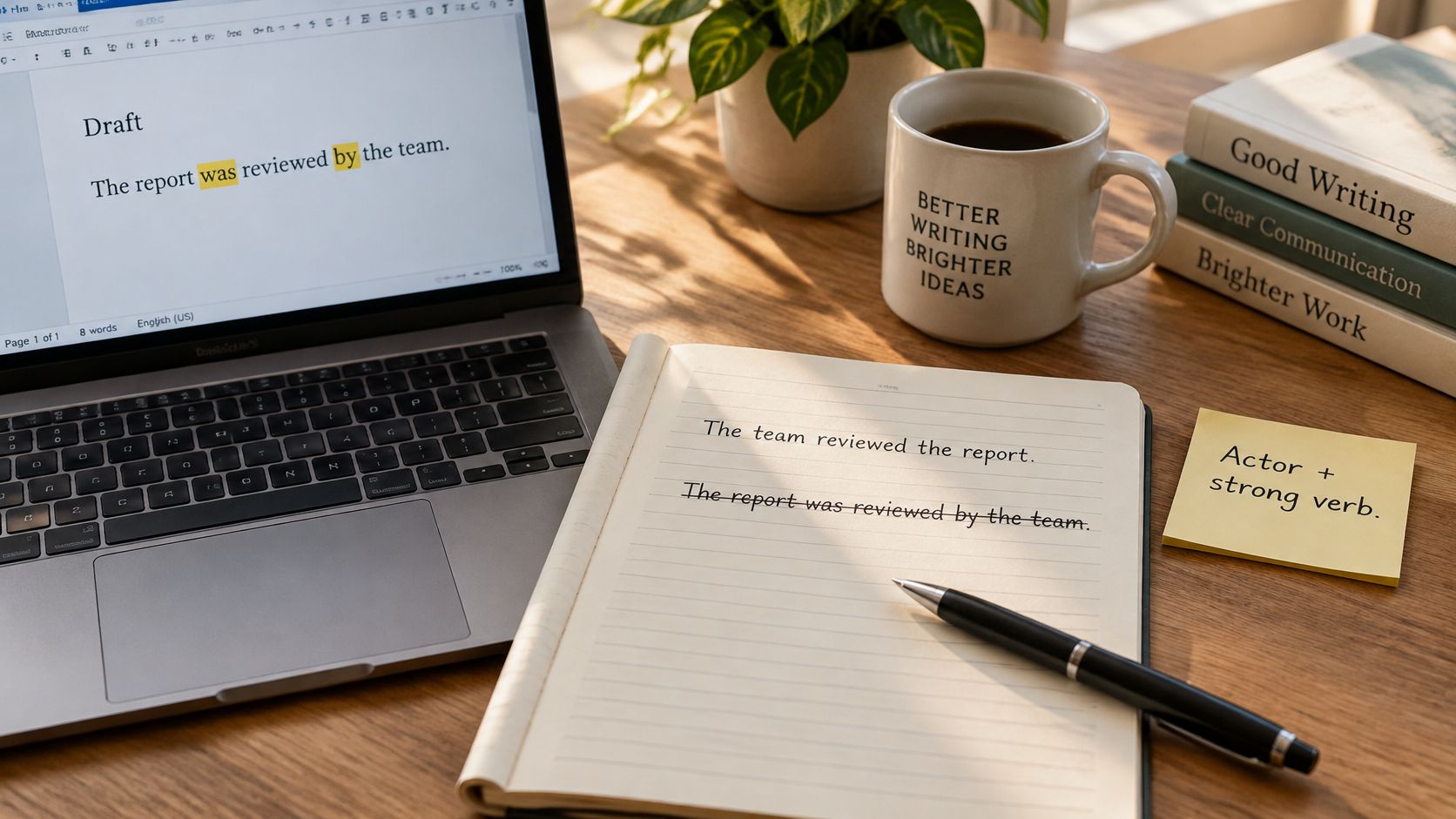
Start by finding a form of be followed by a past participle, such as was reviewed or is processed. Identify who performed the action, then place that actor before the verb.
The U.S. Office of Personnel Management's plain-language guidance recommends active voice. Its practical value is straightforward: readers can see who does what.
- Before: The report was reviewed by the team.
- After: The team reviewed the report.
For developer documentation, the same edit makes system behavior explicit:
- Before: The config file is read by the service at startup.
- After: The service reads the config file at startup.
Use the desk-side reminder below when reviewing action-heavy passages.
Rescue verbs from abstract nouns
Nominalizations are noun forms of verbs or adjectives. The University of Nevada, Reno Writing & Speaking Center recommends reducing abstract characters to improve clarity and concision.
Search for endings such as -tion, -ment, -ance, and -ity. They're clues, not proof that a word needs deleting.
The policy example works only if you know the organization implemented it. Never invent an actor to satisfy an active-voice preference.
Keep passive when the actor isn't known
The sample was contaminated during shipping is appropriate when you don't know who caused the contamination. Changing it to The lab contaminated the sample would manufacture responsibility.
Likewise, don't fix every long sentence by joining clauses into a longer one. Queens Online School's explanation of joining independent clauses correctly can help you preserve grammatical relationships during revision.
The final check is simple: can you name the actor accurately? If not, keep the passive or restructure around what you know.
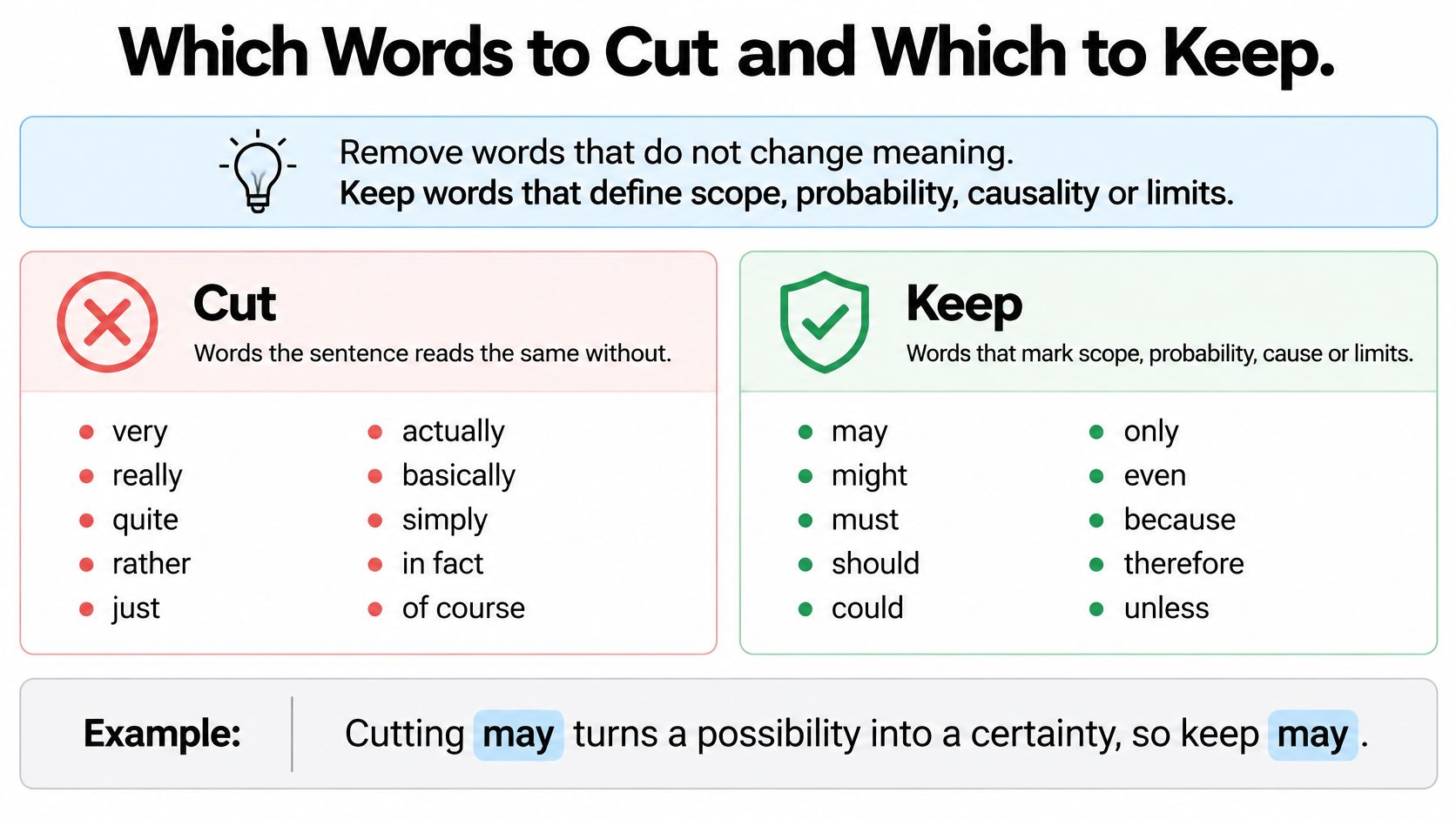
Which Words to Cut and Which to Keep
Remove words that don't change meaning. Keep words that define scope, probability, causality, or limits.
Nature's writing guidance connects concise prose with cognitive load and emphasizes strong verbs. But reducing reader effort doesn't justify deleting the distinctions a reader needs.
Compare these hypothetical claims:
- Qualified: The tool may reduce errors in most cases.
- Overstated: The tool reduces errors.
The revision removes both uncertainty and scope. That's a different promise, not a cleaner expression of the original.
Cut or keep by function
Treat these as contextual decisions. Very may be expendable in promotional copy, but it might matter in a direct quotation or a defined rating.
Use this checklist when a cut looks suspiciously easy:
Don't delete the relationship
Sales fell because the price rose asserts causation. Sales fell. The price rose reports separate events without explicitly connecting them.
Technical substitutions need similar care. Replacing anaphylaxis with allergic reaction loses specificity for a clinical reader. A familiar expression isn't automatically an equivalent one.
This matters when writing an article summary, too. Keep the limitations that govern the original conclusion, even when you omit supporting detail.
After each uncertain cut, ask: Does this change the claim, scope, or cause? If yes, restore the necessary wording. A shorter sentence that loses its condition is a worse sentence.
Check Length, Test Readers, and Tighten One Paragraph Today
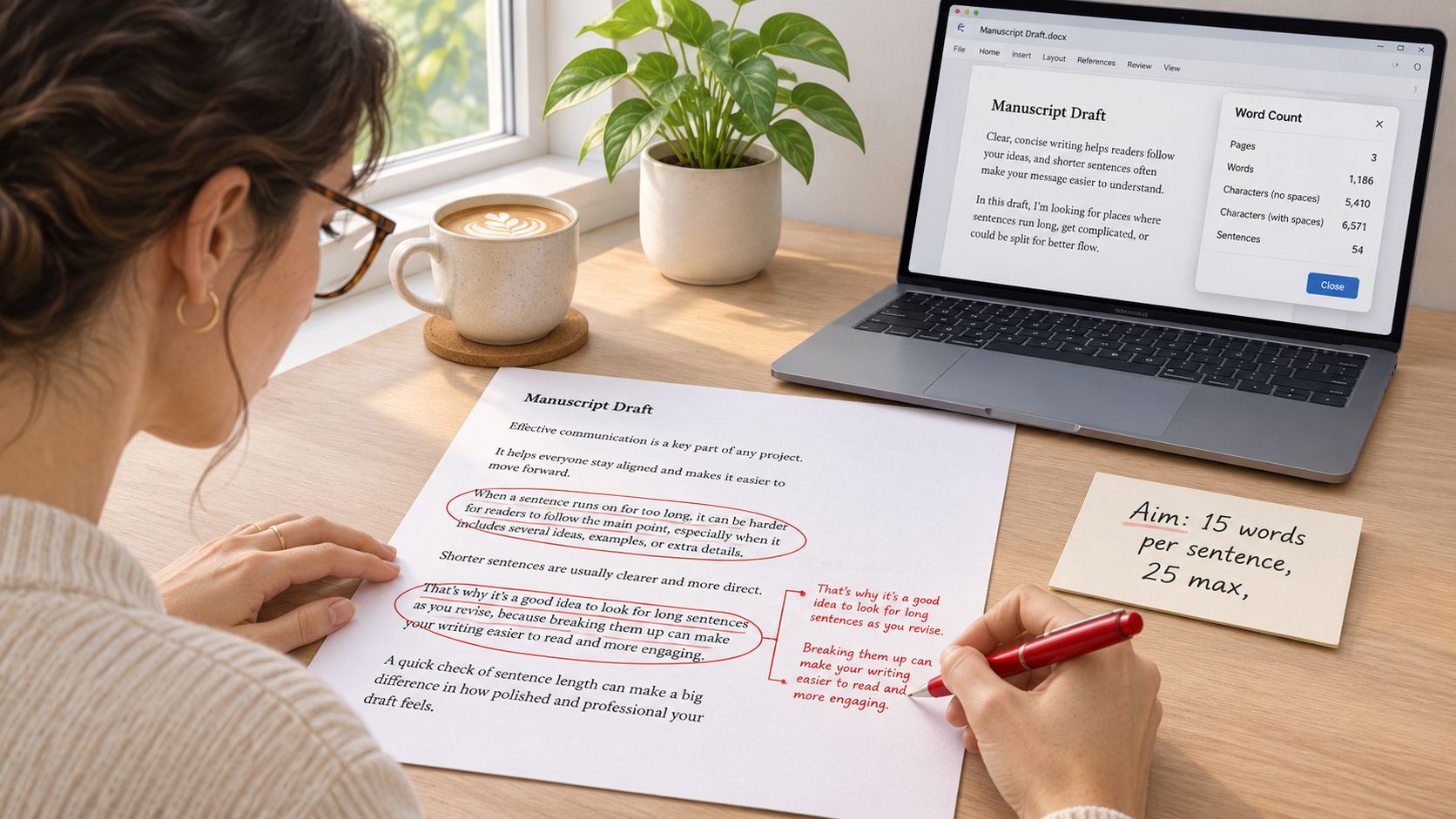
Use sentence length as a diagnostic, not a grading system. The Australian Government Style Manual recommends an average of 15 words per sentence, an upper limit of 25 words, and a mix of sentence lengths.
Flag overloaded sentences, then split them where the ideas separate. Move a sequence of requirements into a list rather than squeezing everything between commas.
Set aside a focused editing session with your draft visible.
Test what readers understood
A preregistered study published in Collabra found that plain-language research summaries improved comprehension and accurate understanding among 166 participants. Its separate reading experiment with 117 participants found that plain terminology improved comprehension without reducing reading time.
That distinction matters. A reader who finishes quickly but misunderstands the instruction hasn't benefited from your edit.
Give your revised paragraph to a small group of audience-matched readers. Ask them to identify:
- Main claim: What happened, or what's being recommended?
- Actor: Who is responsible?
- Constraint: What condition or limitation applies?
- Next action: What should the reader do?
Don't explain the paragraph before they answer. If someone assigns approval to the vendor when the manager must approve it, revise the responsibility statement rather than telling them they misread it.
For a video-based break before your final edit, use the player below.
Edit a paragraph you actually need
Choose a recent paragraph that runs over 80 words as today's practice exercise. Use the content pass and language pass, then record the original and revised word counts without treating the difference as your score.
Mark the deletion you're least sure about. Compare the subject, action, scope, time, cause, and uncertainty, and restore anything the reader needs.
If the paragraph still feels dense, its organization may be the problem. This guide to writing better paragraphs can help you separate competing ideas instead of shaving individual words indefinitely.
In our AI note editor, you can select text to rewrite, shorten, expand, or translate it, or let the AI continue from where you stopped. Use a selected paragraph for a proposed edit, then make the final meaning check yourself.
Keep a personal swap sheet of expressions you repeatedly remove. Include a short “protect” list beside it: uncertainty markers, deadlines, exceptions, and technical terms. That combination helps you edit firmly without turning careful writing into confident nonsense.
Zemith offers an AI rewriter and AI notes alongside tools for translation, PDFs, YouTube to blog, whiteboards, slides, and FocusOS. Visit Zemith, select a paragraph you need to send, and try a shorter version while checking that every necessary condition and commitment stays intact.













 MidjourneyUS$10.00
 ElevenLabsUS$6.00
 RunwayUS$15.00
 Gamma PlusUS$12.00
 Otter ProUS$16.99
 QuillBot PremiumUS$19.95
 Photoroom ProUS$12.99
 Quizlet PlusUS$7.99














 Podcast
 Quiz
 Flashcards
 Mind map
 Infographic